
A self-fulfilling prophecy is an expectation that causes itself to come true. The sociologist Robert K. Merton gave it this name in 1948: a definition of a situation that starts out false, but evokes new behavior that makes it true. The expectation does not predict the future. It changes behavior, and the behavior builds the outcome.
- Merton coined the term in 1948 in the Antioch Review. His core sentence: a false definition of the situation evokes a new behavior which makes the originally false conception come true.
- The idea builds on the Thomas theorem from 1928: if people define situations as real, they are real in their consequences.
- Expectations travel through behavior, not telepathy. The holder treats the target differently, through attention, tasks, tone and interpretation, and the target adapts.
- The famous test is the classroom study by Rosenthal and Jacobson, published as Pygmalion in the Classroom in 1968. Pupils randomly labelled as about to bloom gained more, with the clearest gains in the youngest classes.
- The effect is real but modest. Modern research finds teacher expectations mostly accurate, with a small self-fulfilling slice that falls hardest on stereotyped pupils.
- Pygmalion is the school version of the same mechanism. Placebo belongs to medicine. Confirmation bias filters evidence instead of changing behavior. The law of attraction has no scientific basis.
What a self-fulfilling prophecy is
Merton opened his 1948 paper with a definition that still anchors the term. A self-fulfilling prophecy is, in the beginning, a false definition of the situation evoking a new behavior which makes the originally false conception come true. The prophet then cites the outcome as proof that he was right from the start. Merton called that proof false, because it carries an error forward.
A false definition of the situation evoking a new behavior which makes the originally false conception come true.
The sentence before it matters as much. Merton built on a theorem by W. I. Thomas and Dorothy Swaine Thomas, published in 1928: if men define situations as real, they are real in their consequences. People respond not only to the objective facts, but to the meaning they assign to them. Once they act on that meaning, the consequences become real enough.
Three features separate the mechanism from lookalikes. The starting belief is false, or at least unfounded. It changes what someone does. And the new behavior produces the outcome, which then poses as confirmation. Without the middle link, the behavior, an expectation is only a guess.
How the cycle runs
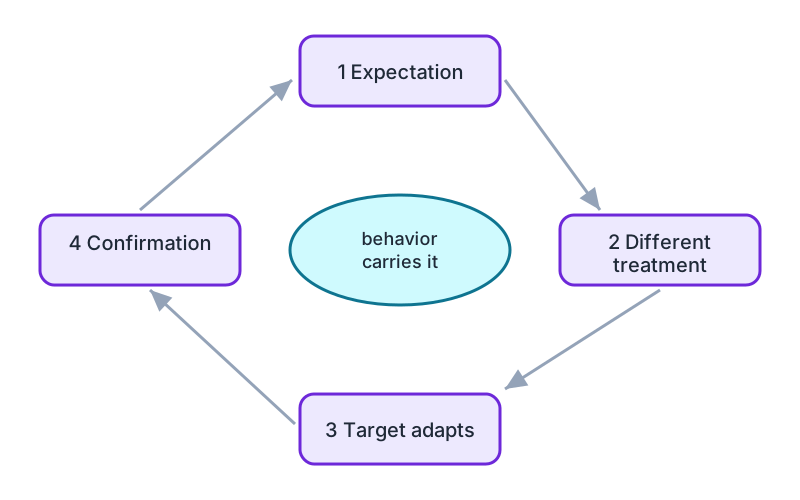
The cycle runs in four steps, always in the same order. Each step names an action, not an attitude.
- 1.Fix the expectation before you act. One person forms a picture of another: a teacher holds a pupil as gifted, a manager holds a new hire as reliable. The picture can be wrong. It still guides what follows.
- 2.Treat the person according to that picture. Give more attention, listen longer, set harder tasks, interpret answers with goodwill, smile more. None of this needs a plan. Tone of voice, eye contact and task choice carry the expectation before a word states it.
- 3.Watch the person adjust their self-image. The child holds herself as competent and dares more. Effort and persistence rise, because the expectation from outside raises above all the judgment of what one can do.
- 4.Read the new behavior as confirmation and keep the expectation. The person shows more of what was expected. The holder sees proof of the first picture and firms it up. The circle closes. It runs upward as a virtuous circle and downward as a vicious one, through the same four stations.
The second step is the hinge. Expectations do not travel by thought alone. They change the holder's conduct, and that conduct changes the target. Studies of nonverbal behavior confirm this channel. In a 1974 interview study by Word, Zanna and Cooper, white interviewers kept more distance, less eye contact and shorter interviews with Black applicants. White applicants given the same colder style then performed worse before blind judges. The treatment, not the group, drove the poorer performance.
The classroom study that made the term famous
In the mid-1960s, Robert Rosenthal and Lenore Jacobson tested whether teacher expectations alone could move pupil performance in a real school. In their elementary-school experiment, teachers received the names of a random group of children, about one in five. Each name came with the same label: likely to show unusual intellectual growth. The test used to justify the names was invented for the occasion. Eight months later, the labelled children had gained more on the retest than their classmates, as reported in Pygmalion in the Classroom (1968). On average, the labelled pupils gained about two points in verbal ability, seven in reasoning and four in overall IQ. The gains sat almost entirely in the youngest classes.
Three limits belong with the result, and exams reward students who name them. First, the numbers were small, in some classes only a handful of labelled children. Second, the test given to the youngest pupils was later questioned, and even the control children gained unusually much. Third, the advantage faded in later follow-up testing. The study shows a short-term expectancy effect in young classes, not proof that expectation raises intelligence for good. Reviews soon pushed back. Thorndike in 1968 and Elashoff and Snow in 1971 found the founding evidence weaker than claimed. A synthesis of 18 experiments by Raudenbush in 1984 found large effects mainly in one setup: false expectations planted before teachers met their pupils.
The same mechanism runs in research itself. In 1963, Rosenthal and Fode told student experimenters that their rats were bred maze-bright or maze-dull, though the animals did not differ. The supposedly bright rats learned faster on record. Expectations can bias handling, attention and scoring without intent to deceive, which is why blind designs became a cornerstone of method. A related school finding also matters: teachers form expectations from gender, background or appearance, and rigid grouping can freeze those expectations into fixed tracks. Low expectations then weigh most on already disadvantaged pupils.
Examples in school and everyday life
Each example names the expectation, the behavior and the result, in that order.
School. A teacher holds randomly labelled children as bloomers and gives them more time and harder tasks. Those children gain more over eight months, at least in the early grades. That is the Pygmalion result with its limits.
Exams. A student holds himself as certain to fail, spends the revision time worrying instead of studying, and writes a weak paper. The weak grade then confirms the first assumption, although it followed from the behavior. Merton used this examination neurosis as his everyday case.
Banks. Depositors hold a solvent bank as insolvent, queue to withdraw, and the withdrawals make it insolvent. Merton told this as a fictional parable, not as a report on a real bank. Its setting is 1932, its victim the invented Last National Bank on its Black Wednesday. The fiction matters: it isolates the mechanism from the history of any actual failure.
Hiring. An interviewer holds an applicant as unpromising, keeps distance and shortens the meeting, and the applicant performs nervously. Blind judges rate the performance lower. The 1974 interview study above documents exactly this chain.
Management. A manager holds new staff as capable, hands out responsibility in small steps and reads errors as a learning path. The staff gain practice and confidence and confirm the picture. The positive twin of this pattern is the Pygmalion effect. Its dark twin is the Golem effect, where low expectations from a teacher or supervisor entrench poor performance. The Golem name comes from Babad, Inbar and Rosenthal in 1982. It is harder to study on purpose. Deliberately lowering expectations raises ethical problems.
What the examples do not show counts too. They show no healing by belief and no career by wishing. Belief without attention, tasks and practice changes no performance. The mechanism needs the second link, the behavior, or the expectation stays a sentence.
What it is not
Four neighbours share words with the concept but not its content. The table sorts them by where each works.
| Term | Where it works | Core |
|---|---|---|
| Self-fulfilling prophecy | Situations and behavior in general | False definition becomes true through new behavior |
| Pygmalion effect | School and leadership | Teacher or manager expectation raises performance, as a special case of the above |
| Placebo and nocebo effects | Medicine | Improvement after a treatment without active ingredient, or harm after a negative expectation |
| Confirmation bias | Thinking and judgment | Noticing what fits the belief and discounting the rest, without changing anyone's behavior |
| Law of attraction | Popular belief, not science | Claim that thought alone draws outcomes, with no scientific basis |
The Pygmalion effect is the best-known special case for teachers and trainers. Rosenthal effect usually means the same experiment, Pygmalion the interpretation for teaching. The perceptual errors article lists Pygmalion beside halo and primacy, as one more way perception of people goes wrong. The placebo effect belongs to medicine and needs no further treatment here. It names only that expectation also shapes the course of illness. Dose, drug and therapy stay outside this article. Confirmation bias differs in its channel. A student who expects a bad day discounts the two smiles and keeps the spilled coffee, as the confirmation bias article describes. A self-fulfilling prophecy instead changes conduct until the day truly turns. The law of attraction claims results by imagination alone and has failed scientific tests. And Merton himself noted the mirror image in a footnote: the self-defeating prophecy. There a warning triggers counter-behavior and precisely does not come true. A fire warning prompts protection, so the fire stays out.
What the evidence says now
The critique limits the finding without deleting it. The effect shows most clearly in young classes, with small numbers and over short time. Anyone who cites it in an exam names the limits with it.
The most influential modern correction comes from Lee Jussim, who argues that teacher expectations predict pupil achievement mostly because those expectations are accurate. Teachers, on the whole, judge well who already does well. Once that accuracy is accounted for, the genuinely self-fulfilling part of the correlation is small. It also fades rather than builds: each new teacher forms fresh expectations from fresh evidence, so one biased year rarely dooms the next. The exception carries the ethical weight. Where bias persists across years, it falls hardest on the most stereotyped pupils, which is where interventions still pay.
A large longitudinal study anchors this reading. Gentrup and colleagues followed 1,026 first-graders in 64 classrooms through a school year. They measured achievement, ability and teacher expectations at the start, and achievement again at the end. Expectations mirrored pupil performance for the most part. But the inaccurate slice still nudged results up or down beyond the true starting level. Feedback quality explained only part of the transmission. Other, subtler behaviors must carry the rest. And interventions can move the needle. A 2018 systematic review by de Boer, Timmermans and van der Werf found 19 programs that raised teacher expectations and, in turn, student achievement. Summary effects sat around four-tenths of a standard deviation for expectations and three-tenths for achievement.
For the reader, the sober use follows. Check the expectation before acting on it. Ask where the picture comes from and what supports it. Hand out attention and tasks on purpose, instead of hanging them on a first impression. Read a result only after the second measurement. And with lasting worry about school, work or mood, talk to a teacher, doctor or counselling service instead of deriving treatment from an article. The counterpart from loss of control is worth knowing too. Learned helplessness describes how uncontrollable events make people passive. The self-fulfilling prophecy describes instead how expectation shapes reality through behavior. Both use expectation, at different stations of the loop.
How Psychology World helps you keep these terms straight
Expectancy effects form a family that exams love to mix up: self-fulfilling prophecy, Pygmalion effect, Golem effect, placebo, confirmation bias. Forgetting is the default for anything you look up once and move on from. What matters is meeting a term again before it fades. In Psychology World, you can save these definitions to your own list, for example Social psychology exam terms. Then drill them as flashcards, as multiple-choice questions once a list holds four or more terms, or by typing the answer out yourself. A daily word pulls a saved term back into view. Our guide to memorising psychology terminology covers the two best-supported study methods, spacing and self-testing, in more depth than fits here.
Frequently asked questions
What is the difference between a self-fulfilling prophecy and the Pygmalion effect?
The self-fulfilling prophecy is Merton's general mechanism for situations and behavior: a false definition evokes behavior that makes it true. The Pygmalion effect is its special case for teaching and leadership, where a teacher's or manager's expectation raises the performance of pupils or staff. Name Merton for the mechanism and Pygmalion or Rosenthal for the classroom claim.
What is the difference from placebo?
Both use expectation, but in different places. Placebo means improvement after a treatment without active ingredient in medicine, and nocebo its negative counterpart. A self-fulfilling prophecy means situations and behavior in general, from school to banks. This article names placebo only as a related case, without doses or advice.
What are self-imposed and other-imposed prophecies?
In a self-imposed prophecy, your own expectation drives your actions and brings about the outcome you predicted, like skipping study because you expect to fail. In an other-imposed prophecy, someone else's expectation changes how you act, like a teacher's view shaping a pupil's year. The remedy differs: change your own avoidance in the first case, and change the holder's behavior in the second.
Can you break a self-fulfilling prophecy?
You break it at the four stations, not with one sentence. Name the expectation and its source. Change the behavior after it: tasks, attention and interpretation. Measure the result twice before taking it as proof. Expect small repeated corrections over weeks, not a jump.
Is the Rosenthal and Jacobson classroom study solid proof?
It is a classic study with clear limits. Design and direction hold: randomly labelled pupils gained more after eight months, concentrated in the youngest classes. The limits are small numbers, questions about the test used with the youngest, and an effect that faded later. Always name all three in an exam, or the finding stretches beyond what it shows.
Is this the same as the law of attraction?
No. The law of attraction claims that thought alone draws outcomes, and it has no scientific basis. A self-fulfilling prophecy works only through the middle link: changed behavior. Without different conduct, by holder or target, the expectation stays words.
Sources
- 1.Merton, R. K. (1948). The self-fulfilling prophecy. The Antioch Review, 8(2), 193-210.
- 2.Thomas, W. I., & Thomas, D. S. (1928). The child in America: Behavior problems and programs. Alfred A. Knopf.
- 3.Rosenthal, R., & Jacobson, L. (1968). Pygmalion in the classroom: Teacher expectation and pupils' intellectual development. Holt, Rinehart & Winston.
- 4.Schaedig, D. (2026). Self-fulfilling prophecy. Simply Psychology.
- 5.Self-fulfilling prophecy. Wikipedia.
- 6.Jussim, L. (2026). Self-fulfilling prophecy. Encyclopaedia Britannica.
- 7.Albers, S. (2022). The truth behind a self-fulfilling prophecy. Cleveland Clinic.
- 8.Thorndike, R. L. (1968). Review of Pygmalion in the classroom. American Educational Research Journal, 5(4), 708-711.
- 9.Elashoff, J. D., & Snow, R. E. (1971). Pygmalion reconsidered. Charles A. Jones.
- 10.Rosenthal, R., & Rubin, D. B. (1978). Interpersonal expectancy effects: The first 345 studies. Behavioral and Brain Sciences, 1(3), 377-386.
- 11.Raudenbush, S. W. (1984). Magnitude of teacher expectancy effects on pupil IQ as a function of the credibility of expectancy induction. Journal of Educational Psychology, 76(1), 85-97.
- 12.Word, C. O., Zanna, M. P., & Cooper, J. (1974). The nonverbal mediation of self-fulfilling prophecies in interracial interaction. Journal of Experimental Social Psychology, 10(2), 109-120.
- 13.Snyder, M., Tanke, E. D., & Berscheid, E. (1977). Social perception and interpersonal behavior. Journal of Personality and Social Psychology, 35(9), 656-666.
- 14.Babad, E. Y., Inbar, J., & Rosenthal, R. (1982). Pygmalion, Galatea, and the Golem. Journal of Educational Psychology, 74(4), 459-474.
- 15.Gentrup, S., Lorenz, G., Kristen, C., & Kogan, I. (2020). Self-fulfilling prophecies in the classroom. Learning and Instruction, 66, 101296.
- 16.de Boer, H., Timmermans, A. C., & van der Werf, M. P. C. (2018). The effects of teacher expectation interventions. Educational Research and Evaluation, 24(3-5), 180-200.