
Sternberg triarchic theory says intelligence has three linked abilities. Analytical intelligence judges and explains. Creative intelligence handles new problems and builds fluent skill. Practical intelligence fits action to real settings. Robert Sternberg proposed the model in Beyond IQ in 1985.
- Analytical intelligence plans, carries out and checks reasoning.
- Creative intelligence copes with novelty and turns practice into fluent routine.
- Practical intelligence adapts to a setting, shapes it or selects a better one.
- The three work together and shift with task and setting.
- It differs from Gardner, which names eight areas rather than three processes.
- Critics question whether practical ability stands apart from general ability.
What the three parts are
The name triarchic means three linked parts. Each part pairs a subtheory with an ability. The subtheory names the view. The ability names what you do.
| Subtheory | Ability | What it covers |
|---|---|---|
| Componential | Analytical | Plan, carry out and check reasoning |
| Experiential | Creative | Handle new problems and build fluent skill |
| Contextual | Practical | Fit action to real settings |
Do not mix these names. Componential goes with analytical. Experiential goes with creative. Contextual goes with practical. Tests often swap one set for the other. The table keeps the mapping clear.
Triarchic is not triangular. Triarchic is the 1985 intelligence model. Triangular is a separate 1986 love model built from intimacy, passion and commitment. Students mix them because the words look close. Keep the dates apart and the confusion ends.
Analytical intelligence
Analytical intelligence judges ideas and explains them. You compare two accounts, test a claim or break a problem into steps. School tests measure this ability most.
Three mental steps carry the work. Metacomponents plan and monitor. They define the problem, choose a method, assign attention and check the result. Performance components carry out the plan. They encode facts, infer links, map relations and apply rules. Knowledge-acquisition components learn new facts. They pick relevant facts, combine them and link them to known facts.
A maths task shows the split. You choose a method for a word problem. You run the steps. You check the answer. You note which new term mattered and store it. The plan, the work and the learning are separate moves. Strength here overlaps with what IQ tests sample. That is why analytical scores track school results.
Creative intelligence
Creative intelligence meets the new and makes practice fluent. It has two poles. Novelty is the new end. Automatization is the fluent end.
Novelty means you face a task without a ready routine. You invent a route. A student who designs a fair rule for a new game uses novelty. A student who frames a study question no teacher gave uses it too. The situation gives no template. You build one.
Automatization means a practiced skill runs with little effort. Decoding, number facts and key terms run on their own. Free capacity then serves harder thought. A fluent reader grasps meaning because decoding costs nothing. Both poles need training. New tasks build novelty. Repeated short practice builds fluency.
This ability differs from high test scores. A learner may score mid-range on a timed test yet design strong work. The learning-styles-myth warns against fixed labels for the same reason. Treat creative moves as skills to practice, not as a type of person.
Practical intelligence
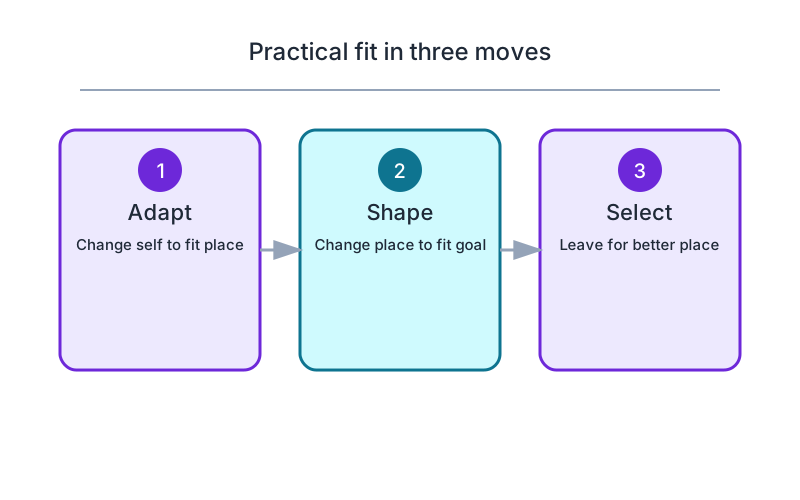
Practical intelligence makes ideas work in real settings. It answers no single test item. It fits you to the world in three ways.
- 1.Adapt to the setting. Change yourself to fit what is there.
- 2.Shape the setting. Change what is there to fit your goal.
- 3.Select a new setting. Leave when fit fails and a better place exists.
A new student learns unwritten lunch rules in a week and follows them. That is adapt. The same student suggests roles so each voice gets time in a loud group. That is shape. The student then asks to join a calmer group for the next project when noise still blocks work. That is select. Order is not fixed. Judgment picks the move.
Tacit knowledge fuels these moves. Tacit knowledge is unwritten know-how from experience. A skilled teacher reads a room without a script. A nurse sorts tasks without a list. Sternberg argued tests miss this know-how. Critics answer that life results still track test scores. The debate section gives both sides with dates.
How it differs from Gardner and g
Gardner and Sternberg both reject one narrow score. They split intelligence in different ways. Gardner names content areas. Sternberg names processes that work across areas.
| Model | Claim | Examples |
|---|---|---|
| Gardner multiple intelligences | Separate abilities live in separate areas | Linguistic, logical-mathematical, spatial, musical, bodily-kinesthetic, interpersonal, intrapersonal |
| Sternberg triarchic | Three processes handle any task | Analytical judgment, creative novelty and fluency, practical fit |
| General factor view | Scores across tasks rise together | People strong in one test tend to score higher in others |
Our gardner-multiple-intelligences guide explains the eight areas and the ninth that never made the list. Test scores across tasks tend to rise together, a pattern researchers call the general factor. Read Sternberg as how you handle a task. Read Gardner as where you handle it. Read g as the shared variance that tests pick up.
Sternberg drew a line Gardner did not. He called musical and bodily-kinesthetic skills talents rather than intelligences, because few cultures require them for daily adaptation. The encyclopedia entry that Sternberg wrote states this limit plainly. Use it when an exam asks how the models differ.
How it is measured and what the data show
Sternberg built his own check. The Sternberg Triarchic Abilities Test sets verbal, number and picture items for each ability, plus short essays. Level-H serves high school learners. A 2001 study gave it to 3278 learners in the United States, Finland and Spain. A three-part model fit best, but the fit was far from perfect. Later teams found one broad factor could explain similar data.
The Rainbow Project took the idea to admissions. Sternberg and colleagues added creative and practical tasks, such as writing captions for cartoons, to a standard admissions test. The extras improved prediction of first-year college grades. Group gaps narrowed. The result supports wider sampling of tasks. It does not prove three separate traits.
A 2021 synthesis of 24 studies found a mean effect size near g 0.63 for successful-intelligence teaching, falling near 0.35 after adjustment for publication bias. Gains remain, but smaller than early reports. Treat the teaching claim as promising with limits, not as proof of fixed abilities.
What critics say
The strongest critique targets practical intelligence. Linda Gottfredson argued in 2003 that practical skill overlaps heavily with general ability. She noted that IQ tests predict income at mid-career, occupational prestige and staying out of jail and staying alive, all of which count as real-world fit. On that view, what Sternberg calls practical is task-specific know-how, not a broad separate trait.
A second critique targets measurement. Nathan Brody examined the triarchic test in 2003 and questioned construct validity. The three scores did not separate as cleanly as the model predicts. If a test cannot tell the parts apart, the three-part structure stays open.
A third critique targets fixed teaching types. Early school studies reported gains when lessons and tests covered all three demands. Later reviews warn against sorting learners into analytical or creative or practical types and teaching only to that label. Vary the tasks for all learners. Mark each task. Talk about the thinking a task needs, never about the kind of learner someone is.
The model remains useful as a lens. It widens tasks beyond recall. It keeps its place while the structure debate runs on.
How to study it so it sticks
Link each name to one use. Analytical is judge and explain. Creative is invent and automate. Practical is adapt, shape and select. Then test recall both ways.
When a term keeps slipping, save it to a bookmark list in Psychology World on iPhone and iPad. Drill the list in short rounds with Flashcard, Question and Typing. Question needs at least four words in the list, so build lists with room to grow. Link the routine to the forgetting-curve for low-frequency terms, and to the method-of-loci when order also matters.
Frequently asked questions
What are the three parts of Sternberg triarchic theory
Analytical intelligence judges and explains through planning, doing and checking. Creative intelligence handles new problems and builds fluent skill through novelty and automatization. Practical intelligence fits action to settings through adapt, shape and select. The three work together on most tasks.
How does triarchic theory differ from Gardner multiple intelligences
Gardner names eight content areas such as linguistic, spatial and musical. Sternberg names three processes that apply across areas. One asks where ability shows. The other asks how a task is handled. Our Gardner guide lists each area with examples.
Is triarchic the same as triangular theory
No. Triarchic is the 1985 intelligence model with analytical, creative and practical abilities. Triangular is the 1986 love model with intimacy, passion and commitment. The names look close and cause frequent mix-ups in search and study.
Is Sternberg triarchic theory still accepted
It remains useful in teaching but debated in psychology. Teachers use it to vary analytical, creative and practical tasks. Researchers debate whether the three parts stand apart from general ability, citing the 2001 test fit, the 2003 critiques and the 2021 adjusted gain near 0.35. Use it as a planning lens, not as a label for learners.
How do I remember adapt shape and select
Read them as three fits. Adapt means change yourself to fit the place. Shape means change the place to fit your goal. Select means leave for a better place when the first two fail. One school-group story can carry all three in order.
Sources
- 1.EBSCO Research Starters (2019). Sternberg Triarchic Theory.
- 2.Encyclopedia Britannica. Human intelligence: Cognitive-contextual theories.
- 3.Cornell University. Robert Sternberg profile.
- 4.Structural Learning (2026). Sternberg Triarchic Theory of Intelligence, With Examples.
- 5.Wikipedia contributors (2025). Triarchic theory of intelligence.