
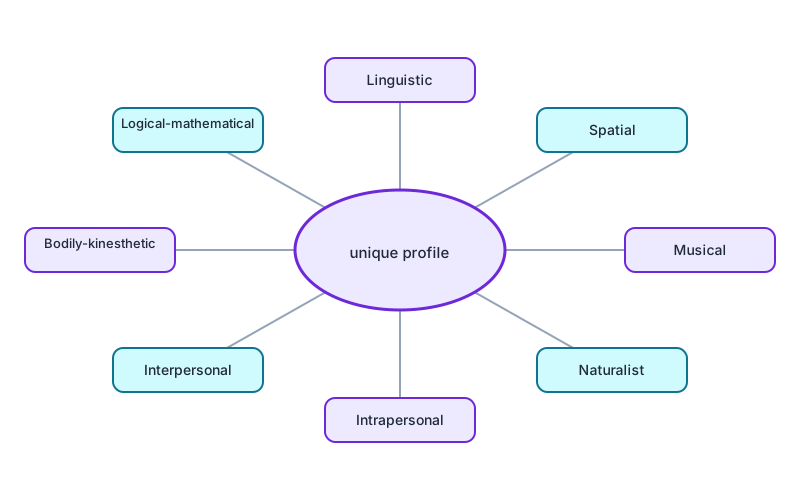
In 1983 Howard Gardner proposed that intelligence is not one general ability but eight relatively independent ones. Everyone has all eight in a unique profile shaped by genes and experience. There is no confirmed ninth intelligence, there is no standard test for your type, and psychologists still argue about whether these are intelligences at all.
- Gardner named seven intelligences in 1983 and confirmed only one more since: naturalist intelligence.
- Existential intelligence, the often listed ninth, was never confirmed. Gardner himself calls it a candidate, at most "8.5".
- Multiple intelligences are not learning styles. Gardner's own advice to teachers is to drop the term styles.
- Measured abilities correlate with general intelligence, which is why a 2023 review calls the theory a neuromyth while 9 in 10 teachers keep using it.
The 8 in one table
Linguistic and logical-mathematical intelligences are the two schools test most. Spatial intelligence is also called visual-spatial intelligence. The other six get less attention from IQ tests, which is exactly Gardner's point: a short-answer test samples a narrow slice of cognition. The table lists each intelligence with a one-line meaning and a typical example.
| Intelligence | Core ability | Example |
|---|---|---|
| Linguistic | Sensitivity to words, meanings and rhythms | A poet finding the exact word |
| Logical-mathematical | Abstract reasoning with numbers and logic | A scientist testing a hypothesis |
| Spatial | Thinking in images and judging visual space | An architect reading a floor plan |
| Bodily-kinesthetic | Skilled control of body movement | A dancer learning a routine |
| Musical | Sensitivity to pitch, rhythm and tone | A composer hearing a melody |
| Interpersonal | Understanding other people's motives and moods | A teacher calming a class |
| Intrapersonal | Understanding your own feelings and goals | A writer setting honest goals |
| Naturalist | Recognizing patterns in nature | A birder naming distant calls |
Everyone carries all eight, not one or two. What differs is the profile: strong in some, average in others, weak in the rest. Even identical twins, with the same genes, end up with profiles that are similar but not identical, because experience shapes each profile too.
What Gardner actually claimed
Howard Gardner developed the theory in the late 1970s and early 1980s and presented it in 1983 in his book Frames of Mind. He wrote it as a critique of the standard view that one intelligence, measured by IQ or short-answer tests, explains who will do well. His definition of an intelligence is short:
An intelligence is the ability to solve problems, or to create products, that are valued within one or more cultural settings. — Howard Gardner, Frames of Mind (1983)
The culture clause matters. What counts as intelligent performance differs between cultures, so a seafaring people can prize spatial skill that Western schools never test.
Gardner set eight tests a candidate ability must pass to count as an intelligence, laid out in chapter 4 of Frames of Mind. In short, each test is one line of proof. An ability shows up in isolation after brain damage. It has an evolutionary history. It runs distinct core operations. It fits a symbol system. It follows its own developmental path. It stands out in savants and prodigies. Experimental tasks support it. Psychometric tests support it. An ability need not pass all eight perfectly, but the more it passes, the stronger its claim.
His favorite image is the computer. Belief in one intelligence means humans carry a single general-purpose computer that runs well, average or poorly. Belief in multiple intelligences means humans carry several relatively independent computers, and strength in one does not predict strength in another. High spatial intelligence says nothing about your musical or interpersonal intelligence.
The eighth and the ninth
The 1983 book described seven intelligences: linguistic, logical-mathematical, musical, spatial, bodily-kinesthetic, interpersonal and intrapersonal. A few years later Gardner added one more: naturalist intelligence, the ability to recognize flora, fauna and other patterns in nature. In a 2025 update he confirmed the count: in all the years since, he confirmed only this one addition.
The often listed ninth, existential intelligence, never made the list. Gardner speculated about it, the intelligence of big questions about life and death, and joked that it stands at "8.5". He also speculated about a pedagogical intelligence, the ability to teach others. Neither satisfied his own criteria, so neither joined the theory. Many classroom posters and quiz sites list nine anyway. For an exam, the safe answer is eight, with existential named as the candidate that stayed out.
Multiple intelligences are not learning styles
Teachers often merge the theory with learning styles, the idea that visual learners should get pictures and auditory learners should get lectures. Gardner rejects the merge. His advice to educators is to drop the term styles, because matching lessons to a preferred style has no persuasive evidence behind it. A student strong in spatial intelligence does not necessarily learn best from pictures, and a linguistically strong student does not necessarily learn best from reading.
What Gardner recommends instead is pluralizing: teach each topic in several ways. Present the concept, show it, let students handle it, discuss it. One way of teaching rarely fits everyone. A varied lesson reaches each learner through at least one strength. The deeper account of why style-matching fails is worth its own read, because the evidence there is now firm: learning styles are a myth.
One general intelligence or many
Gardner wrote against the g factor, the general intelligence Charles Spearman proposed in 1904 after finding that scores on different mental tests correlate. Gardner does not deny the correlations. He argues they come from narrow tests, mostly linguistic and logical-mathematical, so they describe that slice rather than the whole mind. In his words, the theory questions not the existence of g but its province and explanatory power.
| Model | Structure | Place of g |
|---|---|---|
| Spearman's g | One general factor plus task-specific factors | g explains the correlations |
| Gardner's MI | Eight relatively independent intelligences | g describes only the tested slice |
| Cattell-Horn-Carroll | Broad abilities under one general factor | Keeps g at the top |
| Sternberg's triarchic | Analytical, creative and practical parts | Rejects a single g |
The middle position, Cattell-Horn-Carroll, keeps a general factor but divides it into broad abilities. It builds on the split between fluid and crystallized intelligence: reasoning with novel problems versus stored knowledge. Sternberg's 1985 triarchic theory is a fellow pluralist that divides by process rather than content domain. Gardner's two personal intelligences later inspired emotional intelligence, the self-motivation and empathy construct Daniel Goleman popularized in 1995.
What the evidence says
The sharpest problem is measurement. There are no standard tests for the eight intelligences, and Gardner chose not to build them. One widely used attempt, the Teele inventory, proved unreliable. Without shared measures, studies cannot be compared and no synthesis of findings can grow.
The studies that operationalized the intelligences themselves found them correlated. Visser, Ashton and Vernon tested 200 adults across all eight in 2006 and concluded the results contradict the claim of at least eight independent domains. Gardner replied that their tasks leaned on language and reasoning. The authors answered that the correlations came from performance patterns, not item wording. They asked Gardner to supply measures. Later factor analyses of children's scores reached the same verdict: the intelligences cluster together rather than standing apart.
Classroom studies report gains from MI teaching, and three meta-analyses found many positive results. But the reviews also found small samples, weak controls and unreliable measures. None controlled for the usual drivers of any new method: repetition, novelty, extra teacher attention and teacher enthusiasm. A gain from varied, enthusiastic teaching is real, but it is not proof of eight separate computers.
Brain evidence follows the same pattern. Reviews of hundreds of neuroimaging studies found distinct network patterns matching several intelligences, which supporters cite. Critics answer that alignment is not a validity test: nobody has measured brain activity during intelligence-characteristic tasks and found dedicated networks per intelligence. Modern neuroscience describes multifunction networks, not one module per ability.
And yet classrooms run on the theory. About 90 percent of surveyed US teacher trainees planned to use MI strategies, and 94 percent of surveyed Quebec teachers said they used them. A 2023 peer-reviewed review concludes the theory is a neuromyth and urges educators toward evidence-based methods instead. That is the honest status as of 2026: an unproven theory of mind that still works as a reminder to teach in varied ways.
How to use the 8 for study
Treat the eight as a checklist for encoding, not as a label for yourself. When a term resists memory, push it through several intelligences. Say it aloud (linguistic). Sketch it (spatial). Link it to a personal example (intrapersonal). Argue about it with someone (interpersonal). Find its pattern in nature or daily life (naturalist). That is pluralizing applied to your own study, and it overlaps with what actually works: varied, effortful retrieval.
For exams, sort the slippery terms. Naturalist intelligence is confirmed and fair game. Existential and pedagogical are candidates only, and questions love asking which one is not among Gardner's intelligences. Interpersonal aims outward at others, intrapersonal aims inward at the self. Save each into a named list with its one-line meaning and drill the list until the direction of each term is instant. A walkthrough of the method is in how to memorise psychology terms. Collect the terms. Then turn the same list into flashcards, multiple-choice rounds and typing rounds until recall is fast.
Frequently asked questions
Are there 8 or 9 multiple intelligences?
Eight. Gardner described seven in 1983 and later confirmed only naturalist intelligence. Existential intelligence is a discussed candidate, sometimes called "8.5". Gardner never added it.
Is there a test that tells me my intelligence type?
No standard one. Many online quizzes assign a type. But there are no accepted measures for the eight intelligences. Gardner himself declined to build tests. Treat quiz results as entertainment, not diagnosis.
What is the difference between multiple intelligences and learning styles?
Multiple intelligences claims eight cognitive domains everyone holds in some profile. Learning styles claims each person learns best through one sensory path. Gardner rejects the second idea. He advises teachers to drop the term styles and teach each topic in several ways instead.
What is the rarest intelligence type?
No study ranks the eight by rarity, so any list that names one is guessing. Profiles differ by genes, culture and training. Rarity claims say more about the sample than about the theory.
Do multiple intelligences replace IQ?
No. IQ tests still predict school performance reasonably well. Schools prize linguistic and logical-mathematical skill. Gardner's claim is that those two cover only part of human cognition. He does not claim test scores mean nothing.
Sources
- 1.Howard Gardner (n.d.). Frequently asked questions — Multiple intelligences and related educational topics.
- 2.Howard Gardner (2025). Multiple intelligences: New strands of evidence from neuroscience.
- 3.Northern Illinois University (2020). Howard Gardner's theory of multiple intelligences.
- 4.Lynn Waterhouse (2023). Why multiple intelligences theory is a neuromyth.
- 5.Howard Gardner et al. (n.d.). The theory of multiple intelligences.