
Depth perception is your ability to judge distance in three-dimensional space. Two cues need both eyes, and seven cues need only one eye. That split is the whole topic.
The two binocular cues are retinal disparity and convergence. The seven monocular cues are relative size, interposition, linear perspective, texture gradient, aerial perspective, light and shadow, and motion parallax. This article defines each cue, gives one everyday example for each, and ends with a one-question test that sorts any example.
- Binocular cues need both eyes: retinal disparity and convergence.
- Monocular cues need only one eye: the seven listed above.
- You can test any example with one question: close one eye and check what survives.
- A photo still shows depth because monocular cues survive with one eye.
- 3-D movies need glasses because they feed disparity, which needs both eyes.
What depth perception is
Depth perception is the ability to perceive spatial relationships in three-dimensional space and to accurately judge distance. With it, you can describe things as in front, behind, above, below, or to the side of other things. OpenStax states this definition in its chapter on vision.
You use depth perception in almost every movement. It lets you judge the gap to the car ahead, pour a drink without missing the glass, and step down stairs without falling. The visual system builds this sense from depth cues, which are messages from the body and the environment about space and distance. Some cues need both eyes, and some need only one.
Infants show depth perception early. Gibson and Walk (1960) placed 6- to 14-month-old infants on a visual cliff, a glass table with a fake drop on one side. Most infants refused to cross to the deep side. That glass-table experiment is a perception study of its own, so this article stays with the cues themselves.
The two cues that need both eyes
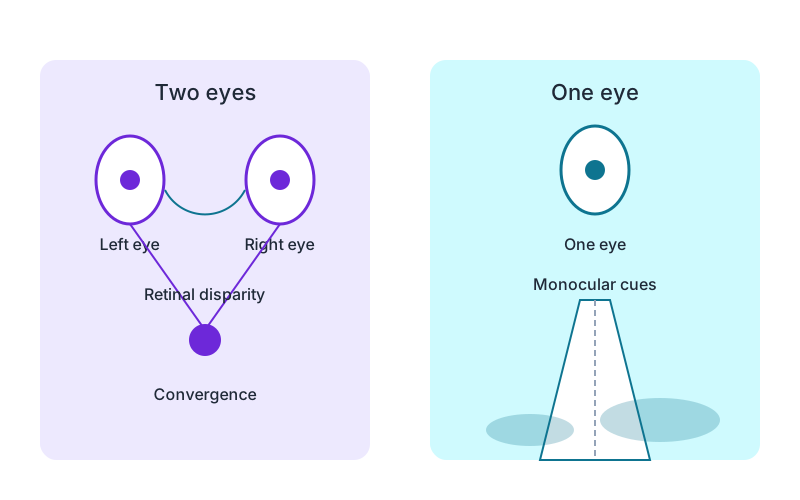
Binocular cues rely on the use of both eyes. There are two of them.
The first is retinal disparity, also called binocular disparity. Each eye sees the world from a slightly different angle, so the two images differ a little. The visual cortex merges the two images into one, and that merge gives depth. The greater the difference between the two images, the closer the object reads.
You can feel disparity at work with a short exercise. Extend one arm, focus on one finger, then close your left eye and your right eye in turn without moving your head. The finger seems to shift against the background. That shift is the different view each eye receives, described in the OpenStax chapter on vision.
The second cue is convergence. To focus on a near object, the two eyes turn inward toward it. The visual cortex reads the size of that inward angle and uses it to judge distance. A psychology textbook puts the working range at objects less than about 50 feet away.
You can feel it too: bring a finger slowly toward your nose while you keep focusing on it. Your eyes turn inward more as the finger nears. With one eye closed, the tension stops, because convergence needs both eyes to work.
The 3-D movie is the classic proof. The glasses send a slightly different image to each eye, and the brain merges them into depth. Close one eye in the cinema and the effect breaks. The movie feeds disparity, and disparity needs two eyes.
The seven cues that need one eye
Monocular cues help you perceive depth with only one eye. Textbooks count more monocular cues than binocular cues, which is why you still judge distance well with one eye closed. You do not bump into things when you walk with one eye shut. The standard list holds seven cues.
Relative size means that smaller reads as farther, when the objects are the same size in reality. Two identical cars on a road show it: the one that looks smaller reads as parked farther away.
Interposition, also called overlap, means that the covering object reads as closer. When one book covers part of another, you read the whole book as nearer and the covered one as farther. This cue is close to figure-ground grouping, where the visual system decides what stands in front.
Linear perspective means that parallel lines seem to meet in the distance. A straight road narrows toward the horizon, and railroad tracks do the same. The nearer the lines look, the farther that stretch of road reads.
Texture gradient means that fine detail reads as near and smooth reads as far. Blades of grass near your feet look sharp and separate. The same lawn farther out looks smooth, with no single blade visible.
Aerial perspective means that haze reads as distance. Mountains far away look pale and washed out next to the sharp hills near you. Painters use this cue when they paint the far hills hazy.
Light and shadow mean that shading reads as shape and depth. Light comes from above in most scenes, so the darker part reads as shadow and the lit part as raised. Turn such a drawing upside down and the raised part can flip to a hollow one.
Motion parallax means that near things move past you faster than far things. Look out of a car window: close posts flash by, while distant hills crawl. The difference in speed tells distance while you move.
Some textbooks add an eighth cue, relative height or position: objects higher in the visual field read as farther. It is worth knowing the name, but the seven above are the list most questions ask for.
Monocular vs binocular cues at a glance
The table below puts the two sets side by side. Read it as a summary of the two sections above.
| Question | Monocular cues | Binocular cues |
|---|---|---|
| How many | Seven in the standard list | Two |
| Needs | One eye only | Both eyes at once |
| Names | Relative size, interposition, linear perspective, texture gradient, aerial perspective, light and shadow, motion parallax | Retinal disparity, convergence |
| Works in a photo | Yes, which is why photos look 3-D | No, which is why a 3-D movie fails with one eye closed |
| Range | All distances, including mountains and horizon | Short distances, under about 50 feet for convergence |
One more helper exists, and it sits outside both sets. Accommodation is the lens changing shape to focus, and the muscles report that change as distance. It only helps at short range, such as threading a needle, and it is far less useful when you drive. Treat it as a short-range helper, never as a third binocular cue. For the wider picture of how detection differs from interpretation, see sensation is detection, perception is interpretation.
The one-question test that sorts any example
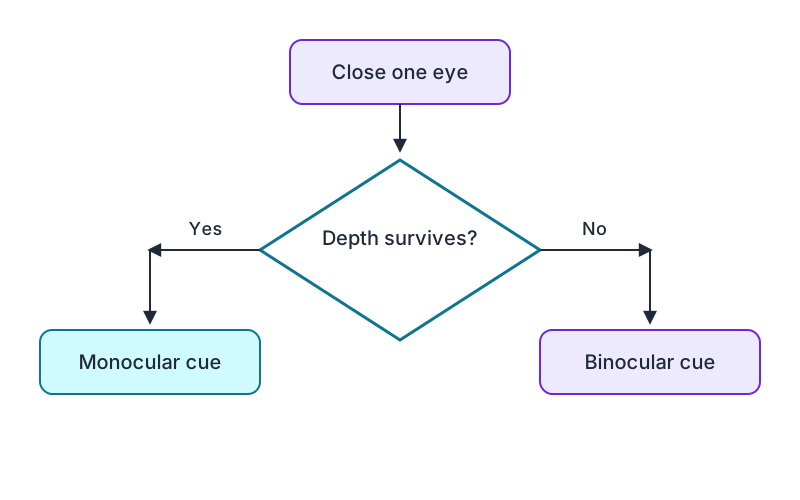
Ask one question about any example: close one eye, and check whether the depth survives. If it survives, the cue is monocular. If it breaks, the cue is binocular. Work through these steps in order.
- 1.Pick the depth in the example and name what carries it, such as the road, the haze, or the glasses.
- 2.Close one eye and imagine the same scene.
- 3.If the depth stays, name the monocular cue: photo of a road means linear perspective, hazy hills mean aerial perspective, overlapping books mean interposition.
- 4.If the depth breaks, name the binocular cue: the 3-D movie means retinal disparity, the finger-to-nose strain means convergence.
- 5.Say the answer in one sentence, such as "The road still narrows with one eye closed, so linear perspective is a monocular cue."
Try it on three cases. A photo of railroad tracks still converges with one eye closed, so linear perspective is monocular. Distant hills still look hazy with one eye closed, so aerial perspective is monocular. The 3-D effect in the cinema goes flat with one eye closed, so retinal disparity is binocular. The close-one-eye rule sorts each one without a list to memorize first.
Close neighbours
Three ideas sit next to this topic and often cause confusion. Keep each in its place.
Accommodation is the lens helper from the table section. It works at short range only. It never joins the two binocular cues.
Stereoblindness is the rare state of responding to monocular cues only, for example after early vision loss in one eye. People in that state still navigate the world, which shows how much work the seven monocular cues do.
Expectations also shape what you see, on top of the cues. Our post on how expectations shape what you see covers that direction of perception. Colour vision runs on its own pair of theories, covered in our explainer on how colour vision works.
Learn the nine terms faster
Nine terms carry this whole topic: the two binocular cues and the seven monocular ones. Look each term up in Psychology World and save all nine to one list. When the list holds four or more words, drill it with Question, then with Typing. Search inside definitions and your study progress are Pro features. The word of the day shows one term each day at a time you choose, and it stays off until you turn it on. Psychology World runs on iPhone and iPad.
Frequently asked questions
What are the 7 monocular depth cues?
The seven are relative size, interposition, linear perspective, texture gradient, aerial perspective, light and shadow, and motion parallax. Each works with one eye only. A photo still shows depth because these cues survive with one eye closed.
Which depth cues need both eyes?
Two cues need both eyes: retinal disparity and convergence. Disparity merges the two slightly different views into depth. Convergence reads the inward turn of the eyes at short range.
Can you see depth with one eye?
Yes. The seven monocular cues keep working with one eye closed, so you still judge distance, avoid obstacles, and read photos as 3-D. Only the two binocular cues drop out.
Why do 3-D movies need glasses?
3-D movies feed retinal disparity by sending a slightly different image to each eye. The glasses separate the two images. With one eye closed, the merge cannot happen, so the effect goes flat.
What is the difference between retinal disparity and motion parallax?
Both compare views, but disparity compares two eyes at the same time, while motion parallax compares one eye over time while you move. Disparity needs both eyes. Parallax works with one eye, as in the car-window example.
Is convergence a short-range or long-range cue?
Convergence is a short-range cue. Textbooks put its working range at objects less than about 50 feet away. For far distances, such as mountains, monocular cues like aerial perspective carry the depth.