
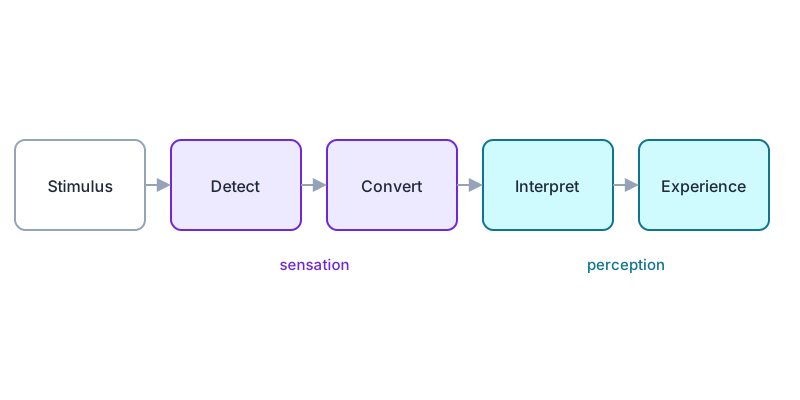
Sensation is detection. Perception is interpretation. When light reaches your eye or sound waves reach your ear, your receptors convert that energy into neural signals. That step is sensation. When your brain organizes those signals into a face, a melody, or a distance judgment, that step is perception. Signals become experience only after the brain interprets them.
Use one test on any example. If the description stops at detection, it is sensation. If it adds recognition or meaning, it is perception.
What sensation is
Sensation is the physical process in which sense organs respond to stimuli from the environment. Light waves strike the retina. Sound waves bend the hair cells of the inner ear. Chemicals bind to receptors in the nose and on the tongue. Pressure activates receptors in the skin. Each of these events is sensation, and each happens before conscious awareness.
The key step inside sensation is transduction. Transduction converts one form of energy into another. Physical energy such as light or sound becomes electrical signals that the brain can process. Photoreceptors in the retina transduce light. Hair cells in the cochlea transduce sound. Without transduction, a stimulus never reaches the brain at all.
Sensation has limits, and those limits are statistical. The absolute threshold is the smallest amount of stimulation detected half of the time. Under ideal laboratory conditions, the eye can detect a candle flame 30 miles away on a clear night, and the ear can detect the tick of a clock 20 feet away in quiet. These values describe optimal conditions, not everyday performance. Sensitivity shifts with attention, fatigue, and recent stimulation. The thresholds section below gives each threshold its full treatment.
What perception is
Perception is the psychological process of organizing, interpreting, and consciously experiencing sensory signals. Sensation delivers raw input. Perception assigns meaning to it. You hear a song not as a set of frequencies but as a melody with a title and a memory attached. You see a friend across the hall not as a pattern of light but as a person you know.
Perception is active. It draws on attention, memory, expectation, and context. Two people can receive the same sensory input and perceive it in different ways, because their brains interpret the signals against different knowledge and experience. Culture, beliefs, and past events all shape what you perceive. This is why perception, not sensation, defines your personal experience of the world.
The one-question test
Ask of each example: does anything get interpreted, or does the story end at detection? The table below applies the test to four exam-style cases.
| Example | Does the story add interpretation | Answer |
|---|---|---|
| Light waves reach the retina and photoreceptors fire | No, it ends at detection | Sensation |
| Hair cells bend as sound waves pass through the cochlea | No, it ends at detection | Sensation |
| You recognize a friend across the hall from a pattern of light | Yes, recognition is added | Perception |
| You hear your name in a noisy room and turn toward it | Yes, meaning and selection are added | Perception |
The fourth case shows how the two processes connect. Your ears detect many voices at once, which is sensation. Your brain selects one voice because it carries meaning, which is perception. That selection has its own classic demonstration, the cocktail party effect.
Thresholds: what gets detected
Not every stimulus gets through. The absolute threshold marks the lower edge of detection. The difference threshold, also called the just noticeable difference, marks the smallest change you can detect, again half of the time. Unlike the absolute threshold, it grows with the stimulus. A phone screen lighting up is obvious in a dark theater and invisible in a bright arena, though the screen itself is unchanged.
Ernst Weber proposed the rule behind this in the 1830s. Weber's law states that the difference threshold is a constant fraction of the original stimulus. Double the weight and you must roughly double the added weight before anyone notices. The rule holds best at medium intensities.
Detection also depends on the observer, not only on the stimulus. Signal detection theory describes the task of finding a signal inside noise. A mother wakes to her baby's murmur but sleeps through louder sounds. An air traffic controller picks one blip out of many on a radar screen. The theory separates sensitivity from decision. Outcomes fall into four cells: hits, misses, false alarms, and correct rejections. Motivation, expectation, and the cost of errors shift where the observer draws the line.
Finally, constant input fades. Sensory adaptation is the decrease in receptor response to a stimulus that does not change. You notice the ticking of a clock when you enter a room, then stop hearing it. Your receptors reduce their firing rate, which frees them to signal change. Adaptation sits in the receptors. Habituation, its often confused neighbor, sits higher up, where the brain learns to ignore a repeated signal.
Attention and organization: what turns signals into experience
Perception needs attention. Selective attention is the ability to focus on one channel while filtering others. The cocktail party effect is its signature case: you follow one conversation through noise, yet your name from across the room still breaks through. When attention goes elsewhere, perception fails even though sensation works. In the classic study by Simons and Chabris, viewers counted basketball passes. Nearly half of them missed a person in a gorilla suit crossing the screen, though the figure stayed visible for nine seconds. Observers who look away miss large changes in a scene the moment they look back.
The brain also builds perception from two directions at once. Bottom-up processing starts with the sensory data and assembles it piece by piece. Top-down processing starts with knowledge and expectation and uses it to interpret the data. You read a familiar phrase so fast that you skip a repeated word, because expectation overrides the raw input. A new reader meets the same phrase piece by piece. Most perception mixes both routes, as the guide to bottom-up and top-down processing shows in detail.
Grouping follows its own rules. The Gestalt psychologists found that the mind sees organized wholes, not scattered parts. Proximity groups items that sit close together. Similarity groups items that look alike. Closure completes an unfinished shape. Figure-ground organization splits an object from its background, and attention can flip which is which. These rules run automatically, before conscious thought.
The visual system also corrects. Size, shape, and color constancies keep objects stable while viewing conditions shift. A friend walking away shrinks on the retina but not in your experience. A white shirt stays white under daylight and lamplight. Depth comes from two eyes working together, through retinal disparity and convergence, and from one-eye cues such as relative size, interposition, and linear perspective. Color itself is interpreted in stages, from three cone types to opponent pairs, which is why staring at one flag leaves an afterimage in opposite colors. The color vision theories explain each stage.
How to study the pair
Exams test this topic with sorting tasks. They describe a scenario and ask which process it shows. Three traps catch most errors. First, detection language means sensation: detect, reach, fire, bend, bind, activate. Interpretation language means perception: recognize, identify, judge, organize, expect. Second, raw features mean bottom-up, while expectation steering the outcome means top-down. Third, fading receptors mean adaptation, while the brain learning to ignore a repeated signal is a different process.
Save the paired terms to one list and drill them together: sensation, perception, transduction, absolute threshold, difference threshold, signal detection, sensory adaptation, bottom-up, top-down. Psychology World turns any list into flashcard, multiple-choice, and typing drills, so a pair you confuse once becomes a pair you keep. Test yourself with the table above covered, then uncover one row at a time and name the answer before you look.
Frequently asked questions
What is the difference between sensation and perception in psychology
Sensation is the detection of a stimulus by sensory receptors and its conversion into neural signals. Perception is the organization and interpretation of those signals into conscious experience. Detection without meaning is sensation. Meaning added to detection is perception.
Can there be sensation without perception
Yes. Signals can reach your receptors and never reach conscious interpretation. A stimulus you do not attend to still stimulates your sense organs, but you perceive nothing. Inattentional blindness cases show detection without perception: the image lands on the retina while the observer, focused elsewhere, sees nothing of it.
What is an example of sensation and an example of perception
Sound waves bending the hair cells of the inner ear is sensation. Recognizing those sounds as a familiar melody is perception. Light striking retinal photoreceptors is sensation. Seeing a friend's face in that pattern of light is perception.
What best distinguishes sensation from perception
Interpretation distinguishes them. Sensation is physical and ends at the neural signal. Perception is psychological and begins where meaning starts. If removing the meaning leaves the event intact, the event was sensation.