
Self-efficacy is the belief that you can carry out the actions a difficult task needs. Albert Bandura proposed the term in 1977. It asks one question: can I do it. The answer shapes which goals you pick, how long you persist, and whether you try again after a failure.
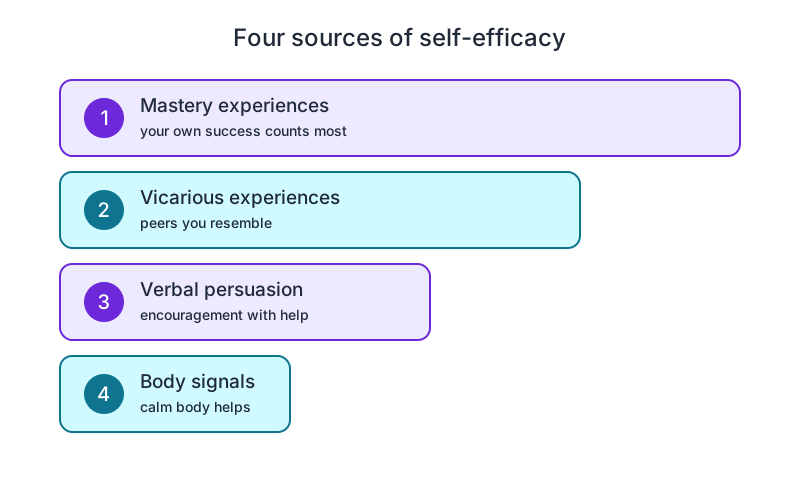
- Bandura names four sources in rank order: your own mastery experiences, models you watch, encouragement you receive, and the reading of your own body signals.
- Your own success is the strongest source. It builds only when you credit your effort and ability.
- Models help most when they resemble you and show effort. Effortless experts help less.
- Encouragement works only with conditions that make success possible. Praise without help backfires after failure.
- A tense body lowers the expectation. A calm body raises it.
- Self-efficacy asks: can I do it. Self-esteem asks: am I worthy. Those are two different judgments. Our guide on the difference between self-esteem and self-efficacy separates them in full.
What self-efficacy is
Self-efficacy means can for a task. It belongs to one task or one area of life. It can change from task to task. You can hold high self-efficacy for statistics and low self-efficacy for a presentation. That is normal. It describes no fixed trait.
The theory separates two expectations. The competence expectation asks: can I carry out the action myself. The outcome expectation asks: does the behavior lead to the goal. You know that learning leads to passing. That is the outcome expectation. You also ask whether you can learn the material yourself. That is the competence expectation. Only the second one is self-efficacy. The distinction comes from the glossary of the INeKO institute at the University of Cologne.
The theory also separates specific from general. Specific self-efficacy covers one concrete task. An example is a speech before 300 people. General self-efficacy covers shaping life as a whole. In everyday speech it matches self-confidence. The separation follows the expert guide on self-efficacy.
| Term | Question | Reach |
|---|---|---|
| Self-efficacy | Can I do it | One task or one area |
| Self-esteem | Am I worthy as a person | The whole person |
| Outcome expectation | Does the behavior lead to the goal | Action and result, without self-reference |
Self-efficacy differs from self-esteem. Self-esteem judges your worth as a person. Self-efficacy judges your can for a task. Both belong to the self-concept. They can drift apart. High self-esteem with low self-efficacy for an exam is possible. The reverse is possible too.
The four sources of self-efficacy
Bandura named four sources in 1977: mastery experiences, vicarious experiences, verbal persuasion, and body signals. The order is a rank order by influence. Mastery experiences stand first. Body signals stand last. The source is Bandura's article from 1977.
Mastery experiences
Mastery experiences mean your own success.
Your own success is the strongest source. When you master a hard task, you trust the next one sooner. When you often fail, you avoid similar tasks sooner. But one condition applies. You must credit the success to your ability and effort. You must read it as internal and stable. Then the expectation grows. When you blame luck or help, it does not grow. A lottery win teaches nothing. It shows no competence of your own. Once strong self-efficacy stands, single failures barely harm it. You read them as input on strategy and effort. The rule comes from Schwarzer and Jerusalem from 2002.
For studying this means: small, well-dosed wins beat big plans. One passed recall round with ten terms counts. One reread page without a test counts less. The difference lies in the credit. Note what you did yourself. Then your memory links success with effort.
Vicarious experiences
The second source is observation. You see another person master a task. Then you trust yourself with it sooner. That is model learning. It works best with similar models. Age, standing, and situation should fit. A fellow student in the same term helps more than a professor. The reason is simple. You infer from her to you. If she can do it, so can you.
The kind of model matters too. Coping models help more than effortless experts. A model who strains and shows hurdles helps more. A model who shows everything with ease helps less. Clear results help more than vague ones. Several different models help more than one. The findings come from Bandura's review of model conditions. The source is Bandura from 1977.
For studying this means: find a near peer. Ask which strategy she uses for one task type. Copy the strategy, not the person. An old exam with a worked solution shows effort with a result.
Verbal persuasion
The third source is encouragement. Others trust you with a task. Then you try harder. You believe in yourself sooner. This covers praise from teachers, parents, and peers. It also covers your self-instruction. The source is Bandura from 1977.
Encouragement stays weaker than your own experience. It has no authentic base of experience. It needs conditions that make success possible. You need near goals, material, and help. Without them it leads to disappointment after failure. Then it discredits the source. Then the expectation sinks further. Bandura warns against exactly this. Empty encouragement without help harms.
For studying this means: ask for concrete help instead of praise. Ask for a next step. Ask for an example task. Ask for feedback on one section. That turns praise into a path. The mechanism resembles the self-fulfilling prophecy in the classroom. Positive expectation steers treatment and performance. It never replaces practice.
Body signals
The fourth source is your body. You read a pounding heart, sweat, and trembling as information. From them you infer your can. High aversive arousal lowers the expectation. You expect failure sooner when tense. You expect success sooner when calm. The source is Bandura from 1977.
The reading decides, not the pulse alone. Arousal before an exam is normal. It means a switched-on body, not missing ability. Who reads it as weakness doubts sooner. Who reads it as readiness and lowers it tests calmer. Slow breathing helps before performance. So do short exercise and rehearsal. The self-efficacy guide of Helsana from 2023 lists meditation, mindfulness, yoga, and sport as techniques. Use them as study tips, not as therapy.
| Rank | Source | Study example |
|---|---|---|
| 1 | Mastery experiences | Pass ten recalled terms and credit the effort |
| 2 | Vicarious experiences | Watch a similar peer with a strategy |
| 3 | Verbal persuasion | Ask for a next step and feedback |
| 4 | Body signals | Lower the pulse and read it as readiness |
Four exercises for studying
Each exercise uses one source. Do one exercise per day. Each takes 10 to 20 minutes. Write short notes. The note secures the credit.
Exercise 1: near goal with a success note
This exercise uses your own success. It is the most important one.
- 1.Pick a near goal for today. Take ten terms from one list.
- 2.Learn them with recall, not rereading. Cover the definition and say it.
- 3.Note three wins in the evening. Add which effort helped.
- 4.When a term fails, note the strategy for tomorrow. Name the trigger in concrete words.
This builds a chain of success and credit. After one week you hold proof of competence. That feeds source 1 at once. A lottery win could never do that. Only your own effort counts.
Exercise 2: model with a strategy log
This exercise uses vicarious experience.
- 1.Pick a similar person. Take a fellow student in the same term.
- 2.Ask for her strategy for one task type. Ask for a worked path.
- 3.Copy three steps of her strategy. Note effort and time per step.
- 4.Apply one step today. Measure the result on one task.
This turns admiration into a method you can take over. Watch effort, not talent. Talent looks out of reach. Effort looks repeatable. Several models help more than one.
Exercise 3: encouragement with a condition
This exercise uses verbal persuasion the right way.
- 1.Ask one person for help. Name one concrete task.
- 2.Ask for a next step. Ask for material or feedback.
- 3.Do the step today. Report the result back.
- 4.When it fails, ask for a fix of the condition. Ask for a smaller goal.
This turns praise into a path you can walk. You avoid empty praise without help. That guards against disappointment. It follows the rule from Bandura: persuasion needs conditions.
Exercise 4: lower arousal with rehearsal
This exercise uses the reading of your arousal.
- 1.When tense, pause short. Sit upright.
- 2.Breathe in slowly through the nose. Hold short. Breathe out slowly through the mouth. Repeat three times.
- 3.Rehearse the exam with time. Work solvable tasks first.
- 4.When thoughts circle, read the task aloud and slowly. Start with the first step.
This teaches calmer testing. The body signals readiness, not failure. That feeds source 4 at once. When you keep postponing tasks because tension threatens, read procrastination as mood repair. It shows why avoidance pays at once and weakens later.
What self-efficacy does for studying
High self-efficacy changes your approach. You pick demanding but realistic goals. You avoid goals too easy and too hard. You show more persistence with hurdles. You raise effort when behind. You seek new strategies instead of giving up. The expert guide on self-efficacy contrasts high with low experience in a table. The effects also stand with Schwarzer and Jerusalem from 2002 for school and performance.
It also guards against setbacks. After a failure you hold the goal. You ask for strategy, not for worth. You separate can from person. Students with high self-efficacy blame too little study after a poor exam. Students with low self-efficacy blame a test too hard. That example comes from the self-efficacy review. The same logic matches growth mindset. There a mistake counts as information for the next step.
Two limits matter. Overestimation harms. Who picks tasks too hard or too much at once fails on plan. That lowers performance despite high expectation. Clinging to failed plans harms too. Sometimes quitting or shrinking is right. Whyte and Saks describe this clinging in 2007. The summary stands in the expert guide on self-efficacy. The fix is grounded expectation with a grip on reality. Pick the next reachable goal. Measure the result. Then adjust.
Learn the terms with a list of your own
In Psychology World, you look up a term and save it to one of your own lists. Make a list named Self-efficacy. Collect the four sources as cards of their own. Add the lines that separate it from self-esteem and outcome expectation. Add the credit rule with the lottery example. Then you have everything in one place.
Drill the list with recall instead of rereading. Use Flashcard for quick repeats. Use the Question mode once the list holds four or more words. Use Typing for the hard cards. How that works is in our guide to memorising psychology terminology. The Question mode needs at least four words per list. So a list of eight to twelve cards pays off.
The daily word keeps continuity. It sends one term each day, and stays off until you turn it on. Open it and save it to the list. Repeat the list over one week. That turns rereading into credited success. That is source 1 in pure form. The four steps of the learning loop and what each study mode does are on the home page.
Self-efficacy is not self-esteem
Self-efficacy is no self-esteem. Self-esteem asks for your worth as a person. Self-efficacy asks for your can for a task. The full split stands in the difference between self-esteem and self-efficacy. Read it when you must split both terms in an exam.
Self-efficacy is also no self-fulfilling prophecy. The prophecy describes how the expectations of others steer your behavior. It works through treatment and grading. Self-efficacy describes your own competence expectation. It works through goal choice and persistence.
| Term | Question | Mechanism |
|---|---|---|
| Self-efficacy | Can I do it | Goal choice and persistence from competence expectation |
| Self-esteem | Am I worthy | Judgment about your own person |
| Self-fulfilling prophecy | What do others expect of me | Treatment and grading steer performance |
Frequently asked questions
What is self-efficacy in simple terms
Self-efficacy is the belief that you can carry out the actions a difficult task needs from your own competence. It asks for can for a task, not worth as a person. Bandura proposed the term in 1977.
How can I improve self-efficacy while studying
Set near goals and test yourself with recall. Watch similar peers with a strategy. Ask for encouragement with concrete help. Lower arousal before exams with breath and rehearsal. Note wins with their effort.
What are the four sources of self-efficacy
The four sources are mastery experiences, vicarious experiences through models, verbal persuasion through encouragement, and the reading of your own body signals. Your own success works strongest. Body signals work weakest.
What is the difference between self-efficacy and self-esteem
Self-efficacy judges your can for a task. Self-esteem judges your worth as a person. So you can hold high self-esteem with low self-efficacy for one exam at the same time.
Sources
- 1.Bandura (1977). Self-efficacy: Toward a unifying theory of behavioral change.
- 2.Schwarzer and Jerusalem (2002). Das Konzept der Selbstwirksamkeit.
- 3.INeKO (2026). Selbstwirksamkeit.
- 4.Wikipedia (2026). Self-efficacy.
- 5.Becker (2026). Selbstwirksamkeit stärken und fördern.
- 6.Helsana (2023). Selbstwirksamkeit stärken: So gelingt es Ihnen.