
Flow state in psychology means full absorption in a task you care about, with clear goals, immediate feedback, and challenge matched to skill. Attention stays in the present, self-consciousness drops, time feels faster, and the activity feels rewarding in itself. If one of the three is missing, adjust that one and test again.
What flow is
Flow is the state of complete involvement in an activity for its own sake, with the ego quiet and skill fully used. People describe it as being in the zone: action and awareness merge, concentration stays high, control feels strong, and the task carries its own reward.
Researchers describe six experiential markers that appear together in flow. Intense concentration holds attention in the present moment. Action and awareness merge, so doing needs no commentary. Reflective self-consciousness fades, so worry about how you look drops away. Control feels high because you know the next move. Time distorts, usually as compression. The activity feels autotelic, which means rewarding in itself and worth repeating.
Two proximal conditions produce those markers. Perceived challenges stretch existing skills without overwhelming them. Clear proximal goals and immediate feedback guide each step and allow quick adjustment. When both hold, experience unfolds from moment to moment and attention stays bound to the task.
The term grew from interviews in 1975 with chess players, rock climbers, dancers, surgeons, and other people who pursued an activity for enjoyment itself. Reports matched across play and work settings, across culture, age, and gender. The 1990 book Flow: The Psychology of Optimal Experience gave the program its widely read form. A 2021 review in the European Journal of Neuroscience still lists nine dimensions, with challenge-skill balance as the key one, and notes that boredom and stress disrupt the state while intermediate arousal supports it. The review summarizes nine dimensions and the central role of balance.
Flow is not passive pleasure. Baths and passive television rarely produce it because active engagement is required. An established reference describes flow as complete involvement for its own sake with ego quiet and peak skill use.
The three conditions
Flow theory states three preconditions. All three must hold at once. Other sources group the same material as six markers, nine dimensions, or ten markers. This article teaches the three-precondition version. The three are stated as clear goals, immediate feedback, and perceived challenge-skill balance.
1. Clear goals
You know what counts as done for this step. Draft the opening paragraph, not write the report. Solve ten items of one type, not study chemistry. A clear goal directs attention and defines progress. Vague goals split attention and block entry.
2. Immediate feedback
You see how each move went without delay. A solved item, a score, a paragraph that holds together, a shape that takes form. Feedback lets you adjust the next move and keeps attention bound. Delayed or missing feedback loosens the loop and invites drift.
3. Challenge matched to skill
Perceived challenge sits near perceived skill, slightly above current level. Confidence stays intact because the task feels doable. If challenge exceeds skill, vigilance turns to anxiety. If skill exceeds challenge, ease turns to boredom. Only the matched ridge recruits full attention.
The 1987 eight-channel model maps this ridge. Massimini, Csikszentmihalyi, and Carli published it to track optimal experience in daily life. Flow sits where both challenge and skill are above personal average and matched. Neighbors explain nearby states. The model and its eight channels are summarized with history and critiques.
| Channel | Challenge | Skill | What it feels like |
|---|---|---|---|
| Flow | High | High, matched | Absorbed, in control, time fast |
| Anxiety or arousal | High | Low to medium | Vigilant, then strained |
| Boredom or relaxation | Low | High | Restless or flat, attention drifts |
| Apathy | Low | Low | Flat, no drive to continue |
The full map splits further into worry, control, and related mixes. The center marks personal average, so flow means above average on both sides, not an absolute level. Intensity grows with distance from the center.
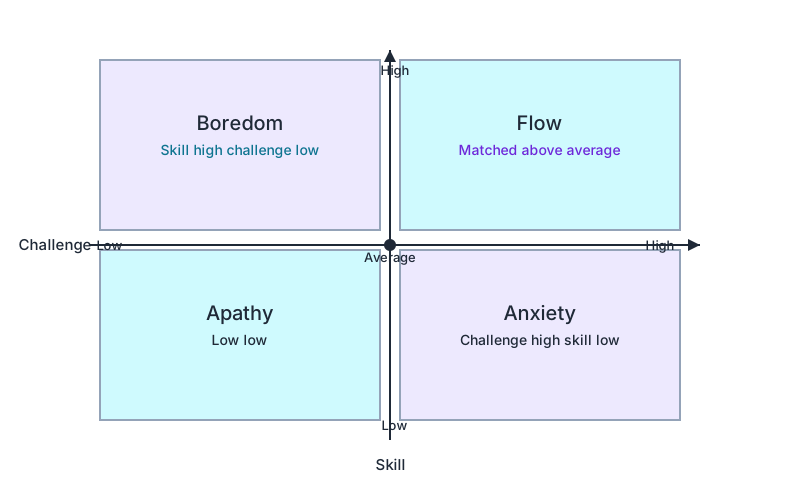
Challenge and skill are perceived, not objective. A 12-term list feels different to a beginner and to a student who already knows eight. Calibrate to your current level, not to a fixed standard.
Autotelic experience deserves care. It means the reward that comes from the activity itself, not from a prize or grade. Grades and praise can accompany study, but flow itself runs on the task reward. That distinction keeps the definition clean.
Control also deserves care. It means a sense that outcomes depend on what you do, with room to adjust the next move. It does not mean guaranteed success. Research on action orientation and internal locus links that control sense to easier entry, but the state needs goals and feedback.
The one-question test
Ask whether goals, feedback, and challenge-skill line up right now. Name the goal in one sentence. Point to the feedback you will see after each step. Rate challenge against skill as too high, too low, or just above level. If one leg fails, fix that leg before you push harder.
A student example shows the test at work. Goal: master 12 terms of one list in 40 minutes. Feedback: each Flashcard answer marked right or wrong at once. Challenge: eight known, four new, so demand sits just above level. All three hold, so start. If ten are new, shrink to six new and six known. If feedback comes only at the end, switch to a game that marks each answer.
Confidence that you can meet the challenge matters here. It is the feeling that success is possible with effort, not certainty of outcome. Build it from recent times on similar lists, not from hope.
Flow versus hyperfocus
Absorption alone does not prove flow. Hyperfocus also absorbs, yet it follows a different structure and stays less steerable. The distinction matters for students who lose hours to a game and call it zone time.
| Feature | Flow | Hyperfocus |
|---|---|---|
| Trigger | Challenge matched to skill, with goals and feedback | Strong interest capture, with or without goals |
| Control | Steerable, you can pause and resume | Sticky, hard to stop even when hungry or tired |
| Outcome | Usually satisfaction and usable progress | Often crash and neglected needs |
| Requirement | All three conditions at once | Absorption alone is enough |
Flow needs the full structure. Hyperfocus can lock onto one attractive target at 3 a.m. and override sleep, food, and plans. Research notes mention hyperfocus in connection with autism, schizophrenia, and attention deficit hyperactivity disorder, where attentional control differs. This article does not diagnose or explain any condition. It uses the table only to test structure: if goals or feedback are missing, call it absorption, not flow.
If concentration has collapsed across activities that once absorbed you, speak to a doctor or mental health professional for evaluation rather than pushing productivity steps.
How researchers measure it
Experience sampling tracks frequency in daily life. Participants wear a pager for a week and report what they do and feel at about eight random signals per day. Reports include context and scaled feelings, coded later by researchers. Studies with this method found flow more often during work than passive leisure, which fits the active-engagement requirement. The method, its items, and the work-versus-leisure finding are described in the flow literature.
Standardized scales measure intensity and tendency. The Flow State Scale-2 measures flow as a state during a specific activity. The Dispositional Flow Scale-2 measures tendency to enter flow in general or in one domain. Short Core Flow Scales give a brief alternative. Exam questions often contrast the two: sampling answers how often, scales answer how strongly or how readily. The scale names and their state-versus-trait roles are listed with psychometric notes.
Brain studies add a cautious layer. During experimentally induced flow with matched calculations, basal ganglia including the nucleus accumbens showed higher activity, while the medial prefrontal cortex showed the lowest activity and amygdala activity stayed low. Authors read this as reward engagement with reduced self-referential processing and low threat response. The review reports the Ulrich experiments and the dopamine and attention-network interpretation. An older hypothesis of broad frontal shutdown remains disputed because later work found stronger frontal engagement outside the medial prefrontal area. Treat mechanism as evolving, and rest study advice on the three behavioral conditions.
How to study in flow
Use one named list and one session. The routine below engineers goals, feedback, and matched challenge for term learning.
- 1.Pick one list of 10 to 20 terms with one finishable goal.
- 2.Set visible feedback for every answer.
- 3.Match challenge just above level.
- 4.Protect one block and remove interruptions.
- 5.Close with a two-minute review.
Step 1 sets the goal. Write it as one line: master list A, items 1 to 12, in 40 minutes. One list keeps the stimulus field narrow so attention has nowhere else to go. A dictionary app with saved lists fits this pattern well: Psychology World lets you store terms in named lists and turn one list into a Flashcard, Question or Typing session, which keeps the goal clear.
Step 2 fixes feedback. Use a mode that marks each answer at once. Flashcard shows the other side, Question marks the choice, Typing judges the string. Do not batch all checking to the end. If a mode hides feedback, change modes.
Step 3 calibrates challenge. Count known versus new before you start. Aim for about one third new. If anxiety rises, shrink new items and retest. If boredom rises, add new items or tighten time. Harder studying that pays off works only while demand stays just above level.
Step 4 protects attention. Silence the phone, close extra tabs, and tell others the block is closed. Work the full block on the single list. Multitasking breaks the loop because feedback no longer follows action.
Step 5 consolidates. Mark missed terms and restudy only those.
A worked example helps. List of 12 terms, eight known, four new. Goal: 12 correct in 40 minutes. Round 1 Flashcard through all 12. Round 2 Question on the four missed. Round 3 Typing on the two still missed. Each round gives immediate marks, challenge stays near level, and the block ends with a clear result.
If putting off the start blocks entry, shrink the first step to one five-minute pass through six cards. Starting restores feedback, and feedback restores pull. Do not negotiate the block length while inside it.
What breaks it
Each breaker maps to one condition, so the fix stays specific.
- Vague goal. Symptom: rereading without a finish line. Fix: rewrite the goal as count plus time.
- Missing feedback. Symptom: no sense of progress. Fix: switch to a mode that marks each answer.
- Too hard. Symptom: tension, avoidance, self-criticism. Fix: halve new items, keep known items for wins.
- Too easy. Symptom: skimming, phone checks. Fix: add new items, shorten time, or raise standard to recall from memory.
- Interruptions. Symptom: repeated restarts. Fix: same place, same warm-up, phone in another room. Fragmented attention resets entry, so protect the block rather than forcing focus.
Passive review rarely yields flow because it lacks goals and feedback. Testing with marks beats rereading for the same reason the theory predicts.
Frequently asked questions
What is flow state in psychology?
It is full absorption in a task with clear goals, immediate feedback, and challenge matched to skill. Attention holds in the present, self-consciousness fades, time feels faster, control feels high, and the activity rewards itself.
What are the three conditions for flow?
Clear goals that define done for this step, immediate feedback after each move, and perceived challenge near perceived skill with confidence intact. All three must hold at once; a mismatch yields anxiety, boredom, or apathy instead.
Is flow the same as hyperfocus?
No. Flow needs matched challenge plus goals and feedback and stays steerable. Hyperfocus is interest-driven capture that can persist without goals and override needs. Test structure, not absorption alone.
How do I reach flow while studying?
Pick one 10 to 20 term list with one timed goal, use a mode that marks each answer, keep about one third new, protect one block without interruptions, and review misses at the end. Adjust list size when anxiety or boredom appears.
Sources
- 1.van der Linden, Tops, and Bakker (2021). Go with the flow: A neuroscientific view on being fully engaged.
- 2.EBSCO (2020). Flow (psychology).
- 3.Wikipedia (2026). Flow (psychology).
- 4.Simply Psychology (2026). Flow State: The Psychology of Complete Immersion.
- 5.Headspace (2026). What is a flow state and what are its benefits?