
Cognitive appraisal theory says your emotions come from how you judge what is happening, not from the event itself. Richard Lazarus proposed it: the same failed test can bring shame, anger, or resolve, depending on what you decide the result means and whether you think you can cope.
- Primary appraisal asks what is at stake for you.
- Secondary appraisal asks what you can do about it.
- Reappraisal updates the feeling when the meaning changes.
- Harm and loss, threat, and challenge are the three stressful verdicts.
- A 2024 review of 309 studies backs the core claim: how you appraise an event shapes the emotion that follows.
What cognitive appraisal theory claims
The claim is short. An event carries no fixed emotion. Your judgment of the event decides which emotion you feel and how strong it runs. Two students can fail the same test and feel different things, because each appraises the failure in a different way.
Lazarus argued that this judgment is a necessary part of emotion. In his words, thought is a necessary condition of emotion, and cognition and emotion are usually fused in nature (Lazarus, 1982). The judgment does not need to be slow or deliberate. Appraisal can be fast, automatic, and outside awareness, which is why a tone of voice can sting before you know why.
This point answers a common exam trap. Appraisal does not mean calm reasoning. It means the meaning you assign, in a split second or on reflection, to what is happening and what it costs you.
The two appraisals, and the third step
Lazarus and Folkman split appraisal into two questions, plus an update. The two questions run at the same time, not one after the other.
| Move | Question it asks | Example before an exam |
|---|---|---|
| Primary appraisal | What is at stake for me | This exam decides my grade, so it matters |
| Secondary appraisal | What can I do about it | I studied the chapters, and I can ask for help |
| Reappraisal | What changed | The teacher added a cheat sheet, so the threat shrinks |
Primary appraisal sorts events into three bins: irrelevant, benign-positive, or stressful. Only the stressful bin produces a strong emotion. Secondary appraisal takes stock of coping options: your skills, your preparation, the help around you, and how the situation might unfold. A student with the same stakes feels less fear when coping resources look strong, which is where self-efficacy enters the picture.
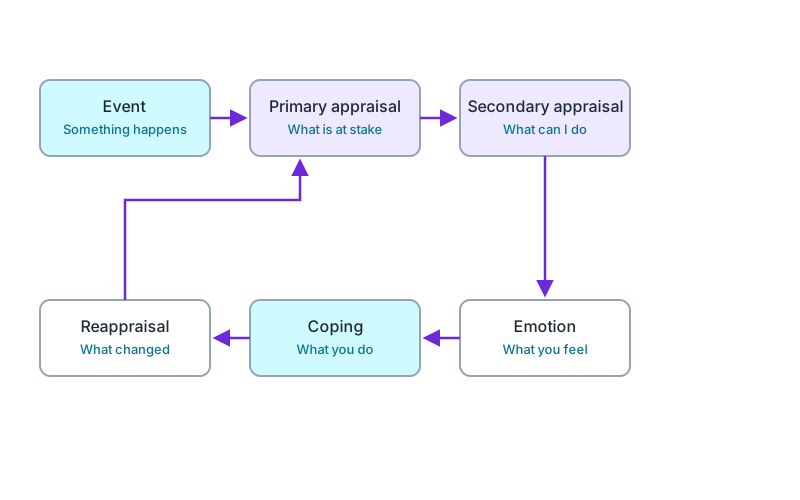
Reappraisal closes the loop. New information, a coping effort that works, or support from someone else can change the meaning, and the emotion follows. Anxiety can turn into relief without the event itself changing at all.
Threat, challenge, harm and loss
A stressful verdict comes in three forms. Each one points at a different time and a different feeling.
Harm and loss look backward. The damage already happened: a failed grade, a betrayal, an injury. The typical emotions are sadness and grief. Threat looks forward. It warns of harm that may still come: the next exam, a medical result, a conflict at work. The typical response is anxiety and watchfulness.
Challenge also looks forward, but it sees possible gain inside the demand: a hard test you can master, a job interview you can win. The typical response is effort mixed with hope.
Threat and challenge often arrive together. A job interview can frighten and energize you at once, because one appraisal counts the risk and another counts the chance. The body's alarm response to these verdicts is described in the general adaptation syndrome, which covers what happens after appraisal sounds the alarm.
The film study that started it
Lazarus built the theory on an experiment with films. In 1962, Lazarus, Speisman, Mordkoff and Davison reported a laboratory study of psychological stress produced by a motion picture film (Lazarus et al., 1962). The film threatened no one in the room, yet viewers showed stress. The meaning did the work.
Later studies changed the soundtrack around such footage, stressing the trauma, encouraging detachment, or pointing at the positive, and watched reactions move with the meaning (Thayer & Levenson, 1983). Change what a scene means to the viewer, and the stress changes with it.
What the numbers say now
The evidence has grown far beyond one film. In 2024, Yeo and Ong reviewed 2,634 effect sizes from 309 studies across 251 reports, covering 47 appraisals and 63 emotions (Yeo & Ong, 2024). They found that 75.0 percent of the predicted appraisal-emotion links were statistically significant, with a moderate-to-large average effect. Appraisal profiles also predicted which emotion people felt, not only how strongly they felt it.
Exams show the mechanism in student life. Schmidt and colleagues asked 610 Italian students about their final school examination (Schmidt et al., 2010). Students who judged the exam as important but their coping as weak felt anxiety and fear, and appraisals explained most of that fear. Students who judged the exam as important and their coping as strong felt hope and challenge instead, and used more reappraisal and problem-focused study.
Reappraisal itself has experimental support. Several studies tested this with karaoke singing, public speaking, and math performance. People who said "I am excited" out loud turned anxious arousal into excitement. They performed better than people who tried to calm down (Brooks, 2014). They adopted an opportunity mind-set instead of a threat mind-set. The tactic redirects arousal rather than suppressing it.
The test that sorts any example
Use these four steps on any exam case. Each step is one action, in order.
- 1.Ask what the person thinks is at stake. If nothing matters to them, stop: no appraisal, no strong emotion.
- 2.Sort a stressful stake into harm-loss, threat, or challenge. Past damage, future danger, or demand with possible gain.
- 3.Ask what coping the person sees. Strong resources turn threat toward challenge; weak resources turn it toward fear.
- 4.Check what changed. If new facts or coping efforts shifted the meaning, name reappraisal and the new emotion.
Try it on a case. A student fails a midterm. The grade matters, so primary appraisal fires. The damage is done, so the verdict is harm and loss, and sadness follows.
Then she learns the final can replace the grade. The meaning changes, reappraisal follows, and sadness gives way to resolve. One event, two appraisals, two emotions.
Cognitive appraisal vs Schachter-Singer
Students mix up the emotion theories, because all of them use the word appraisal or arousal somewhere. The four accounts differ in what each one says comes first.
| Theory | What starts the emotion | Our explainer |
|---|---|---|
| James-Lange | Body changes first, feeling follows | James-Lange vs Cannon-Bard |
| Cannon-Bard | Body and feeling start together | James-Lange vs Cannon-Bard |
| Schachter-Singer | Arousal plus a label from the situation | Schachter-Singer two-factor theory |
| Lazarus appraisal | A judgment of stakes and coping | This article |
Schachter-Singer says you feel arousal, look at the situation, and label it. Lazarus says the judgment comes earlier and decides the emotion itself. Arousal still matters in appraisal theory, but it follows the meaning rather than waiting for a label. When a question mentions mislabeled arousal, pick Schachter-Singer. When it mentions stakes and coping, pick Lazarus.
Other researchers extended the judgment idea. Scherer proposed four checks instead of two: relevance, implications, coping potential, and fit with values (Cognitive appraisal, 2026). Roseman sorted emotions by whether events fit your motives and who caused them. These versions refine Lazarus rather than replace him.
The argument that never quite ended
In 1980, Zajonc argued that affect can come before thought and run on its own system. Lazarus answered that appraisal is always present, even when it is instant and nonreflective, and the two restated their cases in paired 1984 articles. A 2019 retrospective concludes the ending included both views, with definitions deciding each round (Levenson, 2019). For exams, the safe sentence is this: appraisal can be automatic and unconscious, which is why fast emotions do not refute the theory.
Using these terms when you study
Appraisal terms repay drilling, because exams test them in pairs. Save primary appraisal, secondary appraisal, reappraisal, threat, and challenge to one list in Psychology World. Then drill the list with Flashcard, Question, and Typing until each definition comes in your own words. New terms keep arriving through the word of the day, one term each day at the time you choose. It stays off until you turn it on. The app runs on iPhone and iPad; searching inside definitions and tracking study progress are Pro features.
Frequently asked questions
What is cognitive appraisal theory in simple words
It is the claim that your judgment of an event decides your emotion. You ask what is at stake and what you can do, and the answers set what you feel.
Who proposed cognitive appraisal theory
Richard Lazarus proposed it, and he and Susan Folkman set out the full version in their 1984 book on stress, appraisal, and coping. Lazarus extended it into a theory of emotion in 1991.
What is an example of primary and secondary appraisal
A job interview is the example. Primary appraisal says the job matters, so the stakes are high. Secondary appraisal checks your preparation and contacts, and strong coping turns the threat into a challenge.
Is appraisal conscious or unconscious
It can be either. Lazarus held that appraisal is often fast and automatic, so an instant reaction still counts as appraisal rather than proof against the theory.
How does cognitive appraisal differ from the Schachter-Singer theory
Schachter-Singer starts from unexplained arousal that the situation labels. Appraisal theory starts from a judgment of stakes and coping that produces the emotion. Pick Schachter-Singer for mislabeled arousal and Lazarus for stakes and coping.
Sources
- 1.Richard S. Lazarus (1982). Thoughts on the relations between emotion and cognition.
- 2.Lazarus, R. S., Speisman, J. C., Mordkoff, A. M., & Davison, L. A. (1962). A laboratory study of psychological stress produced by a motion picture film.
- 3.Penn State (n.d.). Cognitive Appraisal Theory. Psychology of Human Emotion.
- 4.Sincero, S. M. (2012). Stress and Cognitive Appraisal. Explorable.
- 5.Cognitive appraisal (2026). Wikipedia.
- 6.Schmidt, S., Tinti, C., Levine, L. J., & Testa, S. (2010). Appraisals, emotions and emotion regulation: An integrative approach.
- 7.Yeo, G. C., & Ong, D. C. (2024). Associations between cognitive appraisals and emotions: A meta-analytic review.
- 8.Brooks, A. W. (2014). Get excited: Reappraising pre-performance anxiety as excitement.
- 9.Thayer, J. F., & Levenson, R. W. (1983). Effects of music on psychophysiological responses to a stressful film.
- 10.Levenson, R. W. (2019). Reflections on 30 years of Cognition and Emotion.
- 11.Lazarus, R. S., & Folkman, S. (1984). Stress, appraisal, and coping. Springer.
- 12.Lazarus, R. S. (1991). Emotion and adaptation. Oxford University Press.