
Active recall means closing the book and pulling an idea out of your memory instead of pushing it in by re-reading. In one well-known study, students who tested themselves remembered substantially more a week later than students who restudied, even though the restudiers felt more confident (Roediger and Karpicke (2006). Test-enhanced learning.). This article explains what active recall is, what the research shows, and how to run a simple 4-step routine for psychology terms.
- Active recall is testing yourself from memory after you learn, not during.
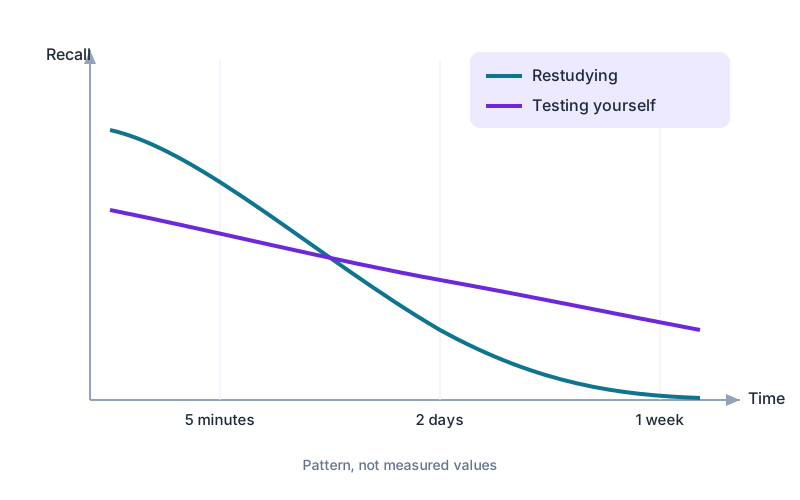
- On delayed tests, testing beats restudying; restudying wins only in the first minutes.
- Recall beats recognition: write or say the answer instead of picking it.
- Wrong answers still help, as long as you check the correct answer after.
- One session is not enough: come back and recall the material on later days.
What active recall is
Active recall, also called retrieval practice or practice testing, is a study method with one rule. After you learn something, close the source and reproduce it from memory. You write the definition, say the steps, or answer the question without looking. Then you check what you got right and restudy only what you missed.
Re-reading and highlighting feel productive because the text looks familiar. Familiarity is not memory. When someone asks you for the definition an hour later, recognition of the page does not help. Retrieval practice trains the exact skill the exam needs: finding the answer with no cues in front of you.
The reason it works has a name: the testing effect. A test does more than measure memory; taking it changes memory. Each effort to retrieve an idea makes the next retrieval easier, even when the attempt fails and you must look the answer up after (Kornell, Hays and Bjork (2009). Unsuccessful retrieval attempts enhance subsequent learning.).
What the studies show
The core result comes from Roediger and Karpicke (2006). Students read prose passages, then either took free-recall tests or restudied the same material. On a test after 5 minutes, the restudiers did better. On tests after 2 days and after 1 week, the testers remembered substantially more.
Study time was equal; only the method differed. Confidence pointed the wrong way. Repeated studying raised students' confidence in their memory while producing worse long-term retention (Roediger and Karpicke (2006). Test-enhanced learning.).
| Condition | After 5 minutes | After 2 days | After 1 week |
|---|---|---|---|
| Restudied the passage | Higher recall | Lower recall | Lower recall |
| Tested themselves | Lower recall | Higher recall | Higher recall |
The advantage is not only about memorizing facts. Karpicke and Blunt (2011) compared retrieval practice with elaborative studying using concept maps. Students who practiced retrieval learned more, and the advantage held on questions that asked for comprehension and inference, not just recall. It even held when the final test asked students to create concept maps (Karpicke and Blunt (2011). Retrieval practice produces more learning.).
A large 2013 review of 10 learning strategies rated practice testing as one of the two most effective, alongside spreading study across days. The reviewers found more than 100 years of research showing that practice tests beat rereading. Tests that ask for recall from memory also beat tests that only ask for recognition (Dunlosky (2013). Strengthening the student toolbox.). The full review is (Dunlosky et al. (2013). Improving students' learning.).
Two more findings matter for daily study. First, getting the answer wrong does not harm learning.
Kornell, Hays and Bjork (2009) gave students questions they could not answer, then showed the answers. Those failed attempts still improved later learning compared with reading the question and answer together. Trying hard first, then checking, beats reading alone.
Second, the effect holds in demanding real programs: in a randomised controlled trial with medical students, repeated testing improved long-term retention relative to repeated study (Larsen, Butler and Roediger (2009). Repeated testing improves long-term retention.). A 2024 systematic review of higher-education students linked active recall strategies with higher academic achievement (Xu et al. (2024). Active recall strategies.).
The delay is the point. Memory fades fast at first; that is what the forgetting curve describes. Retrieval works best when some forgetting has set in, because the effort of pulling the idea back is what strengthens it. Pure repetition still has its uses, as repetition still does for memory explains, but repetition alone cannot replace retrieval.
How to use active recall in 4 steps
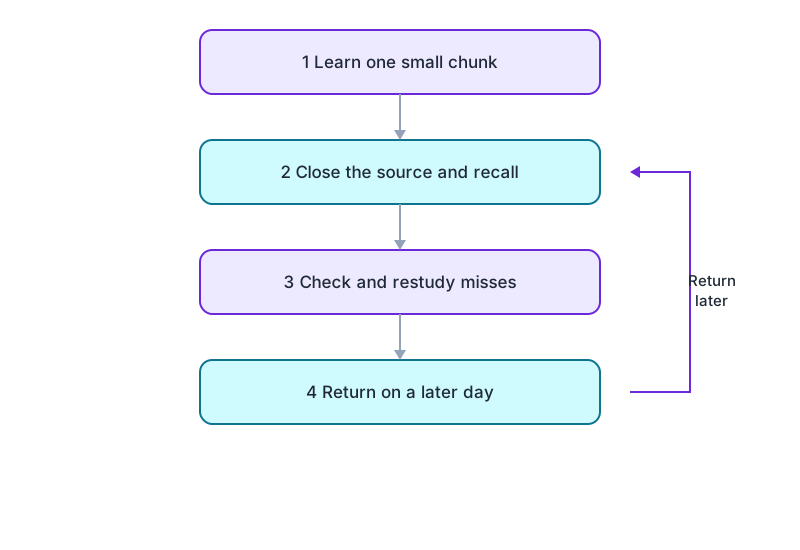
Run these steps for one small chunk at a time: a definition, a short section, a list of three terms.
- 1.Learn the chunk first. Read the definition or section until you understand it.
- 2.Close the source and recall it. Write the meaning in your own words or say it aloud.
- 3.Check the source and restudy only the misses. Compare your version with the text and fix the gaps.
- 4.Come back on a later day and recall the chunk again. Leave days between sessions so forgetting sets in.
Several formats fit step 2. Flashcards work well: prompt on one side, answer on the other. Question lists work too: turn your notes into exam-style questions and answer them without looking. Blurting means writing down everything you remember about a topic on a blank page, then checking. Teach-back means explaining the idea to another person, or aloud to yourself, until the gaps show. Past questions from your course work when your teacher provides them.
Step 4 is where most students stop too early. Study spreads across days beat single-day cramming even with equal total time, so schedule short returns instead of one long session. Our guide to spread study over time covers the timing side in detail.
Mistakes that make it fail
Re-reading and highlighting are the most common trap. In a survey at an elite university, 84 percent of students studied by rereading. Yet rereading gives uneven results. Highlighting failed to help students from schoolchildren to Air Force trainees (Dunlosky (2013). Strengthening the student toolbox.). If your whole session is reading and marking, you practiced recognition, not recall.
Peeking is the second trap. Glancing at the answer before you try removes the effort that drives the effect. Cover the answer, commit to a response, then check. An honest miss followed by the correct answer teaches more than a hinted hit.
The third trap is recognition-only quizzing. Multiple-choice questions where you only pick the familiar option help less than questions that force you to produce the answer. Write the term, say the definition, draw the process from memory. Recall and recognition work differently, and your self-tests should train recall.
The fourth trap is testing once, right after class, and never returning. Immediate testing feels smooth because nothing has faded yet. The durable gains come from recalling after a delay, across days. A single hard recall session after a delay beats repeated easy same-day passes.
Active recall for psychology terms
Psychology courses punish passive study more than most. A term like misinformation effect is easy to recognize on the page and hard to define with the book closed. That gap is exactly what step 2 of the routine exposes. Pick three terms from your current chapter, write one sentence of meaning for each from memory, then check and fix.
A dictionary that lets you save and drill terms fits this loop well. In Psychology World, look up a term, save it to a list for the chapter, and drill the list with the Flashcard, Question and Typing games. Typing is the strictest test because you must produce the answer, while Flashcard mode lets you test in both directions. Our guide to memorise psychology terminology shows how to build those lists in the first place.
Frequently asked questions
Does active recall really work?
Yes, for factual and conceptual learning. Delayed tests favor self-testing over restudying across many studies, a 2013 review rated practice testing among the most effective strategies, and a 2024 systematic review linked it with higher achievement. It raises your odds; it does not guarantee any grade.
How is active recall different from the testing effect?
Active recall is the method: you test yourself from memory. The testing effect is the phenomenon that makes it work: taking a test strengthens later memory. One is what you do, the other is why it helps.
How is active recall different from spaced repetition?
Active recall is about how you study each item: retrieve it, do not re-read it. Spaced repetition is about when: return to items across days instead of cramming. They complement each other, and combining them is the strongest approach the evidence supports.
Do wrong answers hurt my memory?
No, as long as you check the correct answer right after. Failed attempts followed by feedback improved later learning compared with reading alone. Guess, then verify; never leave an error uncorrected.
How long until active recall works?
There is no fixed timeline, and any promise of days would mislead. Expect it to feel harder than rereading from the start, and expect the payoff on tests after days and weeks of returning to the material. Judge it by delayed results, not by how smooth a session feels.
Sources
- 1.Roediger and Karpicke (2006). Test-enhanced learning.
- 2.Karpicke and Blunt (2011). Retrieval practice produces more learning.
- 3.Dunlosky et al. (2013). Improving students' learning.
- 4.Dunlosky (2013). Strengthening the student toolbox.
- 5.Kornell, Hays and Bjork (2009). Unsuccessful retrieval attempts.
- 6.Larsen, Butler and Roediger (2009). Repeated testing improves long-term retention.
- 7.Xu et al. (2024). Active recall strategies.