
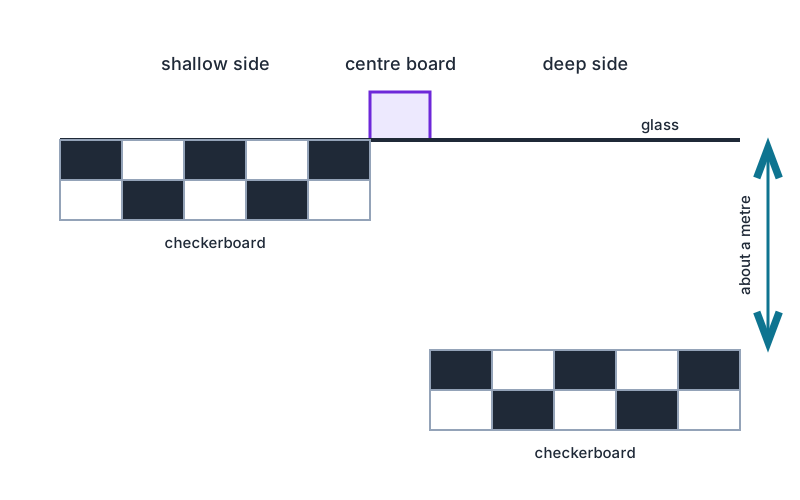
The visual cliff is a glass table that looks like a sudden drop. A checkerboard sits right under the glass on one half. On the other half it lies about a metre below. The deep side looks like a cliff while the glass makes a fall impossible.
In 1960 Eleanor Gibson and Richard Walk placed 36 infants on the board in the middle. The infants were six to 14 months old, and each mother called from both sides in turn. Every one of the 27 infants who moved off the board crawled on the shallow side at least once, and only three ventured onto the glass above the deep pattern. Many peered down, patted the glass, and still refused to cross.
This article explains what that result shows. It covers the apparatus, a one-question test that separates seeing depth from fearing it, and the later research.
- The visual cliff tests depth perception with safe glass, not with a real drop.
- Gibson and Walk (1960) tested 36 infants; 27 moved, all used the shallow side, three crossed deep.
- Seeing the drop is not fearing it: looks and heart rate show one thing, refusal shows another.
- Wariness arrives after weeks of moving yourself, by crawling, walking, or go-cart.
- At an uncertain edge, one-year-olds follow a mother's happy or fearful face.
- The study does not prove that fear of heights is innate.
What the visual cliff is
The apparatus is a large table covered by a continuous sheet of strong glass. A black-and-white checkerboard lies directly under the glass on the shallow side. On the deep side the same pattern lies about a metre below, so the eye sees a sudden drop where the hand feels solid glass. An infant starts on a centre board between the two halves. The mother stands beyond one side and calls, and the researchers watch whether the infant crosses.
The glass carries the infant's full weight on both halves, so the setup risks no fall. Researchers read the behaviour as perception and feeling, not rescue from danger. Sensing the drop is one process; judging what to do about it is another, which is the difference between detecting and interpreting. The checkerboard feeds the eye the kind of bottom-up depth information described in how the visual system builds depth.
What Gibson and Walk did in 1960
Eleanor Gibson and Richard Walk wanted to know whether depth perception needs learning or arrives ready made. The researchers built a task that turns seeing into crawling: cross to the mother, or refuse.
Each of the 36 infants, aged six to 14 months, sat on the centre board first. The mother called from each side in turn. All 27 infants who moved off the board crawled on the shallow side at least once. Only three crept onto the glass above the deep pattern. Many crawled away when she called from the cliff side; some cried because they could not reach her. The original report gives these numbers directly.
The infants' hands told the same story as their legs. They peered down through the glass on the deep side and then backed away. They patted the glass, felt its solidity, and still refused to cross. The study shows that most infants can tell depth apart as soon as they can crawl. Yet it does not prove that such perception or avoidance is innate.
The infants in this study were six to 14 months old, an age band that covers Piaget's sensorimotor stage. Covering several ages at one sitting is testing different ages at one time, so it cannot show when each infant changed. Later teams therefore tested infants too young to crawl, and infants followed over weeks of locomotor experience.
The one-question test
Students mix two achievements that the cliff keeps apart. The first is discrimination: telling the deep side from the shallow side. The second is wariness: treating the deep side as a threat. One question sorts any example: does the evidence show telling apart, or refusing?
| Question | Discrimination | Wariness |
|---|---|---|
| What it is | Telling the deep side from the shallow side | Treating the deep side as a threat |
| Looks | Peers down, then back | Stares, then turns away |
| Hands | Pats or explores the glass | Clings, freezes, or pushes back |
| Heart rate | Changes on either side | Clearly faster on the deep side |
| Crossing | Uses the shallow side when called | Refuses the deep side, cries, or crawls away |
Use the table as a sorter. Patting the glass counts as discrimination. A faster heart on the deep side than on the shallow side counts as wariness, while a change on both sides counts only as attention.
Why fear waits for crawling
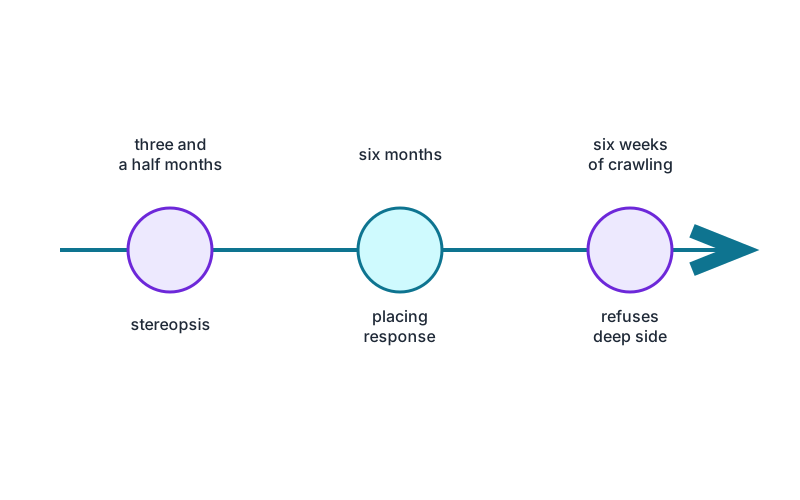
Perception arrives months before wariness. Infants show stereopsis, the use of both eyes for depth, at about three and a half months. They show the visual placing response, reaching for what they see, at about six months. Yet wariness of heights arrives only after weeks of self-produced locomotion. Neither early perception nor a history of falls explains the shift. A 2013 review of this timeline lays out each step.
The go-cart study tested the link directly. Researchers randomly assigned pre-crawling infants to drive a powered mobility device, a small joystick go-cart, for a training period. A control group had no such training. The trained infants improved their postural response to peripheral optic flow, the visual signal of self-movement, while controls did not.
When lowered toward the deep side, trained infants showed heart-rate differentiation of about +3.1 beats per minute between the sides. Controls showed about -2.1. Mediation analysis showed the effect ran through visual proprioception: learning to read self-movement is what made the drop alarming.
Most infants with more than six weeks of crawling experience refuse the deep side entirely. But 10 to 40 percent of experienced crawlers do venture onto it when the mother calls. A 2012 study asked whether those non-avoiders feel no wariness at all. They do.
Non-avoiders showed the same deep-side heart acceleration as avoiders, with a deep-shallow difference of 4.39 against 4.10 beats per minute, no significant gap. They took far longer to place their hands on the deep side than a comparison group took on the shallow side, 35.33 against 11.44 seconds. Six of seven non-avoiders explored the glass by touch, against one of eight comparison infants. Wariness has two faces: complete avoidance, or cautious approach with the same racing heart.
When a mother's face decides
A clear edge decides itself; an ambiguous edge sends the infant looking for a second opinion. That second opinion is the caregiver's face, voice, and gestures, a pattern called social referencing: using another person's emotional signal to judge an uncertain situation.
Sorce and colleagues showed the effect on a 30-centimetre apparent drop in 1985. Twelve-month-old crawlers faced the cliff while their mothers posed a happy or a fearful face. Most infants, 74 percent, crossed on the happy face. None crossed on fear. The risk was ambiguous enough that the mother's signal settled it. A 2016 review of this study records both numbers and its limits.
Later work varied the risk instead of fixing it. Karasik and colleagues tested 30 infants — experienced 12-month crawlers, novice 12-month walkers, and experienced 18-month walkers — on safe, borderline, and risky drop-offs, with mothers encouraging and discouraging in turn. Experienced crawlers and walkers deferred to the mother selectively, at their own borderline heights, and ignored her where perception was clear. Novice walkers took her advice inconsistently and walked over the brink of a 90-centimetre cliff on half the trials, falling into the experimenter's arms. Experience, not age, set how well each infant combined what the edge looked like with what the mother said.
Depth perception, wariness of heights, social referencing, and visual proprioception repay exact definitions, so they are worth fixing one by one. In Psychology World you can save all four to a single list and drill it with Flashcards, Question and Typing until each term stays put.
What the cliff does not prove
The visual cliff does not prove that fear of heights is innate. Gibson and Walk said so themselves: their study does not show that perception and avoidance of the cliff are inborn. What it shows is discrimination at crawling age. The fear arrives later, with locomotion, as the go-cart and heart-rate studies confirm.
Nor do babies see as adults do: stereopsis and placing are narrow abilities, not full depth vision. Timelines vary too: temperament, experience, and the mother's signal shift the outcome, which is why experienced crawlers split into avoiders and cautious crossers with the same racing hearts.
Animal and clinical extensions sit outside this article: their primaries were not opened in this run, so they are omitted rather than repeated secondhand.
Frequently asked questions
What is the visual cliff?
It is a glass-covered table. A checkerboard lies directly under one half and about a metre below the other. One side looks like a sudden drop while the glass prevents any fall. Researchers place an infant on the centre board and have the mother call from each side to see whether the infant crosses.
How old were the babies in the visual cliff experiment?
Gibson and Walk tested 36 infants aged six to 14 months. Later studies extended the method downward: heart-rate measures work in infants too young to crawl, and go-cart training studies used pre-crawling infants around seven months old.
What is the visual cliff designed to assess?
It assesses depth perception and wariness of heights separately. Crossing, looking, and touching show whether the infant tells the sides apart. Refusal, crying, clinging, and a faster heart on the deep side show whether the infant treats the drop as a threat.
Did the visual cliff prove that depth perception is innate?
No. Gibson and Walk wrote that their experiment does not prove innateness. Their infants were already old enough to have learned from months of looking. Later work shows perception precedes wariness, and wariness follows locomotor experience rather than a fixed maturational clock.
Why do crawling babies avoid the drop but younger infants do not?
Because wariness follows self-produced locomotion, not age. Infants show stereopsis at about three and a half months without fearing drops. After weeks of crawling, or even joystick go-cart driving, the visual system reads self-movement from peripheral flow, and losing that signal at an edge brings wariness with it.
Sources
- 1.Gibson, E. J., & Walk, R. D. (1960). The "visual cliff". Scientific American, 202(4), 64-71.
- 2.Dahl, A., Campos, J. J., Anderson, D. I., Uchiyama, I., Witherington, D. C., Ueno, M., Poutrain-Lejeune, L., & Barbu-Roth, M. (2013). The epigenesis of wariness of heights. Psychological Science, 24(7), 1361-1367.
- 3.Karasik, L. B., Tamis-LeMonda, C. S., & Adolph, K. E. (2016). Decisions at the brink. Frontiers in Psychology, 7, 797.
- 4.Ueno, M., Uchiyama, I., Campos, J. J., Dahl, A., & Anderson, D. I. (2012). The organization of wariness of heights in experienced crawlers. Infancy, 17(4), 376-392.