
The tip of the tongue phenomenon is a short failure to say a word you know. You hold the meaning, you feel recall is near, and you can often report the first letter or the number of syllables. It happens when meaning is found but the sound form is not finished, or when a related word blocks the target. Resolving it works best with a first-letter or first-sound cue, a short break, and later spaced retrieval of the same term.
- The tip of the tongue keeps meaning while the sound form stalls, with a strong feeling that recall is near.
- You often recall parts: the first letter, the syllable count, the stress pattern, or words close in sound or meaning.
- William James described the state in 1890, and Brown and McNeill showed in 1966 that the partial recall is above chance.
- Three models explain it: weak transmission from meaning to sound, a blocking word, and metacognitive monitoring of familiar cues.
- A 2025 study of 80 adults found that later-learned, rarely used, and long-unused names raise TOT rates, with recency as the strongest predictor.
- First-sound cues, brief incubation, and spaced retrieval lower later TOTs; frequent failure that blocks daily talk needs a clinician.
What the state feels like
The state has three marks. You cannot say the word now, you know a good deal about it, and you feel that recall is imminent. The name for it in research is TOT, and an older term is lethologica. Surveys find an idiom for it in most languages studied, often with the tongue or mouth in the phrase.
Partial recall is the sign that separates it from simple not-knowing. People report the first letter, the number of syllables, the stress pattern, or a neighbor word that sounds close. The feeling of knowing is strong even while production fails. That split, intact meaning with stalled sound, is the core of the state.
Use and age shape it. Rare words block more than common words. Names learned late, used rarely, or not used for a long time block more than early, frequent, recent ones. Older adults report more TOTs than younger adults, while comprehension of word meaning stays intact.
What Brown and McNeill showed in 1966
Roger Brown and David McNeill gave the first laboratory proof that the feeling is real. They read out definitions of rare words and asked students to name the defined object. When a student reported a tip-of-the-tongue state, they asked for any part of the word they could recall.
They sorted positive TOT reports into three kinds. The student picked the target when the experimenter read it, recalled it before the reading, or recalled a wrong but close word first. Students in a TOT state reported the first letter, the syllable count, words close in sound, and words close in meaning at rates above chance. The result showed that the feeling of imminent recall rests on partial access, not illusion. You can read this study through the review that summarizes it. The history places James in 1890 first and Freud on motivated word-forgetting after him.
The method matters for students. The definition-naming task with low-frequency words is still the standard laboratory task. It mirrors exam life: a rare psychology term is defined, the meaning is clear, and the label will not come. That is why memory researchers treat TOT as a window on lexical access. Implicit memory tests such as word-stem completion belong to the same family.
Why it happens
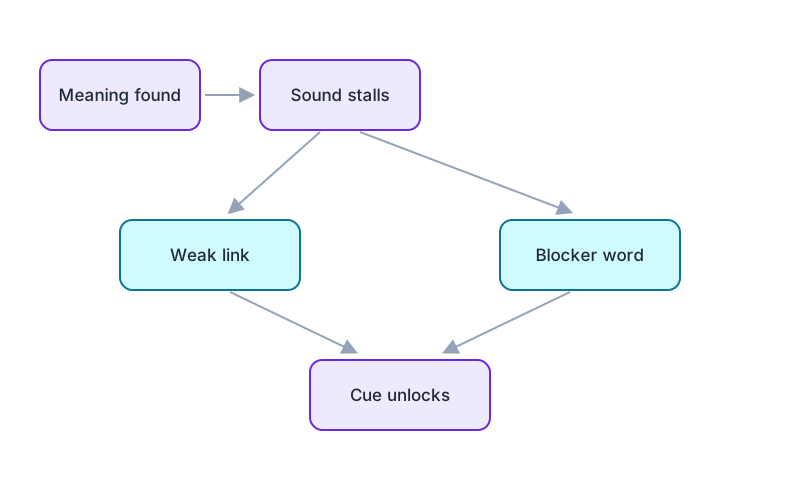
Three accounts explain the stall, and they combine well. The transmission-deficit account says activation passes from the semantic node to the phonological node too weakly to cross threshold. The blocking account says a related word wins for a moment and holds the target down. The metacognitive account says the feeling itself comes from monitoring. Familiar cues and rich partial detail push a threshold. You judge that recall is near and keep searching.
The 2025 faces-and-places study tested three mnemonic predictors together in 80 young adults. Names learned after age 21 raised TOT odds most clearly. The same held for names retrieved fewer than 50 times or last met over two years ago. Place names reacted more strongly than face names. Recency was the strongest predictor, with an odds ratio near 1.5, while higher lifetime frequency protected against TOTs, with an odds ratio near 0.68. The pattern fits both weak transmission and weak cue associations: less-used links carry less activation, and less-familiar cues give less support. It also fits the forgetting curve for low-frequency terms, which describes fast early loss without rehearsal.
Evidence on blockers is mixed, so keep the claim narrow. Related words do come to mind during TOTs, and priming a close form can raise or lower resolution depending on timing and overlap. Ongoing debate asks whether blockers cause the stall or only ride along with it. For study purposes, treat a persistent wrong neighbor as a signal to switch cues, not to push harder on the same cue.
What happens in the brain
Retrieval runs through meaning areas and sound-planning areas, with control areas watching the match. During TOTs, imaging shows stronger activity in conflict and selection areas. These include the anterior cingulate and right prefrontal cortex. The left inferior frontal area selects among rivals. The timing shifts later than fluent recall, which fits a longer search with repeated checks.
Structure sets the limits. Lower integrity of fronto-temporal paths that join meaning and sound goes with more word-finding failure, and older adults recruit wider frontal areas during search. That wider recruitment looks like compensation: the system works harder to finish the same step. None of this turns an occasional TOT into disease. It describes a control process doing overtime on a weak link.
How to sort it from nearby states
Students meet three states that look alike. The table gives the split used in memory research.
| State | What happens | The test that sorts it |
|---|---|---|
| Tip of the tongue | Meaning is clear, sound stalls, feeling of nearness is strong | Can you report parts, such as the first letter, but not the word |
| Feeling of knowing | You predict you would pick the item from a list later | Would a recognition list help, even though recall fails now |
| Anomia | Word production fails often and harms daily talk, often after injury, stroke, or dementia | Does it block daily life often, and did it start with illness or injury |
The middle case links to standard memory tests. Recall asks you to produce the answer, while recognition asks you to pick it out, as the recall and recognition tests show. The last case is clinical. If word-finding failure is frequent, worsening, or blocks daily talk, talk to a doctor or a speech-language professional. This article cannot diagnose, and an occasional TOT needs no care.
What unlocks a TOT
Use a better cue, not more force. Say the alphabet silently to the first letter, or try the first sound and syllable count you sense. A phonological cue that matches the target often finishes the stalled step. If a wrong neighbor keeps coming, drop it and change the cue rather than repeating the blocker.
Take a short break when the word will not come. Incubation resolves a share of TOTs: the block fades and the target surfaces later. Return once, test yourself, and then move on. Straining on the same cue tends to rehearse the blocker.
Lower the next TOT with spaced retrieval. Retrieve the term a day later, then after a longer gap, using short active sessions. Testing beats rereading for the same reason: each effort strengthens the link between meaning and sound. When a saved psychology term keeps sticking, put it in a bookmark list. Drill it in brief sessions with flashcard, question, and typing rounds. That loop is what Psychology World is built for. Link the practice to the forgetting curve for low-frequency terms, and to drills such as the method of loci for hard lists.
What does not help is pushing the same wrong word, cramming the list once, or reading the definition again without retrieval. Priming the exact form shortly before can cut TOTs in the laboratory. In daily study the durable fix is repeated spaced recall, not one more look.
Frequently asked questions
What is the tip of the tongue phenomenon in psychology
It is a short retrieval failure. You cannot produce a known word now, while you keep its meaning and feel that recall is near. You often recall the first letter, syllable count, or close words. Researchers measure it with definition-naming tasks and partial-report checks.
How do I fix a tip of the tongue in the moment
Try the first letter or first sound, then stop and take a short break if it will not come. Drop a wrong neighbor word and change the cue instead of repeating it. Test yourself once more later rather than rereading the definition.
Is the tip of the tongue the same as forgetting
No, it keeps the meaning while only the sound form stalls, and it often resolves with a cue or after a break. Forgetting in the forgetting-curve sense is loss of access over time without rehearsal. Spaced retrieval helps both, but for different reasons.
How common is the tip of the tongue
It is common at all ages and grows more frequent with age, while understanding of word meaning stays intact. Rare, late-learned, and long-unused words trigger it most. Older adults report about twice as many TOTs as younger adults in laboratory tasks.
When should word-finding trouble lead to a doctor visit
When failure is frequent, worsening, or blocks daily talk, or follows head injury, stroke, or suspected dementia. Occasional TOTs with intact understanding are common at all ages and rise with age alone. Only a clinician can judge the clinical line.