
Systematic desensitization climbs a fear hierarchy step by step while the person stays relaxed. Flooding starts with a highly feared situation at once and stays there until anxiety falls.
- Systematic desensitization pairs deep relaxation with graded exposure, from the least feared step to the most.
- Flooding uses immediate, intense exposure, usually in real life, without a hierarchy.
- Implosion is imagined flooding: the most feared scene in the mind.
- The sorter for exams: ranked steps with relaxation points to systematic desensitization; starting at the top points to flooding.
- Both come from classical conditioning work on learned fear, and both are delivered by trained therapists, not as self-help.
What systematic desensitization is
Systematic desensitization is a type of exposure therapy for phobias and anxiety. Joseph Wolpe refined it in the 1950s and described it in his 1958 book Psychotherapy by reciprocal inhibition (Garfield, 1980. This Week's Citation Classic: Wolpe J. Psychotherapy by reciprocal inhibition.). The method builds on earlier work by Mary Cover Jones. In 1924 she helped a boy named Peter lose a rabbit fear by moving the animal closer step by step while he ate (OpenStax, 2026. Psychology 2e: 16.2 Types of Treatment.).
The core idea is reciprocal inhibition: fear and deep relaxation cannot fully coexist. Wolpe described reciprocal inhibition as a relearning process in which a non-anxiety response, repeated in the presence of a stimulus, extinguishes the old fear response (Wolpe, 1968. Psychotherapy by reciprocal inhibition.). In practice, calm replaces fear as the learned response to the feared cue. Our post on classical conditioning explains the learning base, and the Little Albert post shows how a neutral object can become a fear trigger in the first place.
Phobias persist in part because avoidance brings relief, and relief reinforces avoidance. Our post on negative reinforcement explains that loop. Systematic desensitization breaks it by blocking escape during planned contact.
Three steps make up the method:
- 1.Build a fear hierarchy. List feared situations with the client, from least to most feared.
- 2.Teach deep relaxation. Use progressive muscle relaxation, slow breathing, or guided imagery until the client can reach a calm state on command.
- 3.Pair relaxation with graded exposure. Start with the lowest hierarchy item, keep relaxation, and move up only when anxiety at that step fades. If anxiety rises sharply, return to relaxation and repeat the prior step.
The hierarchy is the heart of the method. For a spider fear, it can look like this, from low to high: think about a spider, look at a photo, watch a video, stand in the same room as a closed container, watch another person handle a spider, stand near an open container, touch with a gloved hand, hold with bare hands. Textbooks use the same logic with elevators: think about pressing the call button, then imagine riding, then ride for real, from the second floor to the 29th (OpenStax, 2026. Psychology 2e: 16.2 Types of Treatment.). Exposure can be imagined (in vitro) or real (in vivo); imagined steps help when real contact is hard to arrange (OpenStax, 2026. Psychology 2e: 16.2 Types of Treatment.).
What flooding is
Flooding exposes the person to a highly feared situation at once, without climbing a hierarchy. The contact lasts until anxiety falls. Escape during the peak is prevented, so the feared outcome does not occur and avoidance does not get reinforced. Textbooks define it plainly: the patient meets high-anxiety situations instead of gradual steps (Lumen Learning, 2026. Behavioral Treatments for Anxiety.).
Flooding is often attributed to Thomas Stampfl (1967). It is usually in vivo, which means real contact with the feared object or place (Wikipedia, 2025. Flooding (psychology).). The imagined form is called implosion: the client faces the most feared scene in the mind rather than in real life (Boulougouris and Marks, 1969. Implosion (Flooding): a new treatment for phobias.). In short, flooding is the deep end in real life, and implosion is the deep end in imagination.
A flooding session has a simple shape. After basic preparation, the person enters a situation rated near the top of a 1 to 10 fear scale and stays there with therapist support. The therapist offers little reassurance beyond help with calm breathing and staying in place. The theory is that fear has a time limit when escape is blocked, so the person learns the situation is safe. Ending a session at the peak, before anxiety falls, can strengthen the fear, so timing and consent matter. Flooding can feel traumatic, and it needs careful arrangement with a trained therapist (Lumen Learning, 2026. Behavioral Treatments for Anxiety.).
The mechanism is often described as extinction and habituation: contact continues until the learned fear weakens because no harm follows. Our post on extinction explains that process. Modern accounts add a second idea: the client builds a new safety memory that competes with the old fear link, rather than erasing it.
The difference side by side
The contrast is pace and support. Systematic desensitization is gradual and calm by design. Flooding is immediate and intense by design. The table below states the working distinction textbooks teach.
| Feature | Systematic desensitization | Flooding |
|---|---|---|
| Starting point | Lowest hierarchy step | Highly feared situation at once |
| Hierarchy | Yes, ranked from least to most feared | No graded hierarchy |
| Relaxation training | Yes, before and during steps | Not the driver; brief calm support only |
| Setting | Imagined or real, often imagined first | Usually real (in vivo); imagined form is called implosion |
| Distress during sessions | Lower, client-paced | Higher, by design |
| Course | More sessions, slower | Fewer contacts, faster, but harder to tolerate |
| Main risk | Slow progress, needs vivid imagination for imagined steps | Panic, dropout, or stronger fear if the session stops at the peak |
Use one question to sort any example: does the case climb ranked steps with relaxation, or does it start at the top. Ranked steps with relaxation point to systematic desensitization. Starting at the top points to flooding, and an imagined top scene points to implosion.
Two mini cases show the rule. Case A: a student with dog fear learns muscle relaxation, ranks looking at photos below hearing barking below meeting a calm leashed dog, and masters each step before the next. That is systematic desensitization. Case B: the same student, with consent and a therapist present, spends an extended session in a room with a calm dog and stays until fear falls, without prior steps. That is flooding.
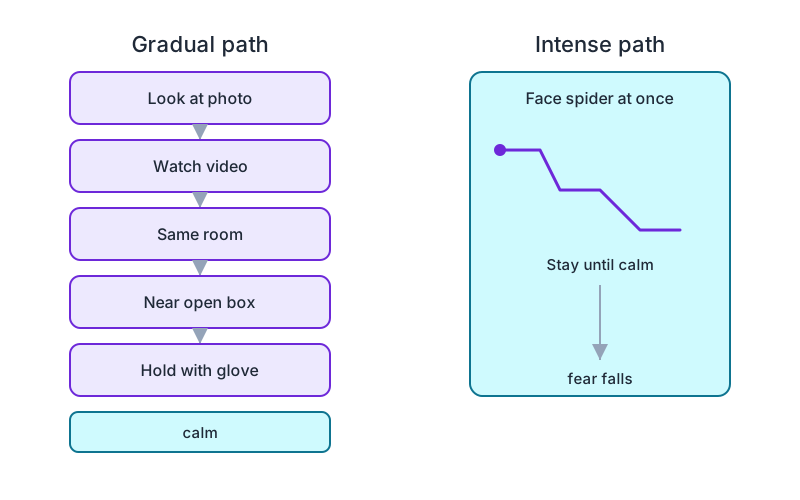
Same fear, two paths
Take a spider fear to see both paths with the same goal.
The systematic desensitization path uses the hierarchy from the prior section. The client practices relaxation first. Then the client meets step 1 while relaxed, signals any anxiety, returns to calm, and repeats until the step stays calm. Only then does step 2 begin. Homework repeats real-life versions between sessions, from pictures toward real contact. The method ends when the agreed goals are met, not always when all fear is gone.
The flooding path skips the ladder. After preparation and consent, the client enters a highly feared real situation, for example a room where a spider is visible in a secure container at close range, and stays with therapist support until anxiety clearly falls. There is no step-by-step order. If the scene is imagined instead of real, textbooks call it implosion rather than flooding.
Virtual reality can serve either path when real contact is hard to arrange. A flight simulation can present graded steps for systematic desensitization or a sustained intense flight scene for flooding-like exposure. Textbooks list VR as an option for public speaking fear, closed spaces, flying, and post-traumatic stress (OpenStax, 2026. Psychology 2e: 16.2 Types of Treatment.).
What the studies found
Direct comparisons began early. Isaac Marks, John Boulougouris, and Pedro Marset ran a crossover trial of flooding versus desensitization in phobic patients (Marks et al., 1971. Flooding versus desensitization in the treatment of phobic patients: a crossover study.). Their published summary surveys the mixed prior work: some snake-phobia studies favored flooding or found it faster, two favored desensitization, and two found no clear difference (Marks et al., 1971. Extract, Cambridge Core.). The trial compared the two approaches directly in phobic patients (Marks et al., 1971. Flooding versus desensitization in the treatment of phobic patients: a crossover study.).
An earlier implosion report shows why flooding drew attention. Three of four phobic patients became almost symptom-free after a mean of 14 sessions and stayed so over six-and-a-half months of follow-up, though the authors said the mechanism was not yet clear (Boulougouris and Marks, 1969. Implosion (Flooding): a new treatment for phobias.). Read that result as a small early case series, not as a success rate for today.
Later work changed the explanation more than the practice. Researchers found that strict relaxation pairing and strict order matter less than once thought. Exposure itself carries much of the effect when contact is prolonged, repeated, and blocks escape. Textbooks now stress that efficacy is best when exposure is graduated, repeated, and prolonged with clear practice tasks (Lumen Learning, 2026. Behavioral Treatments for Anxiety.). Newer models describe inhibitory learning: the client forms a new safety memory that competes with fear, which is why varied practice and violated expectations help. Systematic desensitization remains the gentler entry point, while most current exposure work no longer insists on paired relaxation at every step (Wikipedia, 2026. Systematic desensitization.).
Limits and risks
Both methods suit clear phobic cues that can be ranked or faced, such as animals, heights, enclosed spaces, flying, and injections. Results are weaker when fear has no single cue, as in some social fears, or when the main problem is not learned anxiety. Systematic desensitization has shown little value for conditions such as schizophrenia (Wikipedia, 2026. Systematic desensitization.).
Flooding carries the larger burden. It provokes high anxiety by design, can trigger panic, and has higher dropout risk. Some clients emerge more fearful when a session ends too soon. For that reason, flooding needs informed consent, a trained therapist, and a plan to stay until anxiety falls. If phobias or anxiety limit daily life, talk to a licensed therapist or local mental health service rather than trying intense exposure alone.
Stopping early is the key failure mode for both methods. Leaving at the peak teaches that escape ends fear, which reinforces avoidance (Lumen Learning, 2026. Behavioral Treatments for Anxiety.). Planned return to the prior calm step, or staying with support until the wave passes, is what allows extinction to occur.
How to remember it for exams
Keep the pair as pace plus support. Systematic desensitization equals steps plus calm. Flooding equals top plus stay. Implosion equals top in the mind.
- Systematic desensitization: hierarchy, relaxation, gradual, Wolpe, 1958 book, reciprocal inhibition.
- Flooding: immediate, intense, usually real, attributed to Stampfl, 1967.
- Implosion: imagined flooding, no real contact.
- In vivo means real; in vitro means imagined. Match the term to the setting the question names.
- Common trap: a question that mentions relaxation at every step points to systematic desensitization even when exposure is real. A question that starts near the top of the anxiety scale points to flooding even when the client breathes calmly.
- Common trap: virtual reality is a setting, not a method. Ask whether the VR scene climbs steps or starts at the top.
One useful set to save covers five terms: systematic desensitization, flooding, implosion, reciprocal inhibition, fear hierarchy. Our guide to memorising psychology terminology shows how to turn such a list into flashcards and short mixed quizzes.
Frequently asked questions
Is implosion the same as flooding?
No. Implosion is the imagined form. The client faces the most feared scene in the mind. Flooding is usually real contact with the feared situation. Exams test the setting the question names.
Which method works faster?
Flooding can act faster because it starts at the top and needs fewer graded contacts. Speed comes with higher distress and higher dropout risk. Systematic desensitization is slower and easier to tolerate. Early trials gave mixed winners, so no method claims a general speed prize.
Do you need relaxation for exposure to work?
No. Relaxation helps systematic desensitization stay tolerable, but later work found exposure without strict relaxation pairing also reduces fear. Current practice keeps calm support while focus stays on prolonged contact without escape.
Can flooding treat any anxiety?
No. It suits clear phobic cues that can be faced safely with a therapist. It is a poor fit for problems without a clear cue, for severe conditions beyond anxiety, and for anyone without professional support. A licensed therapist judges fit.
What should an exam answer name first?
Name the pace first, then the support. Ranked steps with relaxation mean systematic desensitization. Starting at the top means flooding, or implosion when the top scene is imagined. One sentence with both parts earns full credit.
Sources
- 1.OpenStax (2026). Psychology 2e: 16.2 Types of Treatment.
- 2.Lumen Learning (2026). Behavioral Treatments for Anxiety.
- 3.Garfield (1980). This Week's Citation Classic: Wolpe J. Psychotherapy by reciprocal inhibition.
- 4.Wolpe (1968). Psychotherapy by reciprocal inhibition.
- 5.Marks et al. (1971). Flooding versus desensitization in the treatment of phobic patients: a crossover study.
- 6.Marks et al. (1971). Extract, Cambridge Core.
- 7.Boulougouris and Marks (1969). Implosion (Flooding): a new treatment for phobias.
- 8.Wikipedia (2026). Systematic desensitization.
- 9.Wikipedia (2025). Flooding (psychology).