
The spotlight effect is the tendency to overestimate how much others notice your actions and appearance. You feel the room saw your mistake, while most of the room saw almost nothing. The first test used an embarrassing T-shirt. Wearers estimated about double the share of observers who could name it, a gap of 23 points.
This article defines the effect in one exam-ready sentence. It shows the study behind the numbers, gives examples that sort any case, and separates the effect from the terms students mix it with. It ends with a study workflow so the term sticks.
What the spotlight effect is
Social judgment means your guess about how others see you. The spotlight effect is an egocentric bias in that guess. You anchor on your own vivid experience and adjust too little for the fact that others are busy running their own show.
The exam-ready sentence is this. The spotlight effect is the overestimation of how much others notice your actions and appearance.
Five experiments support the effect. Thomas Gilovich, Victoria Husted Medvec, and Kenneth Savitsky published them in 2000 in the Journal of Personality and Social Psychology (Gilovich et al. 2000, full text PDF). In Study 1, a student had to wear an embarrassing Barry Manilow T-shirt into a room where other students were working. The wearers estimated that about double the share of observers could name the shirt. The mean gap between estimate and reality was 23 points, with a 95 percent interval from 9 to 38 points.
People who only watched a reenactment on video guessed far lower. The error came from wearing the shirt, not from a general theory about memory. The effect held for flattering shirts in Study 2 and for spoken remarks in a group discussion in Study 3. Your good moments feel more visible than they are, and so do your bad ones.
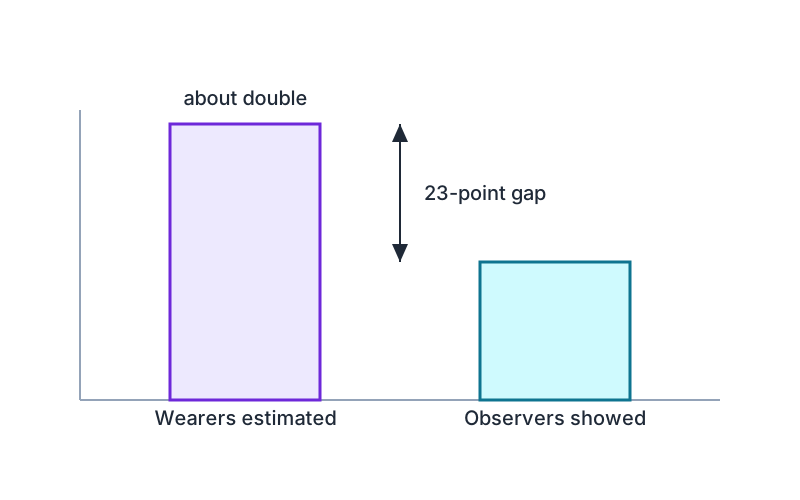
Treat the numbers as study results, not as laws of nature. They describe Cornell students around 2000, recalling a shirt minutes later. The direction of the error is the stable finding. Later work revisited the result and confirmed it (The Decision Lab, sources).
Examples that sort any case
Use two questions on any story. Who feels watched in the story. Who actually noticed, and what did they do next. If the first answer is big and the second is small, expect the effect.
- 1.Ask who feels watched.
- 2.Ask who noticed and what they did next.
A spill at a party shows the split. You spill a drink on your shirt and feel every eye on you for the rest of the night. Weeks later nobody else remembers it. They were tracking their own stains, shirts, and small talk.
A fumbled talk shows the same split. You trip over one sentence and feel the audience will quote it for weeks. The audience noticed a bump and moved on. They grade the whole talk, not your worst ten seconds.
Eating alone shows the prophecy side. You fear strangers will stare, so you skip the solo lunch. In reality almost nobody registers it, and the fear itself creates the avoidance. The belief about attention causes the behavior, not the attention.
Spotlight effect and its two neighbours
Students mix three terms because all three involve misreading other people. Each one overestimates something different.
| Term | What it overestimates | Sort rule |
|---|---|---|
| Spotlight effect | How much others notice you | Ask who noticed and what they did next |
| Illusion of transparency | How well others read your inner states | Ask whether the error is about visible acts or hidden feelings |
| Actor-observer bias | Character as the cause of others, situation as the cause of self | Ask whether the error is about notice or about causes |
If the story is about causes, use the actor-observer bias. If it is about hidden nerves showing through, expect the illusion of transparency. If it is about being seen at all, expect the spotlight effect. The fundamental attribution error sits one step further out: it explains someone else by character while discounting clear pressure.
Why it happens
The tested mechanism is anchoring with weak adjustment. You start from your own rich experience of the moment and then adjust downward for others. The adjustment stops too early. Studies 4 and 5 of the 2000 paper support this reading (Gilovich et al. 2000, full text PDF).
Egocentrism feeds the anchor. You live inside your own view, so you treat yourself as the center of the room. Others do the same from their own seats. Everyone feels lit, and almost nobody is watching (EBSCO research starter).
A second driver is change sensitivity. You know your normal look and manner, so any deviation screams at you. Strangers lack that baseline, so the same deviation barely registers. You compare against your history, they compare against nothing.
Online life may strengthen the habit. Visible counts of views and likes train the feeling that an audience is always present. One recent line of research suggests that feeling carries offline too, though the evidence is still young (The Decision Lab, sources). Read our broader map of cognitive biases to place this one among the rest.
Where the bias grows stronger
The bias runs in both directions but bites harder on mistakes. Good moments feel widely admired, bad moments feel widely mocked, and the bad moments linger longer in your own replay. The paper found the error for flattering shirts and for positive remarks too, so success does not switch it off.
Social anxiety pairs with stronger reports of the effect. The spotlight effect itself is normal cognition, not a mental disorder. People who fear judgment say they feel watched more often and rate their own visible performance lower. The link is an association, not proof that the bias causes the disorder or the reverse. If worry about being watched shapes your weeks, talk to a clinician or counselor rather than self-grading with a bias list.
Group membership can add a layer. One study tested the minority spotlight effect. Minority participants in a race-related discussion felt stared at more, though observers looked at everyone equally. The extra feeling came from the history of being put on the spot, not from extra staring (The Decision Lab, sources). Expect the strongest effect where identity, novelty, and evaluation meet.
How to study this term
Learn it as a triple with its neighbours. Save spotlight effect, actor-observer bias, and self-serving bias as one list, with fundamental attribution error as the fourth card. Drill them as pairs until the table question feels automatic.
Run this loop on any list. First pass: recite each definition aloud from the term alone. Second pass: sort three new examples with the two-question test. Third pass: type each definition from memory. Short repeated sessions beat one long reread for terminology.
Look the term up in the Psychology World dictionary and save it to a list with its three neighbours. Use the list for Flashcard rounds, Question rounds once it holds four or more words, and Typing to test recall.
Frequently asked questions
What is an example of the spotlight effect in plain words
You spill coffee on your shirt at a gathering and feel everyone tracked it all evening. A month later nobody remembers the stain. You estimated a room-wide audience, the room gave you a glance.
What is the difference between the spotlight effect and the illusion of transparency
The spotlight effect is about visible acts: you overestimate who noticed what you did. The illusion of transparency is about hidden states: you overestimate who can tell what you feel. One asks who saw it, the other asks who read your mind.
What is the difference between the spotlight effect and the actor-observer bias
The spotlight effect is about notice: you think more people saw your act than did. The actor-observer bias is about causes: you explain your own act by the situation and someone else act by character. Use the two-question test for notice, and the role question for causes.
Does knowing about the spotlight effect remove it
Often it does not, at least not fully. People who learn the finding still anchor on their own experience first. Knowing it helps you distrust the first estimate and check the second question: who actually noticed, and what did they do next.
How do you reduce the spotlight effect
Reverse the roles and rerun the scene from the audience seat. Ask how much you remember of other people small stumbles from last month. Your weak memory of them is their weak memory of you. For repeated worry, a thought-record worksheet that lists evidence for and against the feared judgment can help, ideally with a professional.
Sources
- 1.Gilovich, T., Medvec, V. H., and Savitsky, K. (2000). The spotlight effect in social judgment (full text PDF). Journal of Personality and Social Psychology, 78(2), 211-222.
- 2.EBSCO (2018). Spotlight effect: Research Starter.
- 3.The Decision Lab. Why do we feel like we stand out more than we really do (with sources).