
The actor-observer bias is the tendency to explain your own act by the situation and to explain someone else act by character. You miss a start and cite traffic, a colleague misses the same start and you cite reliability. This article defines the bias in one exam-ready sentence. It shows the examples that sort any case and separates the bias from the two terms students mix it with.
What the actor-observer bias is
Attribution means the cause you assign to behavior. Internal attribution points to character, ability, effort, or traits. External attribution points to luck, task pressure, rules, or other people.
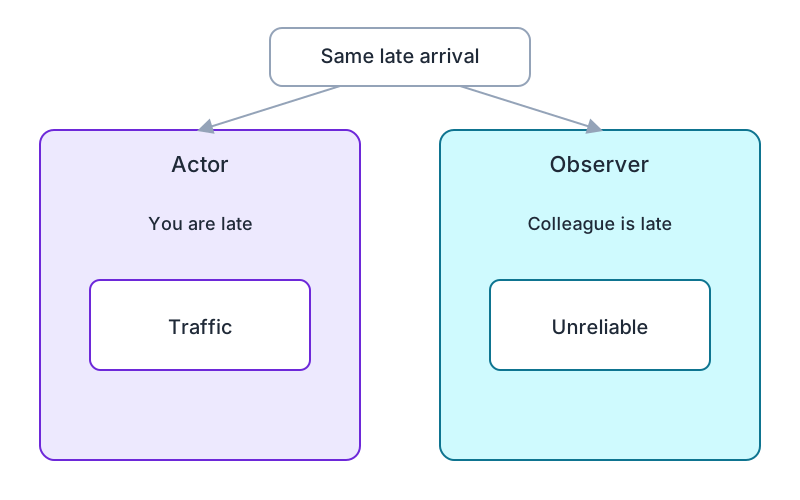
The actor-observer bias is a role split. When you act, you cite the situation. When you watch, you cite character. The same late arrival gets two causes. The actor says the bus failed, the observer says the person fails.
Austrian psychologist Fritz Heider gave the base terms in 1958. Internal causes sit in the person, external causes sit in the world. United States psychologists Edward Jones and Richard Nisbett stated the role hypothesis in 1971. They wrote that actors tend to cite stimuli in the situation. Observers tend to cite stable dispositions of the actor. The APA Dictionary of Psychology defines the effect in the same way and dates the introduction to 1971.
The late-meeting case shows the rule in clean form. Two people miss the same start by ten minutes. The actor lists road works, a late train, and a moved room. The observer lists poor planning and low care. Both stories fit the same delay. The role decides the cause.
Examples that sort any case
Use two questions on any story. Who acts in the story, you or someone else. What cause does the explanation use, situation or character. The actor-observer bias acts on role, not on win or loss.
- 1.Ask who performs the act.
- 2.Ask whether the explanation cites the world or the person.
If the story explains your own act by pressure, expect the bias. If it explains someone else act by traits, expect the bias. If it explains your own win by talent and your own loss by luck, use the neighbour in the next section instead.
Late arrival shows the same split in one line. You arrive late and cite traffic, your colleague arrives late and you cite reliability. The delay matches, the cause follows role.
Grades show the split. You fail a test and cite hard items and noise in the hall. Your classmate fails the same test and you cite weak study and low care. The score matches, the cause changes with role.
Driving shows the same split. You cut a corner and cite a blind bend and rain. Another driver cuts the same corner and you cite skill and care. The move matches, the cause changes with role.
Work shows the same split at scale. You miss a deadline and cite load and shifting specs. Your teammate misses the same deadline and you cite drive and focus. A survey of self-serving bias codes the same work stories by outcome instead, which helps you see the difference between role and valence.
Study choice shows the classic lab form. Jones and Nisbett cite student surveys on choice of major and dating partner. Subjects explained their own choices by properties of the major or the partner. They explained their best friends choices by traits of the friend. The choice type matches, the cause changes with role. EBSCO summarises the same surveys in its 2020 research starter.
Actor-observer bias and its two neighbours
Students lose marks by swapping three terms. The table gives the sorting rule. The text below explains each row.
| Term | Whose act | What decides the cause | Exam question |
|---|---|---|---|
| Actor-observer bias | You vs someone else | Whether you act or watch | Are you the actor or the observer |
| Fundamental attribution error | Someone else act | You discount their context | Is it about them or their context |
| Self-serving bias | Your own outcome | Good or bad outcome for you | Did you win or lose |
The fundamental attribution error explains other people by character and discounts context. Ross named it in 1977. Jones and Harris showed the core effect in 1967 with assigned essays. Readers rated the writer belief from the essay even when the professor assigned the side. The error concerns trait inference from behavior, even with clear pressure. The actor-observer bias concerns explanation of behavior by role. Malle makes the same split in his 2006 review. Textbooks often merge the two, which causes the confusion. A related survey of ten cognitive biases, told apart places these terms in the wider set.
The self-serving bias adds outcome valence for the self. A good outcome for you gets an internal cause. A bad outcome for you gets an external cause. Success feels earned, failure feels situational. It does not ask who acted, it asks how the outcome felt for you. The live guide on self-serving bias shows wins and losses with sport and grade data. The actor-observer split follows role for any valence in classic form. Later work shows valence moderates it, which the studies section explains.
For study, learn the three against each other. Pairs stick better than single definitions, as the guide on how to memorise psychology terminology so it actually sticks explains.
Why it happens
Three causes work together. One is perspective, one is information, one is speed.
Perspective decides what stands out. When you watch someone, the person fills your view. The context fades. You cite traits. When you act, you face the world. Deadlines, noise, and other people fill your view. You cite pressure. Taylor and Fiske showed the effect in 1975. Directly observed people drew personal causes, background people drew fewer. Storms showed the reverse in 1973. Subjects who watched their own talk on videotape cited character more, like observers. The camera moved the view, the cause moved with it.
Information adds a second push. You hold a long record of your own acts. You recall the days you arrived on time, studied hard, and drove with care. You see variation across settings. You cite the setting that changed. You hold a short record of others. You recall one late arrival, one error, one miss. You see a fixed trait. You cite the person. The construct links closely to locus of control. People with an external locus feel luck and others decide outcomes, and they favor situational claims for self.
Speed adds the third push. Personal causes come first to mind, without effort, even from thin acts. Situational causes need work. You must list pressures, weigh each one, and adjust the first call. Adjustment needs time and care. Tired, distracted, or busy judges adjust less and keep the trait call. Gilbert, Trope, and Geeraert groups report the same direction in work from 1989 to 2004, as summarised in open textbooks.
Culture tunes the size. Miller asked children and adults in India and the United States to explain negative acts by others in 1984. Younger children matched. Older children and adults split. United States respondents used personal causes more, Indian respondents used situational causes more for the same act. Collectivist samples show the same moderation across later work. The bias shrinks, it does not flip.
What the studies show, and what stays disputed
The core rule rests on early lab work. Nisbett and colleagues asked college students to complete twenty trait pairs in 1973. Each pair forced a choice between two traits or depends on the situation. Students chose trait terms for self 11.92 times and depends on the situation 8.08 times. They chose trait terms for best friend 14.21 times and situation 5.79 times. They chose trait terms for father 13.42 times and situation 6.58 times. They chose trait terms for newsreader Walter Cronkite 15.08 times and situation 4.92 times. The self drew the most situational answers, the distant public figure drew the most trait answers. Both open textbooks report the same table.
The videotape study gave the perspective claim its best support. Storms placed pairs in a getting-acquainted talk in 1973 and then replayed the talk from the other chair. Actors who saw self on screen cited character more. Observers who saw the scene from the actor chair cited situation more. The split followed the camera, not the person. Later summaries treat this as direction evidence only, without exact sizes.
The meta-analysis changed the status of the rule. Malle pooled 113 articles with 173 studies and 14,686 participants from 1971 to 2004 and published the result in Psychological Bulletin in 2006. Mean effects ran from d equals minus 0.016 to d equals 0.095 across internal, external, and difference scores. The classic asymmetry as first stated sat near zero. Under standard conditions with real events and no valence filter, means fell to about minus 0.093 to 0.007. Sixty-eight studies sat at or below zero, ninety-seven failed to reach a small effect at d equals 0.20.
Four conditions kept a clear split. The actor acted in a highly odd way, or the event was hypothetical. Actor and observer knew each other well, or free text coding scored the answers. Valence split the result. Negative events kept an actor-observer split at about d equals 0.24. Positive events reversed it at about d equals minus 0.16. Across valence, the adjusted mean sat near zero at about d equals 0.04 in random models and minus 0.02 in fixed models. Malle reads this as a self-serving pattern laid over role, not as a general role law. PubMed holds the same abstract under PMID 17073526.
The reformulation keeps a smaller claim. Malle and colleagues argue in work from 1999 to 2007 that the old internal versus external split fits intentional acts poorly. People explain intentional acts with reasons or with background causes of reasons. Reasons cite beliefs and desires. Background causes cite culture, traits, or pressures that shaped the reasons. Across studies, actors gave more reason explanations than observers, more belief reasons than desire reasons, and fewer explicit mental-state markers for belief reasons. The Journal of Personality and Social Psychology paper in 2007 reports the pattern in volume 93, pages 491 to 514. Treat this as direction, not as fixed numbers for exams.
For an exam answer, state the rule with one self and one other example. Cite the 1973 table means and the 2006 pool with its dates, and name one moderator with direction. That shows knowledge plus judgment. Do not state the bias as a law. State it as a lens that labs support in parts and dispute as a whole.
How to study this term
Learn it as a triple with its neighbours. Save actor-observer bias, self-serving bias, and fundamental attribution error as one list. Drill them as pairs until the table question feels automatic. The style in self-serving bias makes a fourth card for contrast with locus wording.
Turn any list into quick games for active recall. Short repeated sessions beat one long reread for terminology.
Look terms up in the Apa dictionary and save them to an exam list. Use the list for flashcards, multiple choice once it holds four or more words, and typing to test recall.
Frequently asked questions
What is an example of the actor-observer bias in plain words
You miss a bus and cite a late train and a moved stop. Your friend misses the same bus and you cite poor planning. The delay matches, the cause follows role.
What is the difference between the actor-observer bias and the fundamental attribution error
The actor-observer split follows role, self by situation and others by character. The fundamental attribution error explains someone else by character while discounting clear pressure. One asks who acts, the other asks trait or context for others.
Are self-serving bias and actor-observer bias the same
No. The actor-observer split follows role for any outcome. The self-serving split follows outcome valence for you, inward for wins and outward for losses. Negative events strengthen the role split, positive events reverse it.
Does the actor-observer bias always replicate
No. A 2006 meta-analysis of 173 studies from 1971 to 2004 found mean effects near zero. The split held for odd actors, hypothetical events, close pairs, free text answers, and negative events. State it as a useful lens, not as a law.
How do you reduce the actor-observer bias
Slow down and list pressures before you judge. Replay the scene from the actor chair. Ask what you would cite for your own same act. None of these removes the split fully, each one weakens it.
Sources
- 1.Malle, B. F. (2006). The actor-observer asymmetry in attribution: A (surprising) meta-analysis. Psychological Bulletin, 132(6), 895-919.
- 2.Malle, B. F. (2006). The actor-observer asymmetry in attribution (full text PDF). Brown University.
- 3.Principles of Social Psychology, LibreTexts 6.2: Inferring Dispositions Using Causal Attribution.
- 4.Principles of Social Psychology, BCcampus 5.3: Biases in Attribution.
- 5.EBSCO (2020). Actor-observer bias: Research Starter.
- 6.APA Dictionary of Psychology. Actor-observer effect.
- 7.Wikipedia. Actor-observer asymmetry (bibliography and reformulation summary).