
The Sapir-Whorf hypothesis says that the language you speak shapes how you think and see the world. In its strong form it says language fully determines thought, and researchers reject that version. In its weak form it says grammar and vocabulary nudge perception, attention and memory, and that version has real but narrow experimental support.
One more surprise comes first. Edward Sapir and Benjamin Lee Whorf never stated their ideas as a hypothesis. A student of Sapir, Harry Hoijer, coined the term, and later researchers split the idea into strong and weak versions. So the name is a label added after the fact, not a claim its authors signed.
This article sorts the versions and shows the best evidence for each. It corrects the two famous examples that fell apart. It ends with a short test for telling strong claims from weak ones.
- The hypothesis claims language shapes thought; the strong version claims it determines thought.
- Sapir and Whorf never wrote a hypothesis; the name and the strong-weak split came later.
- The strong version fails against cross-cultural colour studies and developmental evidence.
- The weak version has support in colour memory, time metaphors and spatial frames.
- Colour categories bias memory most when perception is uncertain.
- The snow-words story and the Hopi-time claim did not survive later checks.
What the Sapir-Whorf hypothesis claims
At its core, the claim is simple. Speakers of different languages carve up reality with different words and grammar, so they may perceive and remember the world in different ways. Linguistic relativity is the name for this influence. Linguistic determinism is the stronger claim that language fixes the limits of thought.
Whorf put the intuition in a famous passage. He wrote that we dissect nature along lines laid down by our native language. Observers reach the same picture of the universe only when their linguistic backgrounds match or can be calibrated. That image guides the whole debate.
Later researchers split the idea into three testable tiers, following Miller and McNeill (1969). The strong tier says language fully determines thought. The weak tier says language biases perception and attention. The weakest tier says language affects memory alone, because ideas that are easy to describe are easier to recall. Almost all supporting research concerns the two weaker tiers.
Strong vs weak: the three versions
| Version | Claim | What it predicts | Status |
|---|---|---|---|
| Strong (determinism) | Language fully determines thought | Untranslatable ideas; speakers of different languages cannot share concepts | Rejected; contemporary linguists do not accept it |
| Weak (relativity) | Language biases perception and attention | Small, domain-specific effects such as faster shade discrimination across native colour boundaries | Supported in narrow domains with small effects |
| Weakest (memory) | Language aids recall | Easy-to-name ideas are remembered better | Supported; naming helps memory under uncertainty |
The table matters because most confusion about this topic comes from mixing the rows. A study that supports the weak version says nothing for the strong one. Keep the rows apart and the debate becomes clear.
Where the idea came from
The roots run older than Sapir and Whorf. In the 1800s, thinkers such as Wilhelm von Humboldt treated language as the fabric of thought, and each grammar as a different view of the world. Franz Boas then argued that every language can express the same content by different means, pushing back against claims that some languages were primitive.
Sapir wrote in 1929 that speakers of different languages live in distinct worlds, not the same world with different labels. Whorf, his student, studied Native American languages through the 1930s and argued that grammatical habits shape habitual thought. His fire-inspector anecdote is famous. While inspecting a plant, he saw workers smoke near gasoline drums marked empty, though vapour still filled them, and he concluded the word empty made the drums feel harmless.
Whorf died in 1941 with most of his papers unpublished. Hoijer then introduced the term Sapir-Whorf hypothesis. In 1953 and 1954, Roger Brown and Eric Lenneberg reformulated the idea as a testable claim about colour perception, which set up decades of experiments.
The colour evidence
Colour is where the weak version has its best evidence. Languages divide the spectrum differently, and those divisions leave traces in memory and speed.
Russian helps the point. The language requires separate basic words for dark blue and light blue, and Russian speakers tell shades apart faster across that boundary than English speakers do. The boundary acts like a line that speeds sorting.
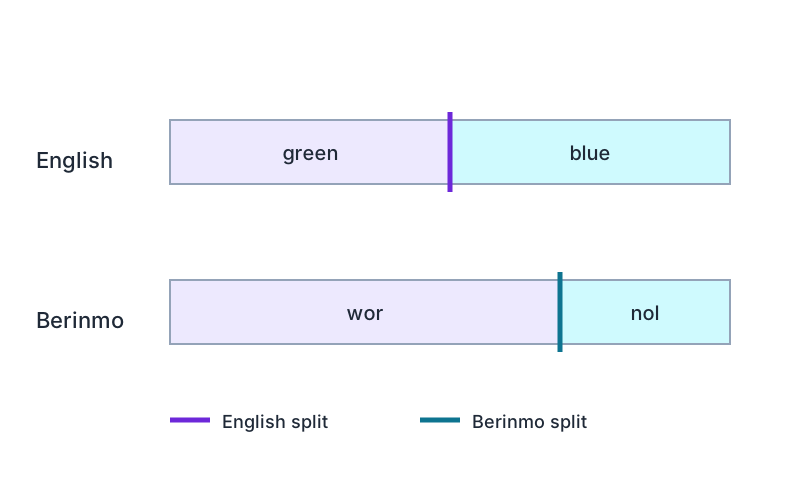
In Roberson's studies, Berinmo and Himba show the mirror image. Berinmo divides the spectrum into wor and nol, Himba into dumbu and burou, and speakers of each language discriminate best across their own boundaries. English speakers show the advantage at the English green-blue boundary instead. The pattern follows the native language in each group.
A 2016 model explains when these effects appear. Cibelli and colleagues tested colour memory in English speakers and compared models with and without English category information. The model with both green and blue categories fit best, and the bias grew stronger after a memory delay. Their conclusion: native-language models fit discrimination data better than other-language models. In plain terms, categories pull memory toward their prototypes, and the pull grows as certainty falls.
Two recent studies sharpen the timing. Maier and Abdel Rahman (2018) compared 28 Greek speakers with 29 German speakers. Greek treats light and dark blue as separate colours, and Greek speakers noticed a blue target more often, with the advantage visible in early brain signals linked to conscious awareness. Forder and Lupyan (2019) found that hearing a colour word just before a matching task improved accuracy, while seeing a preview of the colour did not. A label briefly tunes what the eye reports.
The counterweight belongs in the same section. Berlin and Kay (1969) collected colour naming data from speakers of 98 languages. They found a fixed hierarchy in which colour terms appear. That points to shared biology beneath the differences. The weak claim survives this finding; the strong one does not.
Time and space: what else the weak version predicts
Time talk differs by language, and behaviour follows it. English speakers use horizontal metaphors such as running behind schedule. Mandarin speakers often sequence time vertically, with earlier events up and later events down, and they process vertical time displays faster. Greek speakers use amount metaphors where English uses distance metaphors, and each group is biased by its own metaphor when judging durations.
Space shows a sharper case. Speakers of Guugu Yimithirr, an Australian Aboriginal language, lack relative words such as left and right and use absolute cardinal directions instead. They track compass direction constantly, even after turning around, a skill relative-frame speakers find almost impossible. Their grammar demands constant orientation, so they maintain it.
Grammar also forces attention in smaller ways. In Navaho, handling verbs change with the shape of the object, so young speakers attend to shape earlier than English-speaking children do. Languages that drop pronouns correlate with collectivist values, while languages that require them correlate with individualism. Each finding is consistent with the weak version, and each needs the hedge that culture and environment may share the credit.
Two famous examples that fell apart
Two stories carried the hypothesis into textbooks, and neither survived checking. They are worth knowing because courses still repeat them.
The snow-words story claimed Arctic peoples have dozens of words for snow, forcing a different perception of winter. Linguist Laura Martin traced the claim in 1986. She found about two root words, one for falling snow and one for snow on the ground. Polysynthesis expands them into many surface forms. English does the same with sleet, slush and powder. The count was inflated with each retelling.
The Hopi-time story claimed the Hopi language has no countable time units, giving its speakers a different view of time itself. Ekkehart Malotki later reported that he had found no evidence of Whorf's claims in 1980s Hopi speech or in historical documents going back to the arrival of Europeans. Later scholars still debate the details, but the strong reading of the claim is gone.
Why the strong version failed
Colour universals are the first problem for determinism. Eleanor Rosch tested Dani speakers in New Guinea in 1972. The Dani use only two colour terms, yet they discriminated and remembered focal colours as accurately as English speakers. If language set the limits of vision, that result could not happen.
Thought before language is the second problem. Jean Piaget showed that infants grasp object permanence before they can name it, which means cognitive structures form first and words map onto them later. Daniel Everett reported in 2005 that Piraha speakers reason about space and number without number words, colour words or recursion in their language. Linguists debate his reading of the data. Thought runs without the words determinism says it needs.
The third problem is logic. Jerry Fodor proposed that reasoning runs in an innate mental code, sometimes called mentalese, and speech merely translates it for communication. If translation between languages works at all, the underlying thought must be shareable. The strong version leaves no room for that fact.
So the verdict stands. The strong hypothesis has fallen out of acceptance, while a weak, domain-specific influence on attention, memory and processing speed is well supported.
How to tell the versions apart
Use this short test on any Sapir-Whorf claim you meet, in class or online. It takes less than a minute.
- 1.Check the verb. Determines or limits means someone claims the strong version. Influences, biases or nudges means the weak one.
- 2.Check the translation claim. Impossible to translate means strong. Lossy or approximate translation means weak.
- 3.Check the evidence type. Memory tested after a delay, under noise or from vague displays points to the weak category-adjustment account. Instant perception with full information rarely shows language effects.
- 4.Check the scope. One domain such as colour or time points to weak, domain-specific influence. All thought at once points to determinism, which the evidence rejects.
If a source mixes the rows, sort it with these steps before you quote it.
Keeping the terms apart
Four neighbour terms cause most of the mix-ups. Linguistic relativity is the influence claim. Linguistic determinism is the determines claim. Whorfianism is a loose label for the whole debate. The Sapir-Whorf hypothesis is the historical name for all of it.
These are exactly the terms students confuse under time pressure. In Psychology World you can save them to one list. Drill the list as flashcards, as multiple-choice questions once it holds four or more words, or by typing the answer out.
What each study mode does is on the home page. For the methods with the best evidence, read our guide to memorising psychology terminology. Related reading on how words carry meaning explains the units the hypothesis talks about. Our list of terms that do not translate cleanly into German shows the translation problem in action.
Frequently asked questions
What is the Sapir-Whorf hypothesis in simple terms?
It is the idea that the language you speak shapes how you think. The weak version says it nudges perception and memory in small ways. The strong version says it sets the limits of thought, and researchers reject that version.
Has the Sapir-Whorf hypothesis been disproven?
The strong version has failed against the evidence, from Dani colour vision to infant cognition. The weak version has not been disproven. Colour, time and space studies support small, domain-specific effects.
What is a clear example of linguistic relativity?
Russian speakers tell dark blue from light blue faster than English speakers do, because Russian treats them as separate basic colours. The effect is small and specific, which is typical of the supported weak version.
What is the difference between the strong and weak versions?
The strong version says language determines thought and translation is impossible. The weak version says language influences attention and memory while full understanding stays possible. Only the weak version matches the evidence.
Does speaking two languages change how you think?
Bilinguals show small processing differences tied to each language, such as faster responses under matching time metaphors. Nothing in the evidence suggests they live in different mental worlds. Expect biases at the margins, not separate realities.