
Positive vs negative reinforcement is a difference in operation, not in value. Both make a later behavior more likely. Positive reinforcement adds a stimulus after the behavior. Negative reinforcement removes or avoids an unpleasant stimulus after the behavior.
- Both positive and negative reinforcement increase behavior. Punishment does the opposite job and decreases behavior.
- Positive means added. Negative means removed. Neither word means good or bad.
- A stimulus counts as a reinforcer only when the behavior rises after it. A reward that changes nothing is not a reinforcer.
- Escape stops an unpleasant stimulus that is present. Avoidance prevents one that has not started yet.
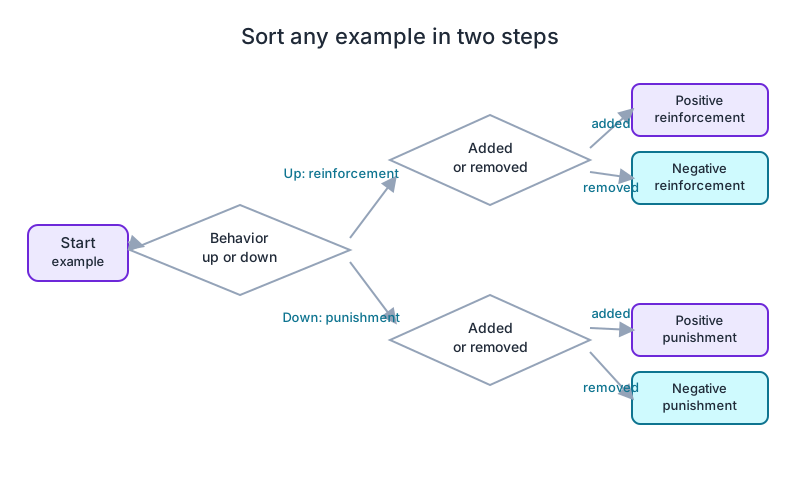
- Two questions sort any example: did the behavior go up or down, and was something added or removed.
The terms belong to operant conditioning, where behavior is shaped by its consequences. The confusion is old. In ordinary speech negative means bad, so negative reinforcement sounds like punishment. In behavior analysis it is the opposite: it strengthens behavior by ending discomfort.
What positive reinforcement adds
Positive reinforcement adds a stimulus after a behavior and the behavior becomes more frequent. The added stimulus is often pleasant, such as praise, a toy, money, or a bonus. What matters is the effect, not the intent. If on-task work rises after behavior-specific praise, the praise worked as a reinforcer. If it does not rise, it did not.
The open textbook used in many introductory courses defines it in one line: a desirable stimulus is added to increase a behavior. Its examples are concrete. A parent tells five-year-old Jerome that cleaning his room earns a toy, and Jerome cleans fast. Second-grade pupils in Dallas read more when each book plus a short quiz earned two dollars. The result was higher reading comprehension. B. F. Skinner, who built the theory in the 1930s, even built a teaching machine that let pupils continue only after correct answers gave immediate reinforcement.
Reinforcers differ in how they gain power. A primary reinforcer works without prior learning because it meets a biological need, such as food, water, sleep, shelter, or touch. A secondary reinforcer starts neutral and gains power through pairing, such as praise, grades, money, stickers, or tokens. Money shows the point well. On a remote island with nothing to buy, stacks of bills do nothing. In a classroom token system, points work because they trade for playtime or privileges. One ward study gave quiet-hands tokens only for target self-care acts, then gave them regardless of behavior, then made them contingent again. Target acts rose, fell, and rose with the contingency.
Positive reinforcement also builds new behavior in small steps through shaping. A pigeon earns food first for turning toward a lever, then for approaching it, then only for pressing it. The same logic underlies modern clicker training. Timing matters. The reinforcer should follow fast, and it should matter to that learner at that time. A full animal ignores food. A pupil who does not value stickers ignores stickers.
One boundary is worth keeping. A salient expected reward for an already enjoyed task can lower later free-choice interest, while surprise rewards and praise for meeting a standard do not. The practical fix is simple: target a specific behavior or standard, prefer praise, and rotate tangible rewards before satiation sets in.
What negative reinforcement removes
Negative reinforcement removes or avoids an unpleasant stimulus after a behavior and the behavior becomes more frequent. The word negative names subtraction. It does not mean harmful or punitive.
The chain has three links. An unpleasant stimulus is present. The learner acts. The act ends or prevents the stimulus, and relief follows. In a Skinner box, shock runs through the floor, the rat presses a lever, the shock stops, and lever pressing rises when shock returns. In daily life, rain starts, you open an umbrella, getting wet stops, and umbrella use rises. A phone pings through work, you switch on Do Not Disturb, interruptions stop, and silencing rises. A dog feels leash tension, steps closer, tension releases, and close walking rises.
Escape and avoidance differ in timing.
| Form | When the act works | Exam example |
|---|---|---|
| Escape | stops an unpleasant stimulus that has started | switch off a blaring alarm; press a lever to stop shock; take a painkiller as a headache eases |
| Avoidance | prevents an unpleasant stimulus before it starts | fasten a seatbelt before the chime; file a Friday report so a Monday meeting is cancelled; carry an umbrella before rain |
Avoidance lasts. Dogs in a shuttle box learned to jump a barrier during a warning signal to avoid shock, then kept jumping hundreds of times after shock was switched off. They moved so fast that they never stayed to learn that shock was gone. The same persistence appears in human avoidance, from cafeteria noise to social fear, which is why avoidance alone rarely teaches a new skill. Lasting change often pairs relief with a positive reinforcer for the replacement act.
How long either form lasts depends on pattern more than on valence. Behaviors reinforced each time rise fast and fade fast when reinforcement stops. Behaviors reinforced at times rise slower and persist longer, which is the partial-reinforcement persistence effect. The classic schedules work is Ferster and Skinner from 1957. Recent summaries of that work show continuous schedules suit new responses while partial schedules resist extinction. The course link above gives the full table under schedules of reinforcement. The claim that one valence always outlasts the other is not supported. Check the schedule before you predict persistence.
The four quadrants in one table
Reinforcement and punishment combine with added and removed to give four cells. The table below is the whole system. Hold it in mind and most exam items reduce to lookup.
| Reinforcement: behavior rises | Punishment: behavior falls | |
|---|---|---|
| Positive: stimulus added | praise after tidying raises tidying; bonus after fast work raises fast work | scolding after texting lowers texting; extra chores after hitting lowers hitting |
| Negative: stimulus removed | chime stops after buckling raises buckling; nagging stops after homework raises homework | toy removed after misbehavior lowers misbehavior; playtime removed after pushing lowers pushing |
Time-out shows how the test beats intent. Remove Sophia from desirable block play after she throws blocks and throwing falls: that is negative punishment, removal of a pleasant stimulus to decrease behavior. Remove a child from an aversive math worksheet and misbehavior rises because escape worked: that is negative reinforcement, even when the adult meant it as punishment. Define by effect. A consequence that raises frequency is reinforcement. One that lowers it is punishment.
The wording has a history that explains the mix-up. Skinner changed his own definition, and analysts have debated since the 1970s whether the positive and negative split is still needed at the edges, for cases such as a heat lamp that both produces warmth and reduces cold. Exams still test the split, and for most classroom items the added-or-removed fact is stated. The full history is laid out under negative reinforcement vs punishment.
Two questions that sort any example
Use these two steps in order on every item. Write one sentence for each step before you choose.
- 1.Ask whether the later behavior went up or down. Up means reinforcement. Down means punishment. Ignore whether the consequence looked nice.
- 2.Ask whether something was added or removed after the behavior. Added means positive. Removed means negative. Combine the two answers.
The table below works four common items through the same steps.
| Example | Step 1: behavior | Step 2: operation | Answer |
|---|---|---|---|
| Child tidies, parent praises and adds 15 minutes of game time, tidying rises | up, so reinforcement | added, so positive | positive reinforcement |
| Driver buckles, chime stops, prompt buckling rises | up, so reinforcement | removed, so negative | negative reinforcement |
| Pupil texts, teacher scolds, texting falls | down, so punishment | added, so positive | positive punishment |
| Child pushes on playground, play removed for five minutes, pushing falls | down, so punishment | removed, so negative | negative punishment |
Three checks catch the usual traps. First, relief is not always negative reinforcement. If headache eased after a pill and pill taking rises, that is negative reinforcement. If a candy bar followed smoking and smoking rises, that is positive reinforcement doing the same job through an added stimulus. Second, avoidance counts even when nothing bad happens on that trial. Buckling before the chime still counts because it prevents the stimulus. Third, test the reinforcer. If praise leaves output flat, praise is not the reinforcer for that pupil on that task. Change the consequence or the contingency.
Pairs like this stick when you drill them against each other rather than one at a time, which is much easier to hold apart when you learn the members against each other instead of reading separate definitions.
Frequently asked questions
What is the difference between positive and negative reinforcement?
Both raise later behavior. Positive reinforcement adds a stimulus after the behavior, such as praise or a bonus. Negative reinforcement removes or avoids an unpleasant stimulus after the behavior, such as a chime that stops or anxiety that drops after a study plan starts.
What is an example of negative reinforcement?
Fastening a seatbelt to stop a chime is a standard example. The chime is unpleasant, buckling removes it, and prompt buckling rises. Taking a painkiller as a headache eases and switching off an alarm work the same way.
What best describes the difference between the two?
Added versus removed. Positive adds something to raise behavior. Negative takes something unpleasant away, or prevents it, to raise behavior. Direction of behavior change is the same. Operation is opposite.
Is negative reinforcement the same as punishment?
No. Negative reinforcement raises behavior by removing something unpleasant. Punishment lowers behavior by adding something unpleasant or removing something pleasant. If frequency rises it cannot be punishment, whatever the intent was.
Do people with ADHD work better with negative or positive reinforcement?
No single type fits all learners. What works depends on whether the consequence actually raises that behavior for that person at that time, how fast it follows, and how the schedule thins. Behavior-specific praise and fast, contingent consequences help most pupils hold attention, and plans should be set with a teacher or clinician, not from a general rule.
Which is more effective in the classroom?
Both can work, and teachers favor positive reinforcement first because it builds the replacement without fear or resentment. Token systems show large classroom effects when tokens stay contingent, specific, and trade for valued outcomes, while nagging removed after work can quietly reinforce avoidance if misused.
Sources
- 1.OpenStax and Lumen Learning. General Psychology: Reinforcement and Punishment.
- 2.Sidman, M. (2006). The distinction between positive and negative reinforcement: Some additional considerations. The Behavior Analyst, 29(1), 135-139.
- 3.Nickerson, C. (2026). Positive reinforcement: What is it and how does it work. Simply Psychology.
- 4.Nickerson, C. (2026). Negative reinforcement. Simply Psychology.
- 5.Lim, A. G. (2026). Schedules of reinforcement. Simply Psychology.