
Misattribution of arousal means you credit a feeling to the wrong source. Your body reacts to one thing, and your mind blames another. On a scary bridge, a racing heart can feel like attraction to the person next to you.
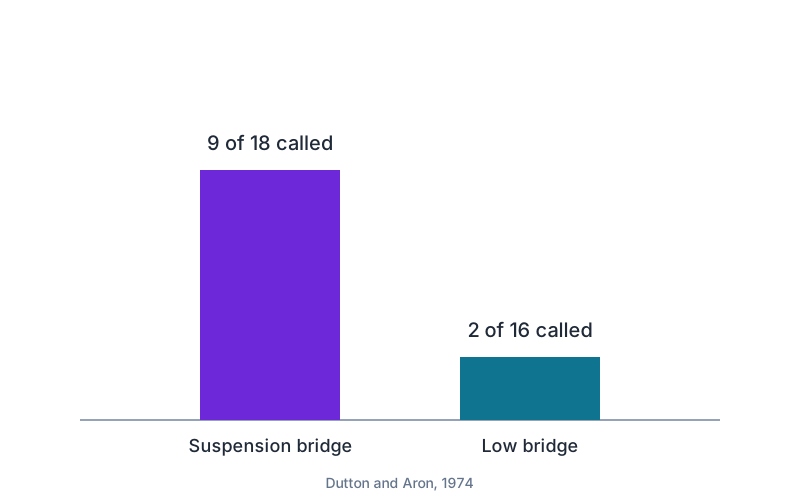
In 1974, two researchers tested this idea on real bridges. Men who crossed a high, swaying bridge called a woman interviewer back far more often than men who crossed a low, stable one. The split, among the men who took her number, was 9 of 18 against 2 of 16. The study was small and had real flaws, and later labs often failed to repeat its result.
This article gives the definition, the bridge study with its numbers, the earlier adrenaline study behind it, and the narrower claim that survived testing. It ends with a one-question test that sorts any example.
- Arousal means body activation: a fast heart, fast breath, and sweat. It fits fear, anger, excitement, and attraction alike.
- Misattribution happens when the true source stays unclear and a person nearby gets the credit.
- The bridge study found more callbacks after the scary bridge, but nobody measured heart rates and the men chose their own bridge.
- Arousal can raise liking for an attractive person and lower it for an unattractive one.
- Leftover arousal from one event can intensify a feeling about the next thing. It does not create the feeling from nothing.
What misattribution of arousal is
Misattribution of arousal is the process where people mistake what causes their felt arousal. Fear, exercise, caffeine, and attraction all raise the heart rate and quicken breath. The body signals look alike, so the mind must guess their cause from the situation. When the guess points at the wrong source, the label on the feeling is wrong too.
The key word is arousal in the narrow sense: activation of the body, not sexual arousal on its own. A pounding heart on a high bridge carries little information by itself. Next to an interviewer who asks for your number, it can read as interest. Next to a rival, the same pounding heart can read as anger.
Psychologists link the idea to a simple rule. An emotion needs two parts: a stirred-up body and an explanation for the stir. The explanation comes from context, and context can mislead. That rule is the core of the two-factor account of emotion, and misattribution is what the rule predicts when the explanation points at the wrong thing.
The bridge study, with the numbers
Donald Dutton and Arthur Aron ran the famous test in 1974 near the Capilano River in North Vancouver. They used two bridges. One was a 450-foot suspension bridge that swayed about 230 feet above the river. The other was a solid wooden bridge about 10 feet above a small stream. Each bridge was crossed by men aged 18 to 35, with no female companion.
An attractive female interviewer stopped each man in turn. She asked him to write a short story about an ambiguous picture, chosen to carry no sexual content. Then she gave him her phone number in case he had questions about the project. The interviewer did not know the hypothesis behind the study.
The men on the scary bridge wrote stories with more sexual imagery. Their stories scored 2.47 on a 1-to-5 scale, against 1.41 on the low bridge. They also called back more often. Of the men who took the number, 9 of 18 called after the suspension bridge, compared with 2 of 16 after the low bridge. With a male interviewer running the same script, the two bridges looked the same, which rules out the idea that the bridge alone made men more talkative.
Two caveats matter, and honest summaries state them. Nobody measured the heart rates of the men, so the fear level on each bridge is assumed, not shown. The men were not assigned to a bridge at random, so thrill-seekers may have chosen the swaying bridge and calmer men the low one. The racing heart itself is the standard fight-or-flight surge: adrenaline, fast pulse, and fast breath preparing the body for action, described in how the body answers threat.
The adrenaline study behind it
The bridge study grew out of an older lab study. In 1962, Stanley Schachter and Jerome Singer injected male students with epinephrine or a saline placebo. They told the students the shot tested vision, under the cover name Suproxin. Some learned the true side effects: pounding heart and shaky hands. Some learned nothing. Some learned wrong effects, such as headache.
Each student then waited in a room with an actor who behaved either playfully or angrily. The prediction was simple. Students with no correct explanation for their racing heart would borrow the mood of the room. Students who knew the shot caused it would stay unaffected.
The results pointed that way, but weakly. On self-reported mood, the uninformed adrenaline group differed from placebo only after the researchers set aside students who had guessed the shot was the cause. The authors called their own conclusions somewhat tentative.
The design also screened health records and used a doctor for the injections, which no student study could repeat today. A tighter follow-up by Schachter and Wheeler in the same year used epinephrine, chlorpromazine, and placebo before a funny film, and found the most amusement signs in the epinephrine group. The full mechanism, with its strengths and its weak points, is laid out in the two-factor theory of emotion.
When arousal makes liking stronger, and when it backfires
Arousal does not always raise attraction. In 1981, White, Fishbein, and Rutstein put men through exercise to create arousal, then showed them a video of a woman presented as either attractive or unattractive. Aroused men rated the attractive woman higher than calm men did. They also rated the unattractive woman lower. The polarity of the existing impression set the direction, and arousal turned the volume up.
A harder question followed. Must the person stay unaware of the true source? Allen, Kenrick, Linder, and McCall tested this in 1989 with two studies. In the first, fear raised attraction as the original model predicted. In the second, arousal from exercise raised attraction even when attention was drawn to its source. Their response-facilitation model says awareness does not always switch the effect off.
The two models still stand side by side, and exam answers should name which one a question assumes.
Outside the lab, Meston and Frohlich surveyed 300 people at amusement parks in 2003. People coming off a roller coaster rated a stranger's photo as more attractive than people waiting to board. The gap vanished for riders with a romantic partner beside them, which fits the idea that an existing label blocks a new one. The result is often quoted as dating advice, but it shows a small shift in ratings, not proof that a scary date wins hearts.
The one question that sorts any example
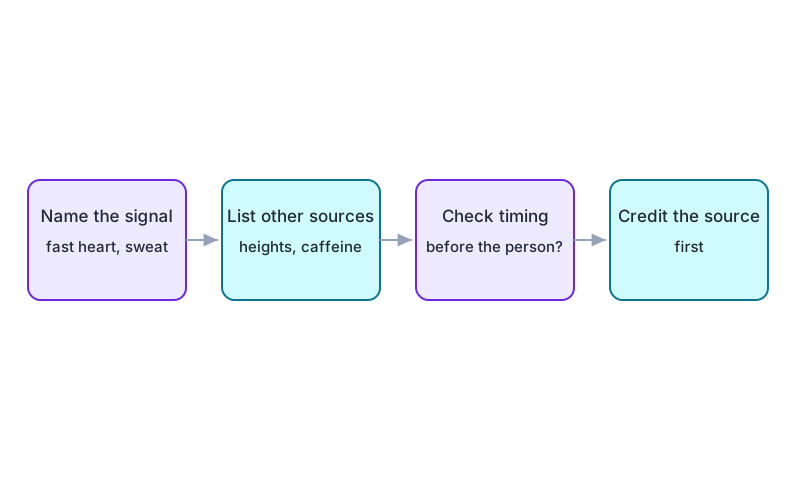
Ask this: where else could this body signal come from? The question works because every case has the same three parts: a signal, a true source, and a claimed source. If the feeling points at a nearby person while the signal comes from somewhere else, the label is suspect.
Run it in four steps.
- 1.Name the body signal in plain words: fast heart, fast breath, sweaty palms.
- 2.List what else is active right now: heights, exercise, caffeine, noise, a deadline, lack of sleep.
- 3.Ask whether the feeling started before the person appeared or only after.
- 4.If a non-person source fits the timing, credit the source first and treat the feeling as leftover arousal.
| Situation | True source of arousal | Feeling points at | Verdict |
|---|---|---|---|
| A roller coaster date feels electric | Fear and speed | The date | Misattribution, if the thrill does the work |
| A calm coffee date feels flat, then a double espresso makes it sparkle | Caffeine | The date | Misattribution, if the cup does the work |
| A gym crush seems stunning mid-workout, ordinary later | Exercise | The crush | Misattribution, if the effect fades with the pulse |
| Nerves before a job interview read as dislike of the interviewer | Evaluation stress | The interviewer | Misattribution, if calm reflection finds no real dislike |
Psychology World runs on iPhone and iPad. Save the term with its neighbours, such as two-factor theory and excitation transfer, to one list, then drill that list with Flashcard, Question, or Typing until each label sticks.
What the replication record changed
The bridge and adrenaline studies sit in every textbook, and neither repeated cleanly. A later rerun of the playful-actor version of the adrenaline study found no such mood pickup, and a related study with hypnosis in place of the injection found the same. Four lab attempts in 1979 to reproduce the fear-and-attraction effect under threat of shock failed too. These misses do not erase the idea, but they shrink it.
The claim that survived is narrower and better supported. A review of two decades of work concluded that arousal left over from one thing can intensify a feeling about something else. Call it excitation transfer: the second feeling borrows energy from the first. That version needs no grand story about choice of partner, only timing and an unclear source.
Newer emotion science tells a compatible story. The brain constantly guesses what body signals mean, using the situation and past experience, and updates the guess with new information. A pounding heart next to someone appealing gives the brain more than one plausible answer, and the label is a best guess, not a readout.
One practical note follows from the same science. Relabeling arousal can calm anticipatory nerves. In lab tests, people who said "I am excited" before singing karaoke or giving a speech did better than people who said "I am calm". The trick helps before the event, when the arousal still waits for a label. It does little during acute panic, when the label has already locked in. A related famous claim shrank the same way on retesting, as the facial feedback story shows.
Frequently asked questions
What is the suspension bridge effect?
It is the nickname for the 1974 Dutton and Aron study. In it, men on a high, swaying bridge called a woman interviewer back more often than men on a low, stable bridge. The researchers read the gap as fear mistaken for attraction. The effect comes from one small field study with no random assignment, so it shows a striking result, not a general law.
Can exercise make someone seem more attractive?
It can nudge ratings upward in the lab, especially right after the workout, and the roller-coaster survey found the same pattern in the field. The shift is small and fades as the pulse settles. It also reverses for unattractive targets, who get lower ratings under arousal. Treat it as borrowed energy, not a changed opinion of the person.
Is misattribution of arousal the same as excitation transfer?
The two overlap but stress different parts. Misattribution names the error: the mind credits the wrong source. Excitation transfer names the mechanism that survives testing: leftover arousal from an earlier event intensifies the next feeling. Most researchers now defend the narrower transfer claim rather than the broad original story.
How do you tell attraction from leftover adrenaline?
Check timing and alternative sources before trusting the label. If the heart was already pounding from heights, exercise, caffeine, or stress before the person appeared, credit that source first. True attraction survives the calm after the signal fades, while misattributed sparkle fades with the pulse.
Sources
- 1.Wikipedia contributors (2026). Misattribution of arousal.
- 2.Neff, M. A. (2023, updated 2026). Misattribution of Arousal: The Suspension Bridge Effect.
- 3.McLeod, S. (2026). Schachter-Singer Two-Factor Theory of Emotion.
- 4.Graham, H. (2021). Misattribution of Arousal: Sexy or Scary?
- 5.Luong, K. (2022). Attraction Hacks: Misattribution of Arousal Theory.