
Metacognition means thinking about your own thinking. It has two parts: what you know about learning, and how you steer it. Students who plan their study, monitor their grasp as they go, and evaluate the result remember more than students who simply re-read.
What metacognition is
Developmental psychologist John Flavell gave the process its name in the 1970s. In a 1979 paper on cognitive monitoring, he described how children begin to reflect on their own memory and understanding. That reflection guides what they do next. Later work kept his core idea: metacognition is knowledge about thinking put to use in steering thinking. A reference guide to the history of the concept traces this line from Flavell through later models of monitoring and control. DecisionLab (2025). Metacognition.
Two parts make up the process. Metacognitive knowledge is what you hold about yourself as a learner, about tasks, and about strategies. Self-regulation is what you do with it: you plan, you monitor, and you evaluate. University teaching resources describe the same split as a knowledge component and a regulatory component. Columbia Center for Teaching and Learning (2018). Metacognition.
Knowledge without steering changes little. Steering without knowledge drifts. The loop needs both.
The three kinds of metacognitive knowledge
Metacognitive knowledge breaks into three kinds. Each answers a different question.
Declarative knowledge answers what. You know yourself as a learner: you learn terms better in short morning sessions, you mix up two similar definitions, you forget names faster than ideas. It also covers what you know about how memory works in general, for example that bare re-reading fades fast.
Procedural knowledge answers how. You know a set of moves: define a term from memory before checking, group terms into a list by theme, test yourself with flashcards, write a one-sentence example for each term. You can run each move without inventing it on the spot.
Conditional knowledge answers when and why. You know which move fits which task. A fresh chapter calls for a slow first pass with examples. A near exam calls for timed recall of a mixed list. A stubborn pair of confusable terms calls for side-by-side comparison plus elaborating on meaning. This when-and-why sense is what turns a bag of tips into judgment.
A student with all three sounds like this before a session: I confuse assimilation and accommodation, so I will test the pair from memory first, then check, because comparison fixes confusions better than re-reading alone. That sentence holds a self-observation, a move, and a reason.
The loop: plan, monitor, evaluate
Regulation runs as a loop with three steps. Teaching resources at MIT describe it as planning learning, monitoring progress toward the goal, and evaluating the outcome. MIT Teaching and Learning Lab. Metacognition.
Planning sets the task, the goal, and the means. Pick one small set, such as ten defense mechanisms. Set a clear goal, such as defining each from memory with one example. Choose the moves and the time: twenty minutes, no notes, then check. A regulatory checklist used in university courses asks exactly these planning questions: what is the task, what is my goal, what do I need, how much time will it take.
Monitoring checks the work while it runs. Ask as you go: does this make sense, am I reaching the goal, do I need to change the plan. The check must rest on evidence, not on a feeling of fluency. More on that failure follows.
Evaluating closes the loop after the session. Ask: did I reach the goal, what worked, what did not, what will I change next time. Write the answers in two or three lines. That note becomes next session's plan.
The loop repeats. Each round tunes the next one.
Why your judgment of learning fails
Self-assessment often misleads, and two traps cause most of the damage.
The first trap is familiarity. A term looks known because the page looks known. Skimming a key-terms list feels like command of the chapter. MIT's teaching guide warns that learners conflate general familiarity with a subject and grasp of the specific content at hand, and that answering chapter questions right after reading gives an illusion of knowing. MIT Teaching and Learning Lab. Metacognition.
The second trap is foresight bias. Predicting recall while the answer sits in front of you overstates what you will recall later. Studying one topic in one block deepens the illusion, because each item prompts the next. On a mixed exam the cues vanish. The same guide points to interleaved practice tests as the fix: shuffle the concepts so each question must earn its answer.
The practical fix for both traps is delay and retrieval. Judge learning after a gap, without the text. Try to define each term, describe how terms relate, and answer questions from memory at least half an hour after reading. Summarizing or generating keywords after a short delay gives a truer reading than an instant check. Research on judgments of learning finds that delayed retrieval attempts lead to more accurate monitoring. MIT Teaching and Learning Lab. Metacognition.
In short: never trust a judgment made with the answer visible. Test after a delay, with mixed items, and believe that score.
Four metacognitive strategies that make the loop work
Four moves carry most of the benefit. Each maps onto one step of the loop.
Start with a pre-test. Before studying a set, try each term cold and mark what comes and what does not. The attempt itself is the plan: it shows where the gaps sit and which pairs confuse you. Use fewer resources, chosen with care. In one classroom study, students who selected resources in advance and explained why each would help outperformed a reminder-only group by one-third of a letter grade. MIT Teaching and Learning Lab. Metacognition.
Then use spaced retrieval to monitor. Test yourself across days rather than in one sitting. Short recall sessions beat long re-reading for the same reason a delayed judgment beats an instant one: each session measures what stayed. For the mechanics of spacing, see spaced retrieval.
Mix the items to defeat foresight bias. Build practice sets that shuffle chapters and formats, so every answer needs its own retrieval path. For how to mix without chaos, see mixing topics in one practice test. The extra effort during practice is one of the harder practices that pay off.
Close with an exam wrapper. After a test or a full practice round, answer three prompts in writing: how did I study, which items troubled me, what will I change next time. University courses hand these out as short post-exam questionnaires, and they work for self-study too. The wrapper turns one result into the next plan.
How to run the loop on psychology terms
A weekly routine makes the loop concrete. It needs a small set, a test, and a review.
Make one list of about ten terms around one theme, such as memory or motivation. For a method to group terms into lists, build the list by theme and add one example per term. Keep the list small enough to test in one sitting.
Study the list with games that force recall. In Apa, you can save terms into lists and study a list with Flashcard, Question or Typing. Question needs at least four words in the list, so keep lists at four or more when you want that format. The daily word brings one term each day at a time you choose, off until you turn it on, which gives the loop a steady next round on iPhone and iPad.
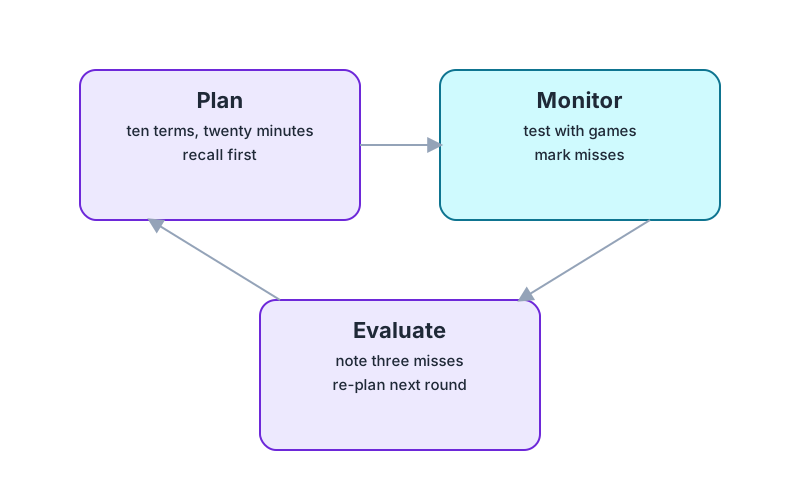
Run the round like this. Plan: ten terms, twenty minutes, recall first. Monitor: test with games, mark misses, resist re-reading the hits. Evaluate: write which three terms failed and why, then shrink or split the list. Next session starts from that note, not from page one.
Watch confidence in a specific task as you go. A feeling of knowing is data, but only a delayed test shows whether the trace will arrive under exam conditions. Trust the delayed score.
Frequently asked questions
What is an example of metacognition in psychology?
Trying to define retrieval failure from memory, rating your certainty, then checking and changing your plan is an example. You monitor the gap, evaluate the miss, and pick a new move for the next round.
What is the difference between metacognition and self-regulation?
Metacognition is the wider process of thinking about thinking. Self-regulation is the steering part: planning, monitoring, and evaluating learning to reach a goal.
Is metacognition a skill you can improve?
Yes. Learners improve by practicing explicit moves: planning a small set, testing after a delay, mixing items, and reviewing with an exam wrapper. Large evidence reviews find strong average gains when these moves are taught inside real course content. Education Endowment Foundation (2025). Metacognition and self-regulation.
How does metacognition help with exams?
It replaces fluency with evidence. Pre-tests find gaps, delayed and mixed recall measures what stayed, and the wrapper converts each result into the next plan. Each round spends time where the misses are.
When should you use a metacognitive strategy?
Use one before, during, and after each session. Plan the set and the moves, monitor with recall evidence, evaluate in two lines. Skip the loop only for a quick lookup with no need to retain.