
The just-world hypothesis says people need to believe the world is fair. Good acts bring rewards and bad acts bring punishment. When an innocent person suffers and observers cannot help, many protect the belief by devaluing the victim. Melvin Lerner and Carolyn Simmons showed this pattern in 1966. Observers watched a learner apparently receive shocks for errors, and those who could not stop the pain rated her more poorly.
- The claim is simple: people get what they deserve.
- Lerner tested it with a staged shock study in 1966.
- Observers derogated the victim when suffering continued.
- Compensation removed the effect.
- Later work links the belief to blame after violence, illness, and poverty.
- A short check with slow thinking and empathy reduces the pull.
What the hypothesis claims
The just-world hypothesis describes a need, not a fact about the world. People want to live in an orderly place where acts have fitting results. The belief works as a contract. If acts bring fair results, plans make sense and effort pays. Lerner summarized the claim in his 1980 book, The Belief in a Just World: A Fundamental Delusion. The Decision Lab guide to the just-world hypothesis uses the same terms: the world is fair, and moral standing decides outcomes.
Other names point to the same mechanism. Just-world fallacy names the error in reasoning. Just-world bias names the tilt in judgment. Just-world theory names the wider account. This article uses hypothesis for Lerner's claim and fallacy for the biased step from suffering to blame.
Lerner came to the question from obedience research. He had extended Stanley Milgram's work and asked how cruelty keeps public support. During clinical training he saw kind staff blame patients for their own distress. He also heard students derogate poor people and ignore the forces that shape poverty. The Wikipedia entry on the just-world fallacy traces this path from Milgram to the first experiments.
The belief protects itself. Threats come daily in the form of unfair pain. Observers then choose among responses. Rational responses accept the injustice, prevent it, compensate the victim, or accept limits. Non-rational responses deny it, withdraw from it, or reinterpret the event, its cause, or the victim. Victim blame belongs in the last group. It moves the cause from the situation to the person.
The 1966 experiment in four steps
Lerner and Simmons ran the first shock study at the University of Kansas in 1966. Their report was titled Observer's Reaction to the Innocent Victim. Seventy-two women took part as observers. Each watched a confederate who seemed to receive electric shocks for errors in a nonsense-syllable learning task. The setup looked real to the observers. The iResearchNet summary of the just-world hypothesis describes the same TV-monitor arrangement with actors and prerecorded events.
- 1.Watch a learner make errors and apparently suffer shocks.
- 2.Continue watching while the suffering repeats and no help is possible.
- 3.Rate the learner on character measures such as attractiveness.
- 4.Learn in one condition that the learner will receive compensation for the pain.
Results followed a clear pattern. Observers felt upset at first. As suffering continued without relief, they rejected and devalued the victim. Greater suffering brought greater derogation. When observers learned the victim would receive compensation, they did not derogate her. Later teams repeated the result with the same structure.
An earlier lottery study pointed the same way. In 1965 Lerner told subjects that one student had won cash in a lottery. Subjects rated the winner as harder working than the loser, though chance had decided the draw. The Markkula Center account of the Just World Theory reports both the lottery result and the shock result. It ends with Lerner's conclusion that observers fit fate to character.
The design has clear limits. The sample was narrow, with 72 women from one university. The shocks were staged, and deception of this kind would face strict ethical review today. The study measures views of one victim, not every response to real harm. It still serves exams well because the compensation condition isolates the mechanism. Remove the ongoing threat through payment, and the need to devalue falls.
Why observers blame instead of helping
Three ideas combine into one push toward blame. First, the contract needs a predictable world. People invest in goals because acts seem to control results. Unfair pain breaks that link. Second, the break creates mental strain. Belief says the world is fair, while the eyes report unfair pain. Leon Festinger called this strain cognitive dissonance. The Decision Lab guide links the hypothesis to cognitive dissonance in the same way. Third, blame restores fit by moving the cause. Observers attribute the pain to the victim's acts or traits rather than to chance or force, a person-over-situation tilt.
Self-protection adds force. If suffering strikes only the blameworthy, the observer feels safe. The observer has done nothing blameworthy, so nothing bad should follow. Research links this step to the self-serving bias, which guards the self against threat.
| Response | Example | Effect on the belief |
|---|---|---|
| Help or compensate | Support the victim or fund care | Restores justice by acts |
| Accept limits | Admit the world is unfair here | Updates the belief |
| Reinterpret the victim | Rate the victim lower or blame acts | Protects the belief without acts |
The table shows the two roads. Help changes the world. Reinterpretation changes the judgment. The experiment blocks the first road by design, so many observers take the second.
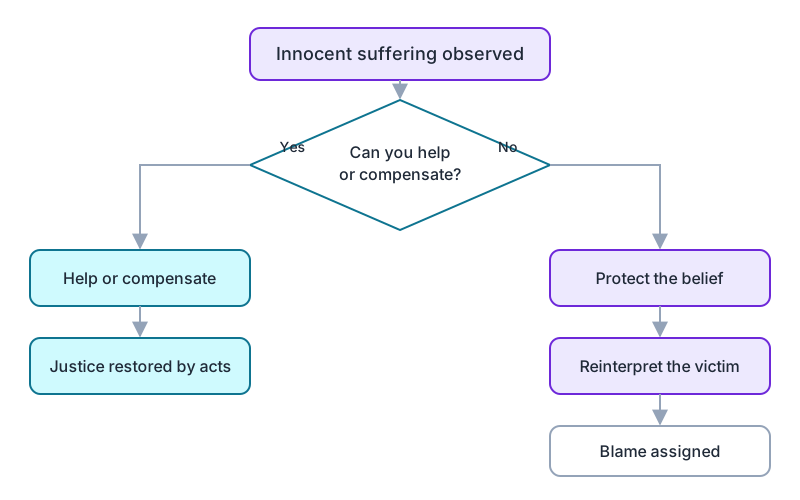
Alternatives have been tested. Veridical judgment says observers saw a real flaw, yet volunteers who agreed to suffer without actual pain were viewed positively. Guilt reduction says involved observers blamed to ease guilt, yet uninvolved observers derogated too. Discomfort reduction says empathy drives the ratings, and empathy instruction in fact reduced derogation in a later video study. Aderman, Brehm, and Katz asked some observers to imagine themselves in the scene, and those observers blamed less. The effect survives as a justice-motive pattern, not as one of these simpler accounts alone.
Where it shows up
Violence research gives the starkest cases. Linda Carli and colleagues gave two groups the same story about a man and a woman, except for the ending. One ending stayed neutral. The other ended with rape. Subjects judged the rape ending as more inevitable and blamed the woman for her behavior in the story, though not for her traits. Teams repeated the pattern with marriage-proposal control endings. In Sweden, Stromwall, Alfredsson, and Landstrom gave 164 participants four rape scenarios that varied victim gender and age. Stronger just-world belief raised victim blame and lowered perpetrator blame. Young male victims drew the most blame from male participants with strong belief. Readers affected by sexual violence can contact a local support service or a national helpline for help. The finding concerns observer judgment, and it never justifies assault.
Illness and poverty show the same tilt. Observers judged sick people as less attractive than healthy people, including cases of indigestion, pneumonia, and stomach cancer. Stronger belief predicted greater derogation of AIDS victims. Poverty drew blame toward the poor among strong believers, while weak believers pointed to systems, war, and exploitation. One exception matters. School studies found high belief linked to stronger anti-bullying attitudes, which fits the contract idea: rules against harm deserve defense. The exception does not erase the main pattern.
Victims themselves may use the same tool. Ronnie Janoff-Bulman found that rape victims often blamed their own behavior rather than their traits. Behavior feels more controllable than character, so blame can restore a sense of control. The cost is heavy self-blame after trauma. The passage needs care. Self-blame after assault reflects a common coping response, not evidence that the victim caused the attack.
Personal and general belief differ. Belief for the self links to well-being, coping, and life satisfaction in reviews. Belief for others links to blame and derogation. Isaac Lipkus built a short global scale in 1991 to separate these strands, after the longer Rubin and Peplau scale of 1975. Exam items often test this split. For the self, the belief buffers stress. For others, it risks blame.
What it is not
Karma shares the language of desert but not the mechanism. Karma states a cosmic rule. The hypothesis states a human need that bends judgment under threat. Keep the two apart on exams.
The fundamental attribution error overlaps but stays narrower. It says observers favor traits over settings. The just-world route uses that tilt for one purpose: to keep the world fair. Name the error as the route, and the hypothesis as the motive.
Hindsight also overlaps in rape-narrative work, where subjects call the ending inevitable. Hindsight looks back and sees necessity. Just-world thinking looks at suffering and decides who deserves what. An answer can show both, but the test differs. Ask whether the item stresses inevitability or deservingness.
How to check it in three steps
Use a short routine before judging a painful case. It borrows slow thinking from Kahneman and Tversky and the empathy result from Aderman and colleagues. Each step takes seconds, and the order matters.
- 1.Pause the fast verdict and state the situational causes first.
- 2.Imagine yourself in the victim's position and rerate the case.
- 3.Ask what compensation or help would remove the need to judge.
The first step slows System 1 and starts System 2. Name chance, force, institutions, and timing before naming traits. The second step copies the empathy instruction that reduced derogation. The third step copies the compensation condition from 1966. If payment or help would end the blame, the blame likely served the belief, not the facts. For control beliefs, compare with our guide to locus of control. It separates expectancy about the self from fairness of the world.
Save this article with attribution-theory and fundamental-attribution-error in one bookmark list. Then drill the design, the mechanism, and one example with study games until each recalls without cues.
Frequently asked questions
What is the just-world hypothesis?
It is the claim that people need to believe the world is fair, so good acts bring rewards and bad acts bring punishment. When innocent suffering threatens that need and help is blocked, observers often devalue the victim to restore fit between fate and character.
What is an example of the just-world phenomenon?
A standard example is Lerner and Simmons 1966. Observers watched a learner apparently shocked for errors. As her pain continued without compensation, they rated her more poorly. Promise of compensation removed the derogation.
What is the downside to the just world belief?
For others, strong belief predicts more victim blame and less support for change, across violence, illness, and poverty studies. For the self, belief can buffer stress and aid coping. The costs fall on observers' judgments of others, not on a single verdict about the belief.
What is the difference between the just-world hypothesis and the just-world fallacy?
Hypothesis names Lerner's claim about the need for fairness. Fallacy names the biased step from that need to blame. Use hypothesis for the theory and fallacy for the error in a specific judgment.