
An implementation intention is an if-then plan. It links a specific future cue to a specific goal-directed response. It has the form "If situation Y occurs, then I will do Z." Across 94 studies with over 8,000 participants, forming one has a medium-to-large effect on goal attainment. The effect size is d = 0.65, according to a meta-analysis by Gollwitzer and Sheeran (2006) summarized in a government reference on the method.
Good intentions alone often fail to turn into action. This article explains what implementation intentions are, why intentions fail, how if-then plans work, and how to write one in four steps.
- A goal intention states what you want to reach, while an implementation intention states when, where, and how you will act.
- Intentions account for about 28 percent of the variance in behavior, and people act on good intentions only about half the time.
- If-then plans work through two processes: the cue becomes easy to notice, and the response starts fast, with little deliberation.
- They help most when the goal is strong and a real obstacle blocks the way.
- A precise cue plus a precise response beats a vague resolution every time.
What implementation intentions are
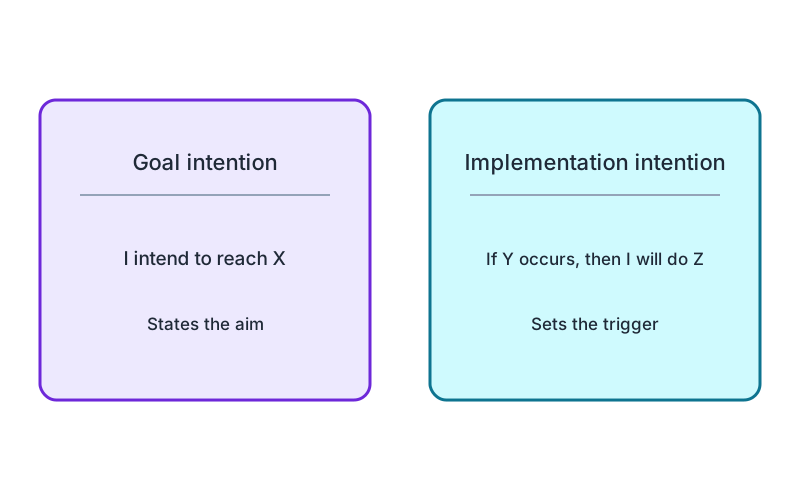
A goal intention has the form "I intend to reach X." It commits you to an outcome, such as learning 20 new terms this week. An implementation intention sits under it. It spells out the when, where, and how.
The form is fixed. If situation Y occurs, then start response Z. The psychologist Peter Gollwitzer introduced the concept in 1999. His paper gives the classic wording (Gollwitzer (1999). Strong effects of simple plans.).
The two kinds of intention do different jobs. The goal intention supplies direction and commitment. The if-then plan delegates control to a preselected cue, so the moment itself triggers the act.
For example, turn "I intend to drill my term list" into "If I finish lunch at 12:30, then I will drill ten terms at my desk". The cue is concrete. The response is concrete. No decision remains for the moment. A goal intention states the aim, while an implementation intention links one cue to one response.
Why good intentions fail
Intentions predict behavior, but only in part. A summary of 422 studies finds that goal intentions account for 28 percent of the variance in behavior. It also finds that people translate good intentions into action only 53 percent of the time (National Cancer Institute. Implementation Intentions.). An experimental meta-analysis sharpens the point: a medium-to-large change in commitment, d = 0.66, leads to only a small-to-medium change in behavior, d = 0.33 (Wieber, Thürmer and Gollwitzer (2015). Promoting the translation of intentions into action.).
Research on goal striving groups the failures into two sets. The first set stops you before you start. You forget to act, because other tasks absorb you. You miss the moment, because the window is short and you do not notice it. Or you hesitate at the critical point, because the act costs effort now and pays off later. Starting an aversive task despite reluctance is the same problem our guide on putting off aversive tasks describes, and if-then plans target it directly.
The second set derails you after you start. Distracting cues pull attention away, old habits pull behavior back, and negative states push mood repair ahead of the goal. Plans that ignore these obstacles leave you exposed at exactly the moments that matter.
How if-then plans work
Two processes carry the effect. First, the mental image of the cue becomes highly accessible. You picked the situation in advance, so you notice it fast when it arrives. Studies with lexical decision tasks show faster responses to cue words after if-then planning, and the speed gain explains part of the behavior gain.
Second, the link between cue and response becomes automatic in a strategic sense. The response starts fast and with little effort, and it does not need a fresh decision at the moment. Dual-task studies show faster responses to planned cues without harm to the main task. Delegation is the right word: you decide in advance, and the cue executes the decision.
This cue-response logic also governs prospective memory, the ability to act on a future task at the right moment. A meta-analysis of 36 studies finds that implementation intentions improve prospective-memory performance. The effect is medium, d = 0.45, as the same review reports (Wieber, Thürmer and Gollwitzer (2015). Promoting the translation of intentions into action.). Our guide on remembering to act on a future cue describes that retrieval problem in detail, and if-then plans strengthen exactly that link.
A field study shows the nuance. Ninety-two young adults, aged 19 to 31, had to photograph the first receipt they received each shopping day for seven days. An if-then statement alone made correct responses faster than a standard instruction. The test gives F(1, 65) = 8.37 and p = .005, but the plan did not raise the share of correct responses (Szarras-Kudzia and Niedźwieńska (2022). Implementation intentions speed up young adults responses.). The plan sped the trigger without adding more triggers.
How do you write an implementation intention
Use four steps. Write each plan in one line, and keep it visible during the day.
- 1.Fix the goal and make it strong. Name one outcome you truly want, such as finishing a 20-term list. If the goal itself is weak, the plan has nothing to carry.
- 2.Pick one cue you will surely meet. Use a time, a place, or a prior act, such as "If it is 6 pm at my desk" or "If I close my lunch box." Vague cues such as "tomorrow" or "later" do not work.
- 3.Pick one response that moves the goal forward. Name the smallest useful act, such as "then I will drill ten terms with flashcards." Keep it executable in that spot.
- 4.Word it as if-then and say it as written. The conditional form matters: "If it is 6 pm at my desk, then I will drill ten terms." Repeat it until you can write it from memory.
Check precision before you start. The cue must be unambiguous, and the response must be doable there. One response belongs to one cue. For a large goal, write several non-overlapping plans, one per part, rather than one grand plan. The same pattern protects time estimates: give each part its own date, time, place, and range, so every block has a trigger.
A dictionary app with saved lists and short games fits this pattern well. Psychology World lets you store terms in named lists. You can turn one list into a quick session, so a plan such as "If it is 6 pm, then I will drill my cell-biology list" stays concrete.
When do they help most
If-then plans help most when two conditions hold. The goal intention is strong and active, and a real self-regulation problem blocks the path. When tasks are hard to start or easy to abandon, planning pays off. The meta-analytic split reflects this: d = 0.61 for failures to get started, and d = 0.77 for getting derailed, as the government reference summarizes (National Cancer Institute. Implementation Intentions.).
They add little when the goal is weak or the path is clear. If you do not care about the outcome, a plan only decorates indifference. If the act is easy and cued well already, the plan is spare capacity you do not need.
Keep one limit in mind. Plans do not replace skills, and they do not fix conflicting goals. When two plans compete for one moment, revise them so each cue points to one response. Review the plans after a week: drop cues you never meet, and rewrite cues you meet but ignore.
Implementation intentions and related ideas
Several ideas sound similar but play different roles. The table sorts them by job.
| Idea | Job | Example |
|---|---|---|
| Goal intention | States the outcome you commit to | I intend to learn 20 terms this week |
| Implementation intention | Links one cue to one response | If it is 6 pm at my desk, then I will drill ten terms |
| Prospective memory | Retrieves the act at the right moment | Seeing the receipt reminds you to photograph it |
Goal setting chooses the destination. If-then planning paves the last step to it. Memory research explains why the step matters: without a salient cue, the act never surfaces at the moment it counts.
Frequently asked questions
What are implementation intentions in psychology?
They are if-then plans that link a specific future situation to a specific goal-directed response. The plan sits under a goal intention and specifies when, where, and how you will act. Peter Gollwitzer introduced the concept in 1999.
Can you give examples of implementation intentions?
"If it is 6 pm at my desk, then I will drill ten terms" is one. "If I receive a receipt, then I will photograph it at once" is another. Each names one cue and one doable response in that spot.
How do you write an implementation intention?
Fix one strong goal, pick one cue you will meet, pick one response that fits that spot, and word it as if-then. Repeat it until you can write it from memory, and keep it visible during the day.
Do implementation intentions work?
Across 94 studies with over 8,000 participants, they show a medium-to-large effect on goal attainment, d = 0.65. They speed responses to planned cues and shield striving from distractions. They help most when the goal is strong and a real obstacle blocks the way.
What is the difference between a goal and an implementation intention?
A goal states the outcome, such as learning 20 terms. An implementation intention states the trigger and the act, such as the time, place, and first ten terms. The goal gives direction, while the plan gives the moment.
Sources
- 1.National Cancer Institute. Implementation Intentions.
- 2.Wieber, Thürmer and Gollwitzer (2015). Promoting the translation of intentions into action.
- 3.Szarras-Kudzia and Niedźwieńska (2022). Implementation intentions speed up young adults responses.
- 4.Gollwitzer (1999). Strong effects of simple plans.