
The endowment effect means an owner asks more for an item than a buyer pays for the same item. In the classic mug test, sellers named a median of 7.12 dollars and buyers a median of 2.87 dollars for the same mug. The gap has standard names: willingness to accept stands above willingness to pay when the seller owns the good.
- The trigger is ownership of the same good, not the good itself.
- Richard Thaler gave it the name in 1980: opportunity costs weigh less than out-of-pocket costs.
- Sellers asked 7.12, buyers offered 2.87, choosers stated 3.12: the gap sits on the selling side.
- The leading account is loss aversion: giving up codes as a loss, getting codes as a gain.
- It is not sunk cost, status quo, or mere liking: the table below sorts the four.
- Tickets and monkeys show the same pattern beyond the mug lab.
What the endowment effect claims
The claim fits one sentence: the same good gets two prices, and ownership picks which one. Willingness to pay is the most a buyer gives for a good it does not own. Willingness to accept is the least a seller takes for the same good it owns. Rational models expect both prices to match. In the tests they do not: sellers demand about twice what buyers offer, and the ratio often runs above two even when the tests pay real money (Achtypi and others, 2020).
Thaler opened his 1980 paper with a wine lover called Mr R (Thaler, 1980). Mr R bought wine for about 5 dollars a bottle. Years later his merchant offered 100 dollars a bottle to buy it back. Mr R refused, although he never paid more than 35 dollars for a new bottle. The same person priced the same bottle above 100 as a seller and below 35 as a buyer. Nothing about the wine changed between the two prices. Only the side of the table changed.
A yard sale shows the same gap without a laboratory. You price used sneakers at 130 dollars because you remember every run in them. A buyer offers 50 because buyers see one more used pair. Your price carries memory and care. Their price carries the market. The St. Louis Fed educator page uses this exact scene: sellers feel the story, buyers do not, and the deal needs a price both sides accept.
Where the name comes from
Thaler coined the term in 1980 in Toward a Positive Theory of Consumer Choice (Thaler, 1980). His point was narrow: people treat opportunity costs as smaller than out-of-pocket costs. Money you fail to gain feels smaller than the same money taken from your hand. Goods in your endowment therefore rank above the same goods outside it.
Two more of his cases make the logic plain. A man mows his own lawn but will not pay the neighbor boy 8 dollars for the same job, and will not mow the neighbor lawn for 20 dollars. Asked what they would pay to cure a tiny risk of illness, and what they would demand to take the same risk on, many people give answers ten or more times apart. Each case asks one question in two frames: what you give up against what you gain.
The mug test and what each number proves
The famous test ran in a classroom with coffee mugs (Kahneman and others, 1990). Half the students received a mug. Then markets ran for the mugs. Theory predicted about half the mugs would change hands. Far fewer traded, about one sixth, because median selling prices ran about twice median buying prices.
Three numbers carry the whole result. Sellers stated a median of 7.12 dollars. Buyers stated a median of 2.87 dollars. A third group, the choosers, picked between a mug and cash at each price without owning the mug first. They stated 3.12, close to the buyers and far from the sellers. The choosers prove the point: the gap comes from reluctance to sell, not from reluctance to buy. Owners hold back. Buyers price as usual.
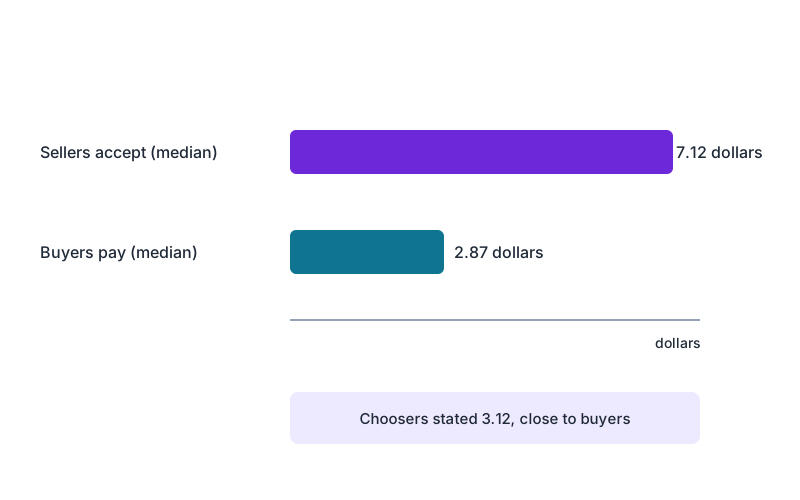
Read the three numbers as one argument. The 7.12 shows owners defend the good. The 2.87 shows buyers weigh the money. The 3.12 shows people without the good think like buyers. So the effect lives on the selling side. That is why the exam question asks who owns the good now, not how nice the good is.
Why it happens
Loss aversion gives the leading account. Giving up the mug codes as a loss from the reference point of owning it. Getting the mug codes as a gain from the reference point of not owning it. Losses weigh more than equal gains, so the seller demands more than the buyer offers. Kahneman and colleagues tied the mug gap to this account in 1990 and 1991, and the overview of the effect states the same link with the same sources.
Reference prices give a second account. Buyers anchor on the lowest market prices they know. Sellers anchor on the highest ones. Weaver and Frederick showed in 2012 that sellers stay closer to known retail prices than buyers do, so part of the gap is a clash of anchors, not only a clash of feelings. The behavioral economics guide lists this account beside loss aversion.
Psychological ownership gives a third account. Mere ownership raises liking fast: students given a dull gift rated it higher than students without it, and the rating rose further after a threat to self-image. Morewedge and colleagues showed in 2009 that buyers who owned one mug priced a second mug like sellers, which points at ownership itself rather than fear of loss. The Decision Lab guide walks through these studies with their numbers.
Inertia gives a fourth account. Neither side holds a sharp price for the mug, so a band of middle prices moves nobody: buyers will not stretch up, sellers will not bend down, and each side stays put. Gal proposed this account, and the overview of the effect reports the 4 to 6 dollar dead zone with the same example. The four accounts compete. Loss aversion leads the textbooks. The rest set the limits.
Four terms, one pattern
Students mix four terms that share one family. The table sorts them with one question each. Endowment asks who owns the good now. Loss aversion asks how a future loss weighs against the same future gain. The sunk cost fallacy asks whether past costs count though they never return. Status-quo preference asks whether the person stays because change codes as loss.
| Case | The question behind it | Example |
|---|---|---|
| Endowment effect | Does owning set the price now | Seller asks 7.12, buyer offers 2.87 for one mug |
| Loss aversion | Does the future loss weigh more than the same gain | A 100-dollar loss needs about 200-dollar gain as cover |
| Sunk-cost thinking | Do past costs count, though they never return | Hold a losing share because much was paid |
| Status-quo preference | Does the person stay, because change counts as loss | Keep the old plan though the new plan pays better |
Use the table as a sorter in the exam. Same good, two prices, owner against buyer: endowment. Future gain against future loss: loss aversion. Past payment dragging a present choice: sunk cost. Staying put against switching: status quo. Name each part when a case mixes them, as investors do when they hold losers long and sell winners early.
Two cases that stick
Tickets show the mechanism without mugs. Carmon and Ariely asked students about basketball final tickets in 2000 (Carmon and Ariely, 2000). Sellers set prices from the experience they would forgo: the game, the crowd, the regret of missing it. Buyers set prices from the money they would forgo: other uses, fair prices, care with cash. Selling prices ran many times above buying prices. The lesson is not one fixed ratio. It is the split in attention: sellers weigh what they lose, buyers weigh what they spend.
Monkeys show the pattern is old. Capuchins received food treats of one kind and could trade for an equally liked kind (Lakshminaryanan and others, 2008). Fruit owners spent only 1.7 percent of their budget on cereal. Cereal owners spent only 15 percent on fruit. Both shares sit far below the 50 percent that equal liking predicts, each with p below 0.0001. The monkeys traded freely for a clearly better treat and still refused equal swaps after a bonus oat covered the effort. So the refusal is not confusion and not laziness. It tracks ownership, in a species that split from our line over 30 million years ago.
People differ too. The gap runs stronger in individualistic samples than in collectivistic ones, as Maddux and colleagues found in 2010 and the Decision Lab guide reports. Read it as a moderator, not a law: self-image feeds ownership, and ownership feeds price.
What weakens it
The effect is strong but not fixed. Close substitutes shrink it: Hanemann argued that theory only expects equal prices for near-identical goods, and tests with plain, replaceable goods find smaller gaps. And design matters: Plott and Zeiler showed in 2005 that careful controls and misconception checks narrow the buying-selling gap, so some published ratios mix real bias with confused bidding. None of this removes the mug result. It sets the range: expect the gap for owned goods with weak substitutes, and expect less of it where markets train people out of it.
How to remember it for the exam
Make a list in Psychology World on iPhone and iPad named Decision. Save four terms: endowment effect, loss aversion, sunk cost fallacy, status quo. Learn them as a group, not alone.
Proceed in this order. Read each definition aloud. Cover the table and name the sorting question for each: own against not own, future loss against gain, past cost against present choice, stay against switch. Run the Question game once the list holds its four terms, then use the Flashcard game and the Typing game, because typing exposes mix-ups between endowment and sunk cost fastest. Repeat the list after two days. That loop of save, drill, and repeat is what Psychology World is built for.
Frequently asked questions
What is the endowment effect in simple terms
It is the pricing gap between owning and not owning the same thing. Owners ask more to give it up than buyers pay to get it. The trigger is ownership now, not quality, memory, or effort alone.
How large is the gap between selling and buying prices
In the mug test the medians were 7.12 dollars to sell and 2.87 to buy, a ratio near two and a half. Reviews find ratios above two are common with real money on the line. Treat any single number as a typical value, not a law: goods, markets, and methods move it.
What is the difference between the endowment effect and loss aversion
Loss aversion is the weighting rule: losses weigh more than equal gains. The endowment effect is one place the rule shows: giving up an owned good codes as a loss. Other accounts such as reference prices and ownership add to the story, so the two terms overlap but are not synonyms.
Does the endowment effect work without money
Yes. Ticket owners weigh the missed game while buyers weigh the spent cash, and capuchin monkeys refuse equal food swaps while trading gladly for better food. Time, seats, and treats show the same ownership gap as dollars.
How do I counter the endowment effect when I sell
Price from the market, not from memory: check what the same good fetches now and stay near the middle of that range. Name the opportunity cost aloud, what the money buys next, before you name your price. As a buyer, pause free trials and test drives long enough to ask whether the good still wins at its price without the story.
Sources
- 1.Thaler, R. (1980). Toward a Positive Theory of Consumer Choice.
- 2.Kahneman, D., Knetsch, J. and Thaler, R. (1990). Experimental Tests of the Endowment Effect and the Coase Theorem.
- 3.Carmon, Z. and Ariely, D. (2000). Focusing on the Forgone: How Value Can Appear So Different to Buyers and Sellers.
- 4.Lakshminaryanan, V., Chen, M. and Santos, L. (2008). Endowment effect in capuchin monkeys.
- 5.Achtypi, E. and others (2020). The Endowment Effect and Beliefs About the Market.
- 6.Caceres-Santamaria, A. (2022). The Endowment Effect.
- 7.Pilat, D. and Krastev, S. (2019). Endowment effect at The Decision Lab.
- 8.Endowment effect at BehavioralEconomics.com, updated 4 December 2024.
- 9.Endowment effect in the English Wikipedia, read 11 November 2026.
- 10.Hodges, S. Teaching notes on the endowment effect, loss aversion and status quo bias.