
Ego depletion is the hypothesis that self-control draws on one limited resource, so using it on one task leaves less for the next. In 1998 Roy Baumeister and colleagues reported that people who resisted chocolate quit unsolvable puzzles after about 8 minutes, while controls persisted for about 20. Large preregistered replications later found essentially nothing, and the strong original claim has not survived. This article gives the study, the numbers, the replication record, and how to sort ego depletion from decision fatigue and cognitive load in exam items.
- The strength model compares willpower to a muscle: effort tires it, rest restores it. The word ego means Freud's executive self, not arrogance.
- The 1998 experiments used a two-task sequence: resist chocolate, then persist at puzzles. The radish group quit sooner, with no difference in mood between groups.
- A 2010 meta-analysis of 198 tests found a medium effect. Bias-corrected re-analyses shrank it to near zero.
- Three multilab projects with about 7,400 participants found effects of 0.04, 0.06 and 0.10. A 2025 project with demanding tasks found about 0.3 and still awaits independent replication.
- Beliefs about willpower change the result: people who see willpower as unlimited show little depletion.
- Exam answers should call ego depletion a contested hypothesis, never a fact.
What ego depletion claims
The claim has three parts. Self-control is one resource, shared by every act of control: resisting food, suppressing emotion, making choices, persisting at hard tasks. Using it spends it. Spending it on one task impairs the next, even when the two tasks share nothing. Baumeister and Muraven later summarized this as the strength model of self-control: willpower works like a muscle that tires with use and recovers with rest (Baumeister et al., 1998).
The standard test is the sequential-task paradigm. Participants do a first task that needs self-control, then a second, unrelated task that also needs it. If the first group performs worse on the second task, the difference is read as depletion. Note what is never measured: the resource itself. No study watches a fuel tank drain. Depletion is inferred from the drop in performance, which makes the explanation circular unless independent evidence backs it.
The name misleads new readers. Ego here is Freud's term for the part of the mind that steers between impulse and demand, not the everyday sense of pride. An exam stem that says "ego" points at self-control, never at arrogance.
The radish study
In 1998 Baumeister, Ellen Bratslavsky, Mark Muraven and Dianne Tice ran four experiments at Case Western Reserve University. Sixty-seven hungry participants came to a room that smelled of fresh-baked chocolate. Some were told to eat only radishes and resist the chocolate. Others ate chocolate, or ate nothing. Then all tried unsolvable puzzles while the researchers timed how long they persisted.
| Group | Time in minutes | Attempts |
|---|---|---|
| Resisted chocolate, ate radishes | 8.35 | 19.40 |
| Ate chocolate | 18.90 | 34.29 |
| No food, control | 20.86 | 32.81 |
The radish group quit after about 8 minutes. The other two groups lasted about 19 to 21 minutes. The chocolate and control groups did not differ, so the effect came from resisting, not from eating. The other three experiments extended the pattern: making a meaningful personal choice, suppressing emotion while watching a film, and an initial self-control task each impaired a later, unrelated task (Baumeister et al., 1998).
Two details matter for exams. Mood did not differ between the radish and chocolate groups in pleasantness or arousal, so a bad mood cannot explain the quitting in this experiment. Dieting status changed nothing either. But the samples were small by modern standards, with tens of participants per condition, and small samples produce imprecise estimates that inflate easily. The study is a striking demonstration, not proof of the fuel tank it names.
Why psychologists believed it
For over a decade, the evidence looked strong. A 2010 meta-analysis by Martin Hagger and colleagues pooled 198 tests and found a medium effect of d equal to 0.6. Textbooks adopted the muscle metaphor. The idea spread beyond psychology: workplaces scheduled hard choices for the morning, diet books blamed evening snacking on spent willpower, and, as Inzlicht notes, even President Obama cited the theory to explain why he limited daily decisions.
Real-life findings piled up, each resting on the same two-task design. Chronic dieters who suppressed emotions ate more ice cream afterward than non-dieters. Athletes performed worse physically after hard mental tasks. Shoppers with many options behind them chose by the simplest rule, cheapest or most familiar. Treat each of these as paradigm-dependent, not settled: they inherit every weakness of the design that produced them.
The glucose story shows how fast a mechanism can collapse. In 2007 Gailliot and colleagues reported that self-control tasks lower blood glucose and that a sugary drink cancels depletion. Later work found the brain's glucose use barely changes during brief tasks, blood sugar does not fall meaningfully in them, and merely tasting sweetness without swallowing can restore performance. That last result points at motivation and reward signals, not fuel. The glucose account is now discredited, and exam answers should never cite sugar as the mechanism.
One moderator held up better. Veronika Job, Carol Dweck and Gregory Walton proposed in 2010 that depletion depends on what a person believes about willpower. Across four studies, people who saw willpower as unlimited showed no depletion after a demanding task, while believers in limited willpower did. A longitudinal field study found the same beliefs predicted eating, procrastination and goal pursuit under load. A fuel tank would not respond to belief, which is exactly why this result cut against the resource model (Job et al., 2010). The belief effect has faced replication scrutiny of its own, so state it as evidence, not as the new law.
The replication record
The turn began with publication bias. In 2014 and 2015 Evan Carter and Michael McCullough re-analysed the literature and found the signature of a filtered field: smaller studies reported systematically larger effects. After bias correction, the estimate sat near zero and no longer differed from it significantly. Hundreds of supportive studies could all lean one way with no conspiracy: publish the hits, file the misses, and the literature looks irrefutable.
Then came the multilab tests. In 2016, twenty-three laboratories ran one preregistered protocol with 2,141 participants in total. Preregistration fixes the design and analysis before data collection, with publication guaranteed whatever the outcome. The pooled effect was d equal to 0.04, with a confidence interval from minus 0.07 to 0.15. It includes zero and rules out any effect of practical size (Hagger et al., 2016).
Critics answered that the 2016 task may have been too weak a manipulation. So a 2021 project led by Kathleen Vohs, with several original proponents as co-authors, tested two well-regarded manipulations across 36 laboratories and 3,531 participants. The confirmatory result was d equal to 0.06, not significant. A Bayesian analysis found the data four times more likely under no effect than under depletion (Vohs et al., 2021).
A third project took a different route. Twelve laboratories used a Stroop task to deplete and an antisaccade task, which requires blocking reflexive eye movements, as the outcome, with 1,775 participants. This time the effect was small but significant: d equal to 0.10, rising to 0.16 after excluding random responders (Dang et al., 2021).
| Project | Labs and participants | Result |
|---|---|---|
| Hagger et al. 2010 meta-analysis | 198 tests | d = 0.6 |
| Hagger et al. 2016 replication | 23 labs, 2,141 people | d = 0.04, not significant |
| Vohs et al. 2021 replication | 36 labs, 3,531 people | d = 0.06, not significant |
| Dang et al. 2021 replication | 12 labs, 1,775 people | d = 0.10, significant |
| Dang et al. 2025 demanding tasks | 14 samples, 2,078 people | d ≈ 0.3, significant |
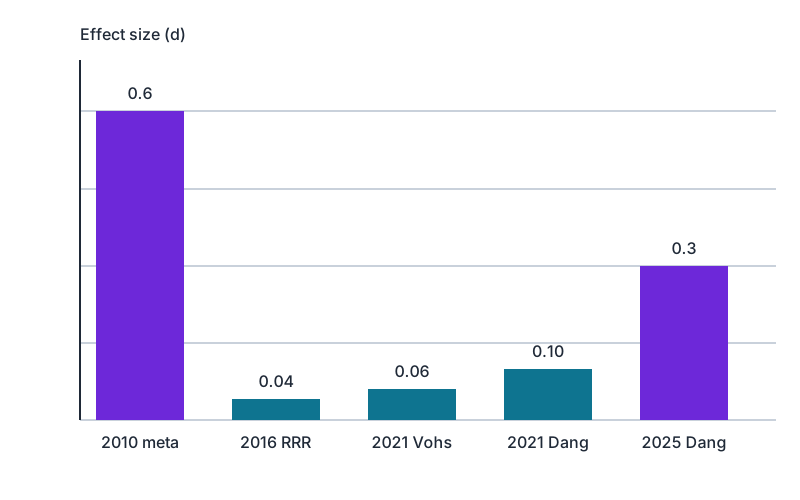
The 2025 row needs its caveat. Most depletion tasks last under ten minutes and may never cross the threshold where self-control truly engages. Dang and colleagues used a 30 to 40 minute antisaccade task and found errors clearly above both control groups. As summarized in a 2026 review, the effect sat near d equal to 0.3 with little variation across samples (Dang et al., 2025). It is the best-powered positive result since the crisis began, and it still awaits independent replication with other demanding tasks. A d near 0.3 is also modest beside the 0.6 the field once believed.
Michael Inzlicht, once a leading depletion researcher, gave the collapse its frankest telling in a 2025 essay. He notes that 23 of the 24 replication laboratories had predicted a real effect before seeing the data. He then failed to replicate the effect in his own lab. His verdict: a few minutes of self-control leaving later temptation irresistible has been debunked; what remains after long, effortful work is fatigue, a topic psychology has studied for over a century (Inzlicht, 2025).
What replaced the fuel tank
Two rival accounts explain the same findings without any draining resource. Inzlicht and Brandon Schmeichel proposed the process model in 2012: effortful control shifts motivation away from have-to restraint toward want-to gratification, and attention drifts from control cues to reward cues. Incentives, mood and beliefs restore performance in minutes, which a real fuel shortage would not allow (Inzlicht and Schmeichel, 2012). A 2020 preregistered study of 686 participants supported the mechanism with computational modeling: depleted participants lowered their response caution, as if disengaging, while inhibitory control itself stayed intact.
Roy Kurzban and colleagues offered the opportunity-cost model instead: the feeling of effort is a cost-benefit signal, not a fuel gauge. Persisting at one task costs the chance to do anything else, so effort tells the mind when to quit. The older conservation hypothesis made a nearby point: the mind holds effort back to guard reserves for emergencies, which is why incentives unlock performance that looked spent.
Critics also attacked the foundations. Lurquin and Miyake argued in 2017 that the field never agreed on what self-control means, never validated its tasks independently, and never specified the model tightly enough to make falsifiable predictions. Many tasks were justified circularly: a task counted as depleting because earlier studies had used it that way. These are standard reliability and validity problems, and they explain why the literature could look solid while measuring little.
Ego depletion versus decision fatigue versus cognitive load
Students mix up three limited-capacity ideas. The mechanism sorts them.
| Question | Ego depletion | Decision fatigue | Cognitive load |
|---|---|---|---|
| What runs out | one self-control resource for all acts of will | decision quality after many choices | working-memory slots during learning |
| Time course | minutes: one task impairs the next | hours: rulings worsen across sessions | seconds: overload happens while material is new |
| Classic study | Baumeister et al. 1998, radishes and puzzles | Danziger et al. 2011, parole rulings across the day | Sweller 1988, worked examples versus problem solving |
| Status today | contested; near-zero in replications | observation stands, depletion reading disputed | well supported in instructional research |
| Exam cue | resist then persist, two unrelated tasks | many choices, quality slides, breaks restore | new material, too many elements at once |
Two footnotes keep the table honest. The parole finding itself was re-analysed in 2016: case ordering and session scheduling explain much of the swing, so cite it as decision fatigue, never as proof of depletion. And cognitive load theory belongs to learning, not willpower: our guide to studying within working-memory limits covers it in full.
How to sort exam examples
Two questions sort most items. Did one self-control task come first and an unrelated one second? If yes, test ego depletion. If the stem stresses many decisions, test decision fatigue. If it stresses new material overwhelming memory, test cognitive load.
| Scenario | Answer | Why |
|---|---|---|
| After resisting snacks, a student quits hard puzzles fast | Ego depletion | two unrelated tasks, resist then persist |
| A hiring panel makes worse calls late in the day | Decision fatigue | many choices, quality slides with time |
| A learner fails when a lesson shows seven new rules at once | Cognitive load, not depletion | new material exceeds working-memory slots |
| A believer in unlimited willpower shows no drop after strain | Belief moderator, Job et al. 2010 | beliefs about willpower change the result |
| A textbook says willpower is a proven limited fuel | Outdated claim | replications near zero; call it contested |
| A student delays study to repair mood, then feels guilt | Procrastination, not depletion | mood repair now at the cost of later goals |
The last row shows the nearest neighbor. Procrastination is short-term mood repair: avoidance pays at once through relief. Depletion claims a spent resource. A stem about feelings points at the first; a stem about prior exertion points at the second.
How to keep the terms apart
Three images hold the three ideas. A fuel tank stands for the depletion claim: spend willpower, run low. A long menu stands for decision fatigue: choose all day, choose worse. A small desk stands for cognitive load: pile on new material, things fall off. If the sentence contains two unrelated tasks in sequence, test the tank first. If it contains many choices, test the menu. If it contains new material, test the desk.
The vocabulary of this topic is small: ego depletion, strength model, sequential-task paradigm, decision fatigue, willpower beliefs, replication. In Psychology World, you look up a term and save it to one of your own lists. Then you drill the list as flashcards, by typing the answer, or as multiple-choice questions once the list has four or more terms. The four steps of the learning loop and what each study mode does are on the home page. For study methods with strong evidence behind them, read our guide to memorising psychology terminology.
Frequently asked questions
What is ego depletion with an example?
Ego depletion is the hypothesis that self-control uses one limited resource shared by all acts of will. The classic example: hungry people who resisted chocolate and ate radishes quit unsolvable puzzles after about 8 minutes, while others persisted for about 20. Resisting on the first task left less persistence for the second.
Is ego depletion proven?
No. Early work looked strong, but bias-corrected analyses and three large preregistered replications found effects near zero. A 2025 project with much more demanding tasks found a modest effect near 0.3 that still awaits independent replication. Exam answers should call ego depletion a contested hypothesis.
What was the radish study?
Baumeister and colleagues ran it in 1998 with 67 hungry participants. One group ate only radishes beside tempting chocolate, others ate chocolate or nothing, then all tried unsolvable puzzles. The radish group quit after 8.35 minutes against about 19 to 21 for the rest, with no mood difference between groups. Small samples and an unmeasured resource limit what it proves.
How is ego depletion different from decision fatigue?
Ego depletion claims one self-control task impairs the next unrelated task within minutes. Decision fatigue observes that decision quality slides after many choices across hours, as in parole rulings across a day. Different mechanism, different time course, and the parole finding itself was later shown to rest partly on case scheduling.
Can you overcome ego depletion?
Rest helps: one study found a ten-minute break restored performance fully. If-then plans reduce the decisions each step needs. Believing willpower is unlimited removed the drop in some studies. A sugary snack is not a reliable fix, because the glucose account behind it has not held up. Treat each tactic as paradigm-dependent evidence, not as a cure.
What should an exam answer say about ego depletion today?
Define the strength model, name Baumeister et al. 1998 with its numbers, then add the verdict: large preregistered replications found near-zero effects, so the strong claim has not survived, though small effects after very demanding tasks remain possible. That two-part answer earns what a definition alone cannot.
Sources
- 1.Baumeister, R. F. et al. (1998). Ego depletion: Is the active self a limited resource? Journal of Personality and Social Psychology, 74(5), 1252-1265.
- 2.Hagger, M. S. et al. (2016). A multilab preregistered replication of the ego-depletion effect. Perspectives on Psychological Science, 11(4), 546-573.
- 3.Vohs, K. D. et al. (2021). A multisite preregistered paradigmatic test of the ego-depletion effect. Psychological Science, 32(10), 1566-1581.
- 4.Dang, J. et al. (2021). A multilab replication of the ego depletion effect. Social Psychological and Personality Science, 12(1), 14-24.
- 5.Job, V. et al. (2010). Ego depletion — is it all in your head? Psychological Science, 21(11), 1686-1693.
- 6.Inzlicht, M., & Schmeichel, B. J. (2012). What is ego depletion? Toward a mechanistic revision of the resource model of self-control. Perspectives on Psychological Science, 7(5), 450-463.
- 7.Dang, J. et al. (2025). Revisiting ego depletion: Evidence from multi-lab collaborations. Journal of Pacific Rim Psychology, 19.
- 8.Frothingham, M. B. (2026). Ego Depletion Theory. Simply Psychology.
- 9.Ego depletion. Wikipedia.
- 10.Inzlicht, M. (2025). The Collapse of Ego Depletion.