
A double-blind study hides who receives the treatment and who receives the control from both participants and the researchers who work with them. Neither side knows until the end, usually after random assignment to a treatment group and a placebo or control group. Trials without this hiding exaggerated subjective outcomes by about 23% on average in one large review of trial methods.
This article defines the design in plain terms. It shows who stays unaware in each version and which bias each layer removes. It then walks through a trial and notes when blinding is impossible or not allowed.
- A double-blind study keeps treatment assignment hidden from participants and researchers at the same time.
- Single-blind hides it from participants only, while triple-blind commonly hides it from data analysts as well.
- Random assignment puts people into groups by chance, while blinding keeps those groups unaware during the trial.
- Participant expectancy shows as demand characteristics and placebo responses, while researcher expectancy shows as observer and confirmation bias.
- One review of 24 method studies found trials without double blinding exaggerated subjective outcomes, with almost no bias for death or other objective outcomes.
- Blinding fails when a treatment cannot be hidden, and placebo control is unethical when a standard treatment exists.
What is a double-blind study
A double-blind study keeps the assignment hidden from two sides at once: the people taking part and the researchers working with them. In the usual drug-trial form, one group receives the treatment under test. Another receives an inactive look-alike called a placebo. Both pills look the same and are given the same way. Sometimes a third group receives no treatment at all, which helps separate a real placebo response from change that would have happened anyway.
The design controls two channels at once. Participants cannot adjust their behaviour to match what they think the hypothesis expects, and researchers cannot treat groups differently or read results toward their own hypothesis. For this reason, textbooks call the randomized double-blind placebo-controlled trial the gold standard for causal evidence (Simkus, 2026). It provides the strongest test that the treatment itself caused the difference.
Randomization and blinding do different jobs. Random assignment puts participants into groups by chance, which balances the groups at the start, while blinding keeps those groups unaware during the trial (Evidentiq, 2022). One removes selection bias, while the other removes expectancy and observer bias.
Who is blinded in single, double and triple designs
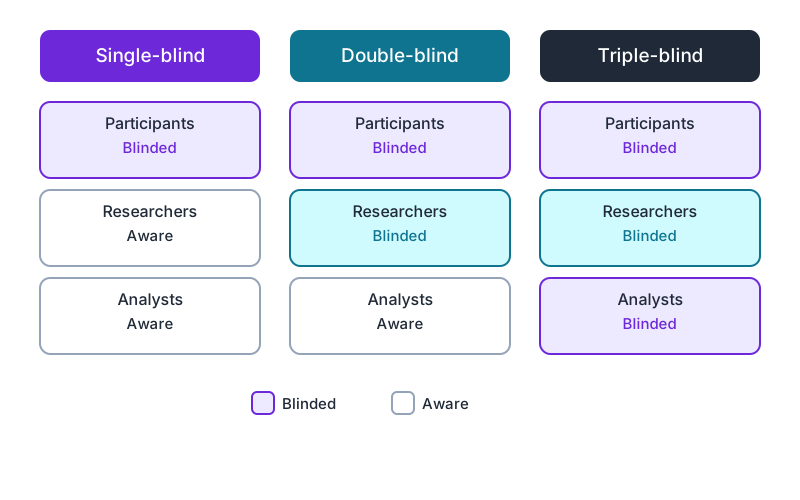
The three names differ only in who stays unaware of the assignment. The rest of the trial can look the same.
| Design | Participants know | Researchers know | Analysts know |
|---|---|---|---|
| Single-blind | No | Yes | Yes |
| Double-blind | No | No | commonly Yes |
| Triple-blind | No | No | No |
In a single-blind study, the researchers know who receives the treatment while the participants do not (Simkus, 2026). In a double-blind study, the assignment stays hidden from both participants and researchers, so neither side knows who received what. In a triple-blind study, the people who carry out the statistical analysis stay unaware as well. This is the commonly used meaning, although fields differ on who counts as the third party. In a single-blind drug trial, patients take identical pills while only the doctor knows who received the real drug (Evidentiq, 2022).
A blinding can cover many roles beyond the two main ones, including doctors, technicians, data collectors and data analysts (Evidentiq, 2022). The principle stays the same: anyone whose expectations could change behaviour or judgment stays unaware for as long as possible.
| Layer added | Bias removed | Classic demonstration |
|---|---|---|
| Single-blind | Participant expectancy, including demand characteristics and placebo response | Participants inferring the hypothesis and acting as good subjects |
| Double-blind | Researcher expectancy as well, including observer and confirmation bias | Handlers unintentionally shaping animal learning toward expected results |
| Triple-blind | Analyst expectancy in scoring and analysis | Commonly described for trials with subjective scoring |
Students often confuse the placebo group with a no-treatment group. The placebo group receives an inactive look-alike and serves as the baseline for comparison, while a no-treatment group receives nothing at all (Chegg, 2021). Most trials use two groups, treatment against placebo or control, while some add a third no-treatment arm.
Why both sides must stay unaware
Participants are not passive responders. In 1962, Martin Orne showed that volunteers try to guess what an experiment expects and then adjust their behaviour to confirm it. A review of the procedure summarizes the finding plainly. Participants tried to guess the hypothesis and adjusted their behaviour to confirm it. They acted as good subjects rather than honest responders to the treatment itself (Simkus, 2026). When participants guess the hypothesis, they produce demand characteristics rather than a clean response to the treatment.
Researchers bring expectations too. In 1963, Robert Rosenthal and Kermit Fode gave student handlers rats described as fast or slow learners, although the animals did not differ at all. Handlers with supposedly fast rats recorded faster maze learning than handlers with supposedly slow rats. The review summarizes the result plainly: the fast-labelled animals learned faster, although the rats did not actually differ in ability at all (Simkus, 2026). Expectancy alone shaped the outcome, with no intent to bias the data.
Single blinding removes only the first channel. Even with a placebo control, researchers who know the assignment may give subtle cues, attend more to one group, or read ambiguous symptoms toward the expected treatment. Double blinding closes both channels at once, so a difference between groups can be attributed to the treatment rather than to expectations on either side.
How a double-blind trial runs
The steps below describe the usual placebo-controlled form. Details differ by field, but the order stays the same.
- 1.Define the hypothesis and the outcome in advance, including how symptoms or performance will be scored.
- 2.Assign participants to groups by chance, so the groups start similar and selection cannot favour one treatment.
- 3.Make treatment and placebo look and feel the same, and give them the same way.
- 4.Keep assignment hidden from participants and from staff who interact with them or score outcomes.
- 5.Collect data the same way from every group, with no extra attention to any one group.
- 6.Unblind only at the end, then compare treatment against placebo or control and analyse by original assignment.
Unblinding can happen early for safety. If a participant develops complications, the doctor can reveal that person's assignment in order to treat them, and that participant then leaves the study (Evidentiq, 2022). The rule protects the person first and the design second.
Blinding also appears outside medicine. Taste tests use identical boxes so neither server nor taster favours one brand, and teaching examples use the same logic for a new drink or study method (Chegg, 2021). The same principle applies: hide the label, keep handling identical, and compare fairly.
What the evidence says about blinding
A large methods review combined 24 meta-epidemiological studies of trial design and asked whether reported design features predicted larger effect estimates (Page et al., 2016). For subjective outcomes, trials with lack of or unclear double blinding exaggerated intervention effects. The ratio of odds ratios was 0.77, with a 95% confidence interval from 0.61 to 0.93. This came from one meta-epidemiological study (Page et al., 2016). One minus 0.77 is 0.23, which is why summaries describe this as about 23% exaggeration on average.
The scope matters. The same review found little evidence of such bias for death or other objective outcomes. The ratio was 0.92, with a confidence interval from 0.74 to 1.14 (Page et al., 2016). Bias concentrates where human judgment enters the outcome, such as pain or symptom ratings, rather than in counts of events that leave little room for interpretation. This is why blinding matters most for the validity of subjective judgments.
Evidence varies by outcome type and by study, and later work has debated the average size of the effect. Treat the 23% figure as what one large review found for subjective outcomes, with a wide interval, not as a fixed penalty that applies to every trial. The direction is consistent: removing blinding favours the tested treatment when judgment shapes the measure.
When blinding fails or is not allowed
Blinding is impossible when the treatment cannot be hidden. A therapy with obvious side effects reveals the assignment, and treatments such as physical therapy are difficult to fake (Simkus, 2026; Evidentiq, 2022). Surgery, talking therapies and behavioural training raise the same problem: both sides can tell what was delivered (Simkus, 2026; Evidentiq, 2022).
Ethics also limits the design. Double blinding is ethical only if it serves a scientific purpose, and in most circumstances a placebo-controlled trial is unethical where a standard therapy already exists (Simkus, 2026). In such cases researchers compare the new treatment against the standard one, with blinding where still possible, rather than against no treatment.
Blinding can extend beyond drug trials, including to qualitative work where scoring or coding involves judgment, although the roles blinded differ by design (Simkus, 2026). The same rule applies: blind whoever could shape the result through expectations.
How to keep the terms apart
Students meeting these terms in research-methods units often mix three pairs at once: single against double, double against triple, and random assignment against blinding. Use one question for each pair.
Ask who knows the assignment. If only participants stay unaware, it is single-blind. If researchers stay unaware too, it is double-blind. If analysts stay unaware as well, it is triple-blind in the commonly used sense.
Ask what randomization did. Random assignment puts people into groups by chance at the start. Blinding keeps them unaware after that. A trial can randomize without blinding, but it cannot be double-blind without hiding the assignment from both sides.
Ask what the control received. A placebo control looks like the treatment but has no active effect. A no-treatment control receives nothing. An animal study with unaware researchers is commonly called a blind study. Single-blind would be inaccurate and double-blind unnecessary. Animals cannot infer the condition, as an IB teaching guide notes, so the blinded side is the researcher (Dixon, 2016).
Psychology terminology comes in near-synonym pairs that differ by one word, and learning them in isolation is what leaves you confident about each one and uncertain about which is which. In Psychology World you can save single-blind, double-blind, triple-blind, placebo and demand characteristics to one list and drill them together. Use flashcards, multiple-choice questions once the list has four or more words, or typing out the answer. Typing is the mode that really tests you. What each study mode does explains the differences. Our guide to memorising psychology terminology covers the retrieval and spacing methods with the best evidence behind them.
Frequently asked questions
What is an example of a double-blind study
A common example is a drug trial with two groups. One receives the drug and another receives an identical placebo. Neither participants nor the staff who assess symptoms know who received which. A taste test with identical unmarked boxes for two products uses the same logic outside medicine.
What is the difference between a double-blind study and a triple-blind study
In a double-blind study, participants and researchers stay unaware of assignments. In a triple-blind study, the people who analyse the data stay unaware as well, in the commonly used meaning. The extra layer guards scoring and analysis when judgment could shape the result.
Is a double-blind study the same as a randomized trial
No. Randomization assigns participants to groups by chance, while blinding keeps those groups unaware of assignments during the trial. A randomized trial can be open, single-blind, double-blind or triple-blind. The double-blind randomized placebo-controlled form is often called the gold standard.
Are double-blind studies ethical
They are ethical when they serve a scientific purpose and when withholding treatment does not harm participants. A placebo-controlled trial is generally unethical where a standard therapy already exists. In that case researchers test against the standard treatment instead.
Can blinding be used in qualitative studies
Yes, in a limited way. Blinding can cover coding or scoring where judgment enters, even when the interaction itself cannot be hidden. The roles blinded differ from drug trials, so reports should state who stayed unaware of what.
Sources
- 1.Page, M. J., Higgins, J. P. T., Clayton, G., Sterne, J. A. C., Hróbjartsson, A., & Savović, J. (2016). Empirical evidence of study design biases in randomized trials: Systematic review of meta-epidemiological studies. PLOS ONE, 11(7), e0159267.
- 2.Simkus, J. (2026). Double-Blind Experimental Study And Procedure Explained. Simply Psychology.
- 3.Evidentiq (2022). What is a double-blind study in clinical trials?
- 4.Chegg (2021). Double-blind experiment.
- 5.Dixon, T. (2016). Single and Double Blind Designs. The IB Psychology Blog.