
Deindividuation means you lose track of yourself as an individual when you feel immersed in a group. You feel less identifiable, less responsible, and less guided by your own standards. You follow the immediate situation and the people around you more than you would alone.
Students meet this term in social psychology when they study crowds, anonymity, and group behavior. It explains why ordinary people sometimes act in ways they would avoid on their own. This article defines it in plain words and traces its history. It names its causes, retells the two studies textbooks cite most, and shows what a large review found.
- Deindividuation is a loss of self-awareness and personal responsibility in a group setting.
- Common triggers are anonymity, shared responsibility, arousal, and an unstructured setting.
- Hooded students in one early study gave about twice as much shock as identifiable students.
- Anonymous trick-or-treaters in a group took extra sweets far more often than identifiable children alone.
- A review of 60 studies found only a small average effect and favors a group-identity reading.
What is deindividuation?
Deindividuation is a state in which immersion in a group lowers your self-focus and your sense of being evaluated. You feel anonymous, responsibility feels shared, and attention shifts from your own values to cues around you. Behavior then tracks the local norms you perceive, whether those norms are helpful or harmful.
This state does not always produce aggression. It can raise generosity, disclosure, and cooperation when the salient norms point that way. The key change is reduced self-regulation, not a drive toward harm. When the crowd models restraint, immersed people often show restraint.
Think of it as a shift in which identity guides you. Your personal identity fades into the background while your membership in the present group moves forward. You still act for reasons, but the reasons come more from the situation than from private reflection.
Where did the idea come from?
Gustave Le Bon described crowd behavior in his 1895 book on the crowd mind. He argued that anonymity, suggestibility, and rapid spread of ideas could turn a gathering into a psychological crowd. Members felt powerful, anonymous, and guided by contagion rather than judgment. Later writers kept the observation but rejected the claim of a single crowd mind.
Leon Festinger and colleagues gave the process its modern name in 1952. They studied small discussion groups and proposed that members who felt unidentified showed weaker inner restraints. Their paper reported more hostile remarks about parents when speakers felt harder to identify. The method now looks directive, but the term stayed.
Philip Zimbardo expanded the theory in 1969 in a Nebraska symposium chapter. He listed input conditions such as anonymity, loss of individual responsibility, arousal, sensory overload, lack of structure, and altered states from drugs or alcohol. He described the outcome as impulsive and stimulus-driven, less responsive to the victim or to normal sanctions. He also applied the idea beyond crowds to other settings where identity felt hidden.
Edward Diener shifted the focus in 1980 from anonymity itself to reduced self-awareness. In his view, anonymity and group size mattered when they pulled attention away from the self. Without self-monitoring, people regulated themselves less and responded more to immediate cues. Field work could manipulate anonymity but could not confirm the inner state directly.
Steven Prentice-Dunn and Ronald Rogers split self-awareness in 1982. Public self-awareness concerns how others judge you and falls when accountability cues fade. Private self-awareness concerns attention to your own thoughts and values and falls when arousing and absorbing settings capture you. They held that only reduced private self-awareness counted as deindividuation proper.
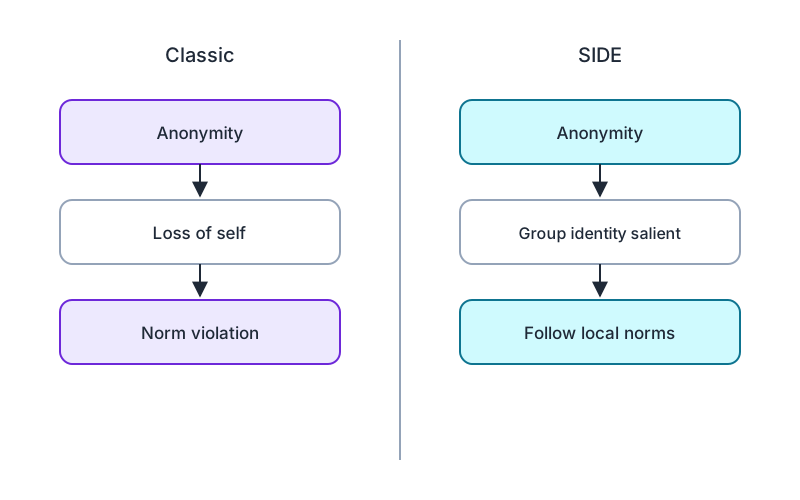
Russell Spears, Martin Lea, and Tom Postmes proposed the social identity model of deindividuation effects in 1995. In this view, anonymity does not erase identity but makes group membership more salient. People follow the norms of the salient group rather than acting at random. A religious procession, a work team, and a hostile mob can each produce conformity, but to different norms.
Why does it happen?
No single trigger explains every case. Studies manipulate a set, and effects depend on which norm feels salient. The triggers below appear across the classic work (EBSCO (2019). Deindividuation.).
- Anonymity. Others cannot identify you, so fear of evaluation drops.
- Shared responsibility. Accountability spreads across members, so personal guilt feels lower. Readers who know diffusion of responsibility in the bystander effect will recognise this mechanism.
- Arousal and sensory overload. Noise, crowding, and pace capture attention and leave less capacity for self-monitoring.
- Unstructured or unfamiliar settings. Clear roles and scripts are missing, so people copy what others do.
- Group size and immersion. Larger and more cohesive gatherings increase anonymity and normative pressure. This overlaps with mere presence effects on performance but adds identity change.
- Altered states. Alcohol, drugs, fatigue, and strong emotion reduce self-observation.
Any one cue rarely suffices. A masked runner alone at dawn feels anonymous but still follows personal goals. The same mask in a loud stadium crowd, with shared chants and no clear script, creates stronger pressure to match the group.
Which two studies should you remember?
Two findings return in textbooks because they are easy to picture. Both use simple behavior as the measure. Both have limits you should state when you cite them.
Hooded students and shock duration
Zimbardo tested whether hiding identity raised aggression toward another student. Female volunteers believed the study concerned creativity under stress. They controlled how long a supposed shock lasted for a peer they heard but could not help. Hooded participants wore large coats and hoods in dim light and were never named. Identifiable participants wore name tags in brighter light (Simply Psychology (2026). Deindividuation in Psychology.).
Hooded students delivered roughly twice as much shock duration as identifiable students, and their durations rose across trials. Identifiable students adjusted to the victim. They eased off for a likeable peer and increased for an unlikeable one, while hooded students treated both alike. The authors read this as reduced stimulus control under deindividuation.
A second study with Belgian soldiers found the opposite pattern. Hooded soldiers felt self-conscious and anxious rather than aggressive. Uniformed soldiers kept their usual low identifiability and gave longer shocks. Zimbardo concluded the hood manipulation had failed for soldiers and that uniforms already anonymised them. The reversal warns against a simple rule that concealment always raises aggression.
Halloween sweets and stealing
Diener and colleagues moved the test outdoors to ordinary trick-or-treaters. More than 700 children met bowls marked take one on Halloween night. Homeowners either asked each child for a name or created anonymity. Children arrived alone or in groups. The measure was taking more than one sweet (Simply Psychology (2026). Deindividuation in Psychology.).
| Condition | Took extra |
|---|---|
| Anonymous and in a group | 57% |
| Anonymous and alone | 21% |
| Identified and in a group | 21% |
| Identified and alone | 8% |
Anonymity and group membership each raised stealing on their own. Children who were both unidentified and grouped took extra at about seven times the rate of identified loners. The strength is ecological validity in a natural ritual. The limit is mechanism. The design manipulated anonymity and group size but did not measure reduced self-focus directly.
What does it look like in everyday life and online?
Crowds provide the clearest cases. Spectators chant abuse they would not shout alone. Queues dissolve into pushing when exits feel blocked. Uniformed roles, from teams to services, reduce individual markers and raise group salience. The same process can raise giving during charity drives when generosity feels expected.
Online settings recreate several triggers without physical proximity. Comment threads, games, and group chats reduce identifiability and eye contact. Responses arrive fast and norms feel local. People disclose more, support strangers, and also flame, harass, and pirate. One programme of research found lack of eye contact predicted hostile language more strongly than anonymity alone, which refines the simple anonymity story (Simply Psychology (2026). Deindividuation in Psychology.).
Group size matters online as it does offline. Large forums and live chats increase immersion and make local models more influential. An aggressive model comment raises later aggression among anonymous readers more than the same comment raises it among identifiable ones. Visible supportive replies can pull behavior the other way, consistent with following salient norms rather than losing all norms.
To sort cases, ask three questions. Who could identify me here. Which norm feels expected right now. Would I act this way if my name and face were visible. If the answers change together, deindividuation is a plausible description, not a proved inner state.
How is it different from nearby ideas?
Students confuse this family of terms because all involve other people. Each term answers a different question. The table defines each in one sentence and points to our deeper explainers.
| Term | One-sentence distinction |
|---|---|
| Deindividuation | You feel immersed and unidentifiable, so the immediate group situation guides you more than private standards. |
| Conformity follows group pressure while staying identifiable | You match others while still feeling like yourself, often to fit in or be correct. |
| Diffusion of responsibility in the bystander effect | Responsibility spreads across witnesses, so each person feels less pressure to act. |
| Groupthink and polarization | A cohesive decision group narrows options or shifts them more extreme, as in group polarization in online discussion. |
| Social facilitation | Others are present but you remain identifiable, and arousal changes how well you perform learned tasks. |
| Social identity and group norms | You act as a group member because that membership feels salient, which is the mechanism SIDE proposes. |
| Following norms to fit in | You follow perceived social rules, either to belong or because others seem informed. |
Spelling also causes errors. Deindividuation is the social-psychological term. Deindividualization is a different form and usually a misspelling in this context. Use the i-form for the crowd process and check your list before you save it.
What does the evidence really say?
A broad quantitative review changed how researchers teach this topic. Postmes and Spears gathered 60 studies with 4,714 participants and found a small average link between deindividuating manipulations and behavior against general social norms (Postmes and Spears (1998). Deindividuation and antinormative behavior: A meta-analysis.). The effect was statistically reliable but modest. Variation across studies was high, which argues against a single robust state.
The same review found little support for a general deindividuated state that always produces norm violation. People who felt less identifiable conformed more closely to situation-specific norms (Postmes and Spears (1998). Deindividuation and antinormative behavior: A meta-analysis.). Reduced concern about being judged and anonymity toward outsiders showed small consistent effects. Direct manipulations of private self-awareness did not show a reliable general effect in that set.
This pattern supports the social identity reading over the classic release reading. Anonymity heightens the salient group identity rather than removing identity altogether. The St Pauls riot analysis often cited for SIDE found selective targeting of symbols of power and sparing of local shops, which fits norm-guided action rather than random impulse.
Three limits belong in any honest account. Most classic work is laboratory based with students and shock or noise measures, which limits generalization. Field designs show behavior but cannot verify the inner state they invoke. Costume meaning confounds concealment, as shown when hoods resembling one group raised aggression while nurse uniforms lowered it despite equal coverage. State these limits when you use the term.
How can you test yourself?
Use these prompts after you read, not during. Answer in your own words, then check the sections above.
- 1.Define deindividuation in one sentence without copying this article. Name loss of self-focus and guidance by the immediate group.
- 2.Name two causes and the mechanism for each. If you choose anonymity, add reduced fear of evaluation.
- 3.Sort one example. Decide whether a loud stadium chant fits deindividuation, conformity follows group pressure while staying identifiable, or diffusion of responsibility in the bystander effect. State the cue that decides it.
- 4.Explain the Belgian-soldier reversal in one sentence. Show that concealment alone does not fix behavior without the salient norm.
To keep these terms apart, save deindividuation and its neighbours to a list and drill the list with Flashcard, Question and Typing on iPhone and iPad. Short daily rounds beat rereading because you practise active recall.
Frequently asked questions
What is an example of deindividuation?
Anonymous trick-or-treaters in a group took extra sweets far more often than identifiable children alone. Online pile-ons, stadium chants, and uniformed excesses follow the same logic when local norms favour them.
What are two causes of deindividuation?
Anonymity and shared responsibility are the two most cited causes. Anonymity lowers fear of evaluation, while shared responsibility spreads accountability across members. Arousal and unstructured settings add to both.
What is Zimbardo's theory in one line?
Zimbardo proposed that anonymity, arousal, and related input conditions reduce self-observation and weaken normal restraints. Later work recast the mechanism as reduced self-awareness and then as a shift to group identity.
How is deindividuation different from conformity?
Conformity means matching others while you still feel identifiable. Deindividuation means feeling immersed and unidentifiable, so the immediate group situation guides you more strongly.
Is deindividualization a word?
It appears as a variant spelling, but the established term for this process is deindividuation. Use deindividuation in notes and lists to match textbooks and search results.