
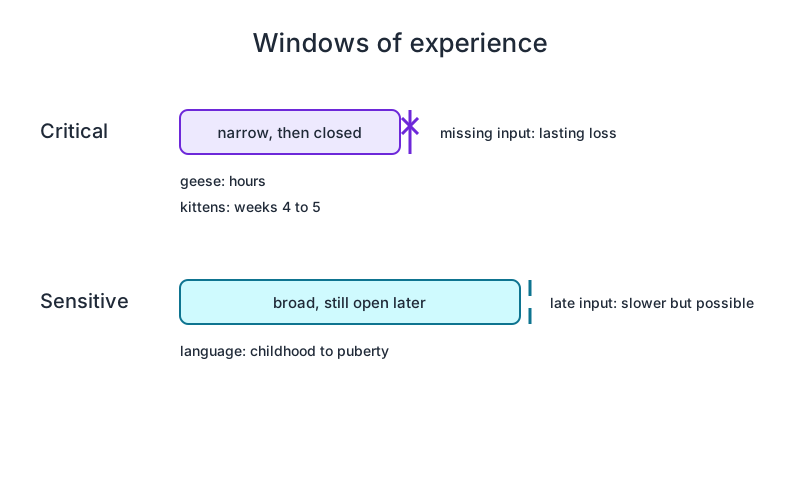
A critical period is a limited window when a specific experience must occur for normal development, or the outcome stays impaired. A sensitive period is a broader window when experience has an unusually strong effect, but learning remains possible later with more effort.
- A critical period requires input. Without it, the change is lasting or irreversible.
- A sensitive period favors input. With it, learning is faster and stronger. Without it, learning is slower but still possible.
- Filial imprinting in geese is the classic critical period, about 13 to 16 hours after hatching.
- Monocular vision in kittens is the classic brain critical period, with peak sensitivity in weeks 4 and 5 and closure near month 3.
- Language exposure from early childhood to puberty is the classic human sensitive period, with vocabulary easier to acquire late than grammar.
- Modern reviews treat a critical period as a special irreversible subclass of sensitive periods, and prefer the word sensitive for most human development.
Critical vs sensitive in one table
| Point | Critical period | Sensitive period |
|---|---|---|
| Core question | Must the input occur now for normal development | When does input have the strongest effect |
| Timing shape | Narrow window with clear start and end | Broad window with gradual rise and fall |
| If input is missing | Lasting or irreversible change | Weaker or slower learning, but later learning possible |
| If input arrives late | Little or no full repair | Repair possible with more time and effort |
| Classic example | Geese imprinting in hours after hatching | Second language grammar in childhood |
| Human example most cited | Early binocular vision in the first years | First language and second language learning |
The table gives the distinction. The sections below give the evidence behind each row, so the rule does not stay abstract.
What a critical period means
A critical period is a time when a given behavior needs a specific environmental input to develop normally. After the window ends, the behavior stays largely unaffected by later experience. Failure to receive the input during the window is hard or impossible to remedy fully. This definition comes from the Neuroscience textbook chapter on critical periods, which summarizes animal and human work on vision and language.
The American Psychological Association dictionary states the same idea in shorter form. It defines a critical period as an early stage when an organism is especially open to specific learning or socializing experiences that will not recur at a later stage. It lists imprinting in ducks in the first days of life and binocular visual stimulation after birth as examples.
A key review by Eric Knudsen adds the circuit view. Sensitive periods are times when experience has an unusually strong effect on a neural circuit. Critical periods are the subset when experience is essential for normal performance and alters the circuit permanently. In this view, a critical period is not the opposite of a sensitive period. It is the strictest case within it. Complex behaviors such as attachment or intelligence reflect many such windows in different circuits, so one behavioral test underestimates them.
What a sensitive period means
A sensitive period is a developmental window when experience shapes the brain more strongly than at other times. Similar experience outside the window still has an effect, but reorganization is less strong. Both sensitive and critical periods involve heightened plasticity. The difference is reversibility and strength of the late effect.
Recent theory prefers the word sensitive for most human development. The reason is that onsets and ends are flexible and depend on environment, not fixed like a timer. An encyclopedia entry on sensitive periods cites Michel and Tyler on this shift. It states that the older term critical period assumed innate fixed onset and termination, while newer work shows flexibility, so sensitive is now more common.
Reviews of children raised in institutions reach the same caution for humans. They find little evidence for strict critical periods in human brain development beyond early perception. They therefore focus on sensitive periods. A review of emotional development adds a second caution. Negative early experience alone does not prove a sensitive period. Proof requires that input at one age changes outcome more than the same input at another age, for a specific process. For emotion, which combines face perception, reward, and fear learning, robust windows for broad outcomes remain limited.
The animal work that named the terms
Two animal studies gave the terms their meaning. One concerns following and bonding. One concerns vision.
Geese that follow the first moving object
Konrad Lorenz described imprinting in precocial birds in 1935 and 1937. Young greylag geese learn the visual traits of a parent soon after hatching and then follow it and treat it as the social target. If the first suitable moving stimulus is Lorenz himself, or his boots, or a box on a model train, the goslings follow that object instead. The window lasts about 13 to 16 hours after hatching in his report. Textbooks often round it to 12 to 16 hours.
Three traits made the case special. The window was very short. The result was irreversible. The object learned early could later guide sexual responses, even when the bird had lived with its own species in the meantime. In one report, a male Muscovy duck raised by greylag geese later courted greylag geese instead of Muscovy ducks. A gosling isolated for over a week and attached to humans kept following humans even after two weeks with a turkey hen for warmth. Lorenz concluded that the process fixes the target of social responses in a way ordinary associative learning does not.
For exams, imprinting is the safe critical-period example. It is short, specific, and irreversible in the classic description.
Kittens that lose vision in one eye
David Hubel and Torsten Wiesel closed one eyelid of kittens early in life and recorded from visual cortex. With monocular closure during the first months, very few cortical cells still responded to the deprived eye. The ocular dominance distribution shifted so that almost all cells responded to the open eye. The retina and thalamus still worked. The loss was cortical. Behaviorally, the animal was blind in the deprived eye. Opening the eye later gave only limited cortical recovery.
Timing mattered. Susceptibility started near the beginning of week 4, stayed high through weeks 4 and 5 into weeks 6 to 8, then declined and ended near the end of month 3. At the peak, 3 to 4 days of closure already caused a sharp shift. A 6-day closure reduced the share of cells the closed eye could drive to a fraction of normal. A 3-month deprivation from birth dropped it from about 85 percent to about 7 percent. A year of closure in an adult cat caused no such change.
Monkeys showed the same pattern with a longer window, to about 6 months. Human clinical observations suggest susceptibility most pronounced in the first year and extending to 5 to 10 years. Wiesel summarized this gradient in his Nobel lecture.
For exams, monocular vision is the safe brain critical-period example. It has numbers, a peak, and an adult control.
Language in humans: sensitive more than strictly critical
Language is the human case students meet most. Eric Lenneberg proposed in 1967 that primary language acquisition runs from about age 2 to puberty. Before 2, maturation blocks it. After puberty, completion of lateralization reduces plasticity. Minimal exposure is still required. The case of Genie became the direct test.
Genie was discovered at 13 years and 9 months after extreme isolation with almost no language input. At discovery she had no language. After years of exposure and study, reported by Susan Curtiss and colleagues in 1974, she acquired vocabulary steadily. She learned singular and plural nouns, negation, possession, prepositions such as under and beside, conjunction with and, and comparatives and superlatives. By about 17 she used vocabulary at roughly a 5-year-old level in comprehension tests and combined words to express meanings.
Grammar lagged far behind. Production stayed telegraphic, without consistent tense, function words, or complex syntax. Comprehension of grammar stayed below other cognitive scores. Vocabulary shows learning beyond puberty. Syntax shows a stronger constraint.
Strict irreversibility for all language does not fit Genie, because she did learn words and meanings. A sensitive period fits better. Early exposure gives fluent grammar with ease. Late exposure still gives words, but grammar needs far more effort and stays limited. Second language data fit the same shape: exposure before age 7 often gives native-like grammar, later exposure gives lower proficiency but not zero.
Readers who study lateralization can link this section to the brain basis of language. The contrast between left-hemisphere language dominance and bilateral early processing helps explain why timing matters, as described in work on Broca vs Wernicke aphasia.
How to sort any exam case in three questions
Use three questions in order. Write them as commands on a practice card.
- 1.Ask what the input must do. If the behavior needs a specific input to develop at all, mark it as critical candidate. If input only boosts speed or strength, mark it as sensitive candidate.
- 2.Ask what missing input causes. If missing input causes lasting loss despite later input, keep critical. If later input still teaches the skill with more effort, choose sensitive.
- 3.Ask whether late repair fully restores the function. If repair stays partial at the circuit level, keep critical. If repair reaches normal function with effort, choose sensitive.
Apply the test to the classics.
- Geese following: must see a parent figure in hours, or bonding misdirects and stays misdirected. Critical.
- Kitten monocular vision: must receive balanced binocular input in weeks to months, or cortex shifts to the open eye with limited recovery. Critical.
- Second language grammar: benefits strongly from early exposure, but adults still learn with effort. Sensitive.
- First language after extreme isolation: words return more than grammar. Sensitive framing with a strong constraint on grammar, not zero learning.
Students who save these four terms to a Development list can drill them with flashcards until the mapping is instant. Look up the term, save it to a named list, and turn that list into a quick study game.
Do not confuse a window with a stage. A stage theory describes a sequence every child passes through, such as the sensorimotor to formal sequence in Piaget's stages of cognitive development. A window describes when input has maximal effect on a specific circuit. Attachment timing links to care experience in the first years, as summarized in work on the four attachment styles, but human attachment research does not support one strict critical period in the Lorenz sense. Treat it as sensitive and process-specific.
What the terms do not mean
A critical period is not any important childhood stage. Erikson stages, Piaget stages, and puberty are not critical periods by themselves. They become relevant only when tied to a specific input and a specific outcome with timing data.
Sensitive does not mean fragile or emotional. It means plastic. A sensitive child in everyday language is not the same as a sensitive period in development.
Critical does not mean the brain stops learning after the window. Adult learning continues. The claim is narrower. A specific circuit loses its early ease of rewiring and needs more energy to change, as Knudsen describes.
Sensitive does not mean everything is equally reversible. Some sensitive effects still leave lasting traces, especially after severe deprivation. The distinction is about degree and effort of repair, not about care being unimportant.
Frequently asked questions
What is the difference between a critical and a sensitive period in one sentence
A critical period is a narrow window when a specific experience must occur or the outcome stays impaired, while a sensitive period is a broader window when experience has the strongest effect but later learning is still possible.
Is language a critical or sensitive period
Language is best described as a sensitive period with a strong constraint on grammar. Early exposure gives fluent grammar. Late exposure still builds vocabulary but grammar stays limited, as Genie showed after isolation until age 13.
Is there a critical period for attachment in humans
No strict critical period in the Lorenz sense has been shown for human attachment as a whole. Early care has a strong effect and later care still helps. Treat attachment timing as sensitive and tied to specific processes such as face recognition, stress regulation, and trust.
What is the classic exam example for each term
Use geese imprinting in the first hours for critical, and second language grammar in childhood for sensitive. For brain mechanism, use kitten monocular vision with peak in weeks 4 and 5 for critical.
Can adults still learn after a sensitive period ends
Yes, but with more effort and often to a lower ceiling for that specific skill. Adult second language learning, late vision therapy, and late vocabulary growth all show partial but real gains.
Sources
- 1.Eric Knudsen (2004). Sensitive periods in the development of the brain and behavior. Journal of Cognitive Neuroscience.
- 2.Konrad Lorenz (1937). The companion in the bird's world. The Auk.
- 3.Torsten Wiesel - Nobel lecture on visual development and critical periods.
- 4.Hubel and Wiesel (1970). The period of susceptibility to unilateral eye closure in kittens. Journal of Physiology.
- 5.Fromkin and colleagues (1974). The development of language in Genie: a case of language acquisition beyond the critical period.
- 6.Neuroscience - Critical periods in visual and language development. NCBI Bookshelf.
- 7.Biological Psychology, Chapter 7.5: Sensitive and critical periods of development. Pressbooks.
- 8.Sensitive periods. Encyclopedia entry on terminology shift toward sensitive periods.
- 9.Institutional rearing and sensitive periods in human brain development. PMC review.
- 10.Sensitive periods in emotional development. PMC review.