
When one item in a set stands out from the rest, you remember that item better than the others. Psychologists call this the von Restorff effect, also known as the isolation effect. It dates to 1933, and it gives you a practical tool: make the thing you must remember the odd one out.
- The effect: a distinctive item among similar items is recalled better than its neighbours.
- The origin: Hedwig von Restorff reported it in 1933 with lists of similar words containing one isolate.
- The reason: the isolate draws extra attention during learning and offers a stronger cue at recall.
- The limit: the boost fades when everything is distinctive, and it varies from person to person.
- The use: isolate one key term per study list, mark it visually, and test yourself on it.
What the von Restorff effect is
The von Restorff effect predicts that when several similar items appear together, the one that differs from the rest is the one people recall best. The classic demonstration uses the isolation paradigm: participants study a list of categorically similar items with one distinctive item hidden in it, then recall as many as they can. The isolate wins (Wikipedia).
The theory is named after Hedwig von Restorff (1906–1962), a German psychiatrist and pediatrician. In her 1933 study she presented lists of similar items with one isolated item and found that memory for the isolated item improved (Laws of UX). Nearly a century later, the finding still replicates, including in a 2025 study of free recall, recognition, and source memory.
Distinctiveness can come from meaning or from physical features. A word can differ in sense, or it can differ in size, shape, color, spacing, or underlining. The textbook example is a furniture list — desk, chair, bed, table, chipmunk, dresser, stool, couch — where "chipmunk" stands out because it is an animal among furniture. A shopping list with one item highlighted in bright green works the same way through color rather than meaning.
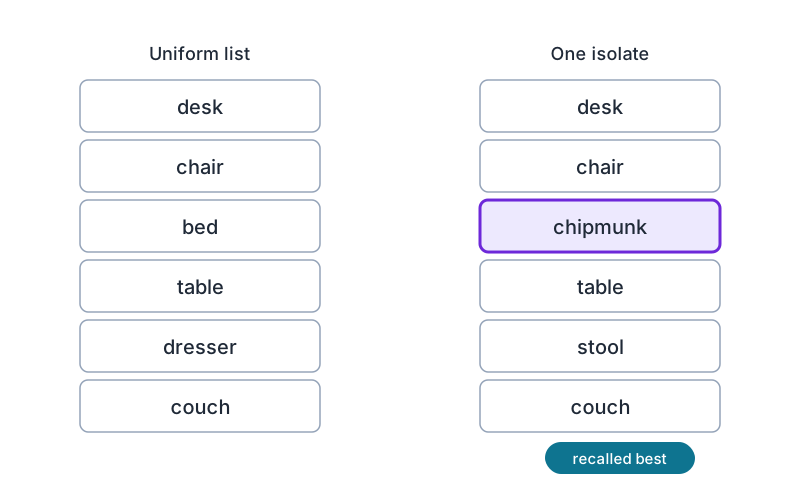
For a map of the wider family of memory biases this effect belongs to, read our overview of cognitive biases.
Why the odd one stands out
Researchers explain the effect in three ways, and each one is probably part of the truth.
First, attention. Noticing that an item differs from its neighbours takes extra mental work, so the isolate gets more attention during learning. Direct support comes from brain recordings: isolated items evoke a larger P300 wave, a signal of attentional engagement, and the size of that signal predicts later recall (Karis, Fabiani, and Donchin, 1984).
Second, rehearsal. The total-time hypothesis says people repeat the isolate more in working memory than the surrounding items. Longer rehearsal produces deeper encoding and a stronger memory trace.
Third, retrieval cues. People seem to file the isolate in its own mental category, which hands it a unique cue at test time. When every other item shares one category and the isolate has one of its own, the isolate is easier to locate in memory (Chee and Goh, 2018).
Brain research points the same way. Frontal brain regions help detect and process distinctive stimuli, and patients with frontal damage form new memories that lack distinctiveness (Elhalal, Davelaar, and Usher, 2014). The effect even appears in monkeys, which suggests roots in how brains handle the unexpected in general (Parker, Wilding, and Akerman, 1998).
Where the effect breaks down
The effect is reliable, but it has edges worth knowing before you rely on it.
Context decides what counts as distinctive. Modern theory holds that the isolate must violate an established pattern. It is the contrast with the background, not any property of the item alone, that draws the extra attention. This debate goes back to Hunt (1995), who showed that distinctiveness is subtler than von Restorff's original account suggested — her 1933 lists showed a boost regardless of where the isolate sat, which later work qualifies.
Age moderates it. College students show a clear isolation boost in immediate memory tests, while older adults show a smaller one, consistent with a reduced ability to bind a distinctive item to its context (Bireta, Surprenant, and Neath, 2008).
Strategy moderates it too. People who already use elaborate memory strategies show little or no isolation effect. Their encoding is distinctive throughout, so one more distinctive item adds nothing (Karis, Fabiani, and Donchin, 1984). And most lab evidence comes from short word lists; a 2025 study argues such designs may even understate the effect as it works in richer material.
Two near neighbours deserve one line each. Serial position effects (primacy and recency) come from an item's place in a list, not from standing out. The bizarreness effect comes from strange imagery, not from contrast with neighbours.
How to use isolation when you study
The principle converts directly into study tactics. Each tactic isolates one item against a uniform background. Use one tactic per list: when everything is marked, nothing is.
- 1.Isolate one term per list. When you build a study set, pick the single term that matters most and give it a distinct treatment. Keep the rest of the list uniform.
- 2.Mark it visually. Use one color, one underline, or extra spacing for the isolate only. Textbook designers use the same principle when they color-code key concepts.
- 3.Give it its own category. File the isolate under a separate heading or group the surrounding terms so the background reads as one block. A lone item with its own cue is easier to retrieve.
- 4.Pair it with deep processing. Distinctiveness helps encoding, and meaning keeps it there: connect the isolate to something you know, the way deeper processing helps memory. A visual code or a memory palace image makes the isolation stronger still.
- 5.Test the isolate, then space the rest. Quiz yourself on the marked item first, then review the whole list on later days: spreading repetitions protects what encoding started.
One caution: highlighting every other line in a chapter destroys the background the effect needs (Coglode). Restraint is part of the technique.
A study app can carry part of this for you. In Psychology World you can bookmark the terms you must learn into a named list, then drill that list with flashcards until the isolate stops being an isolate and becomes knowledge.
Frequently asked questions
Who was Hedwig von Restorff?
She was a German psychiatrist and pediatrician (1906–1962) whose 1933 study gave the effect its name. She showed that an isolated item among similar items is recalled better than the rest, and the finding carries her name because her experiment defined the isolation paradigm later researchers kept using.
Can you give an example of the von Restorff effect?
Study this list: desk, chair, bed, table, chipmunk, dresser, stool, couch. Most people recall "chipmunk" first. It differs in meaning from every other word, so it draws extra attention and carries its own retrieval cue.
Why does the von Restorff effect happen?
Three accounts share the credit. The distinctive item draws extra attention, gets rehearsed longer, and receives its own retrieval cue because it sits in a category of one. Brain recordings support the attention account: isolated items evoke a larger P300 response, which predicts recall.
Is the isolation effect the same as the serial position effect?
No. Serial position effects depend on where an item sits: first items benefit from primacy, last items from recency. The isolation effect depends on contrast with neighbours, wherever the item sits. A normal item at the start of a list gains primacy; a distinctive item anywhere gains isolation.
Does highlighting textbooks actually work?
Highlighting applies the principle: one marked passage stands out against plain pages. It helps only with restraint. When marks cover whole chapters, the background is no longer uniform and the boost disappears. Mark one key point per page, then test yourself on it.