
A tip-of-the-tongue state is a retrieval block with the meaning intact. You know what you want to say, and you feel the word is close. You may even know its first letter or its syllable count. The full form still will not come. Psychologists call this state lethologica. They treat it as a window into recall: meaning and sound travel by separate routes. The sound route can stall while the meaning route arrives.
What a tip-of-the-tongue state is
A tip-of-the-tongue state has three parts, and all three must hold. First, you cannot retrieve the word right now. Second, you hold a strong feeling that retrieval is imminent, that the word sits just out of reach. Third, you keep partial knowledge of the word, such as its first letter, its rhythm, or a similar-sounding word. A typical case: you see an actor's face clearly and know the film, but the name will not come. William James described this state in 1890 in The Principles of Psychology, and it has kept its name from everyday speech ever since.
The state differs from two nearby states. A feeling of knowing means you believe you would recognize the answer from a list, without sensing that recall is seconds away. Ordinary forgetting means the trace itself seems gone, with no partial clues and no sense of nearness. In a tip-of-the-tongue state the trace is present and the clues are real. That difference matters, because the clues predict that you will recall the word soon. Recall itself comes in formats that test makers exploit. The difference between recall tests explains the strange part: a word you cannot produce now may still feel known.
The partial clues also mark the state as a failure inside explicit memory. You consciously chase a fact you once learned, and the conscious route stalls. Implicit habits and skills keep running fine meanwhile. The block feels strange for that reason: one memory system works while another halts.
The 1966 experiment that proved the feeling is data
Roger Brown and David McNeill ran the first laboratory study of the state in 1966 at Harvard. They read participants the definitions of rare words, nothing more, and asked them to name the defined word. When a participant reported a tip-of-the-tongue state, the researchers asked what else they knew about the missing word. They asked before revealing it.
The results showed the feeling was genuine information, not illusion. Participants in a tip-of-the-tongue state recalled the first letter of the target, its number of syllables, and words similar in sound or meaning. All at rates better than chance. They knew the shell of the word while missing its body. Later work kept the same definition-naming task as the standard laboratory method. Read a definition of a low-frequency word. Report whether you know it, do not know it, or sit on its tip. Then measure which partial clues you hold.
The study also set the pattern every later theory must fit. Any account of the state must explain how a person can know so much about a word and still fail to say it.
What causes the block
Current research describes three accounts, and they cover three different jobs: the failure, the rival, and the feeling.
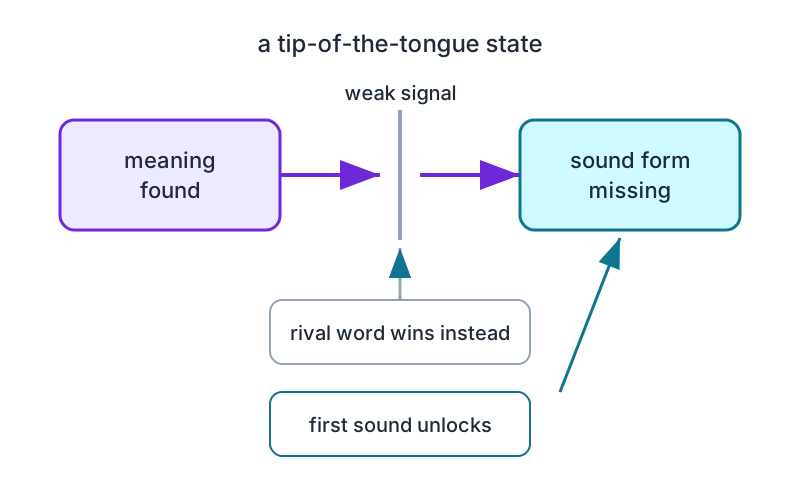
The transmission-deficit account, proposed by Deborah Burke and colleagues, remains the most influential. It holds that word retrieval runs in stages. Meaning nodes activate first, then activation must travel onward to the nodes that store the sound form. In a tip-of-the-tongue state the first stage succeeds and the second stalls: the signal from meaning to sound is too weak to cross the threshold. Aging, disuse, and low word frequency weaken these links, which fits the finding that older adults and rare words produce more blocks.
The blocking account points to a rival instead of a weak link. A related wrong word, an interloper, reaches threshold first and occupies the channel. A classic laboratory example is retrieving harp when the target is lyre. Brain imaging during tip-of-the-tongue states shows extra activity in the left inferior frontal gyrus and the anterior cingulate cortex. These regions select among rivals and monitor conflict. Whether blockers truly cause the state or merely ride along is still debated. Giving people blockers in experiments sometimes helps rather than harms retrieval.
The monitoring account explains the feeling itself. The cognitive system reads partial cues, such as semantic familiarity and contextual fit, and judges that recall is near. That judgment is the feeling of imminence, and it has a use. People with stronger familiarity signals persist longer, and persistence raises the chance of success. The feeling is the system telling you to keep searching.
Why some words stick more than others
Frequency decides much of the pattern. Rare words produce more tip-of-the-tongue states than common ones, because their sound links get less practice. Proper names are the worst case. A name links to one person only, with no meaning network to support it. So names of people and places block most often.
Bilingual speakers report more states in their weaker language, and they retrieve picture names more slowly even in their dominant one. Two language systems share the channel, so selection costs rise. Strong emotion around the target also raises the rate. Emotional states tend to be recalled later. That fits the monitoring story: arousal marks the trace as important and keeps the search alive.
Age raises the rate most clearly. Older adults experience roughly twice as many tip-of-the-tongue states as young adults, above all for rare words and names. Their grasp of meanings stays intact. The sound links weaken; the knowledge does not. Frequent states on their own do not signal dementia. Research finds no link between everyday tip-of-the-tongue frequency and dementia. A sudden, severe loss of word-finding after injury or stroke is a different matter. It belongs to a clinician.
What brings the word back
The most reliable rescue is a first-sound cue. Hearing or seeing the initial letter or syllable often unlocks the full form within seconds. That follows directly from the two-stage story: the cue feeds the stalled sound route. A related word with a similar sound can help the same way. It can also become a new rival. So cues work best when they match the target closely.
Waiting helps too. Stepping away and returning later resolves many states, because the wrong rival fades while the target's activation persists. Trying harder by repeating the same failed search tends to deepen the rut instead. A short break, a different task, and one fresh attempt beats a long grind at the same blocked path.
For students the lesson is practical. A tip-of-the-tongue state during revision marks a weak sound link, not a lost fact. The meaning is present, so the efficient move is to retrieve the full form once, check it, and schedule another retrieval soon. That cycle is the core of spaced repetition: repeated, spaced recall strengthens exactly the links that stall. Quick retrieval games on a saved list of terms train the same motion, turning a stuck moment into a durable trace.
Frequently asked questions
What is the tip-of-the-tongue phenomenon in psychology?
It is a temporary state in which you cannot retrieve a known word despite intact knowledge of its meaning. Recall still feels near. You often keep partial clues such as the first letter or syllable count. Psychologists study it as a retrieval failure, not as forgetting.
Is lethologica the same thing as the tip-of-the-tongue phenomenon?
Yes. Lethologica is the technical term for the same state. It names the experience, not a disorder. Frequent everyday states are normal. Only word-finding loss caused by brain injury, stroke, or dementia counts as a clinical condition, called anomic aphasia.
Why do I remember the first letter but not the word?
Because retrieval runs in stages. Your memory of the meaning and the shell of the word, its first letter and rhythm, activates while the full sound form stays below threshold. Brown and McNeill showed in 1966 that these partial clues beat chance, so they are real traces of the target.
Is a frequent tip-of-the-tongue state a sign of dementia?
On its own, no. The rate rises with normal aging while comprehension stays intact, and studies find no link between everyday frequency and dementia. Treat a sudden or severe loss of word-finding, especially after a head injury or stroke, as a reason to see a clinician promptly.
Does the tip-of-the-tongue phenomenon happen in other languages?
Yes. A 1999 survey found a tongue, mouth, or throat idiom for the state in 45 of 51 languages studied, which suggests a shared human experience. Signers of sign languages report a tip-of-the-finger variant.