
Social facilitation means the presence of others changes how you perform. Others help when the task is simple or well learned. They hurt when the task is complex or new. The rule is task dependent, and it has held since the first tests in 1898.
What social facilitation is
Social facilitation is the change in performance that happens when other people are present. The others do not coach, help, or compete in a formal way. They are present as co-actors or as an audience. A co-action effect means you work side by side with others on the same task. An audience effect means passive watchers observe you.
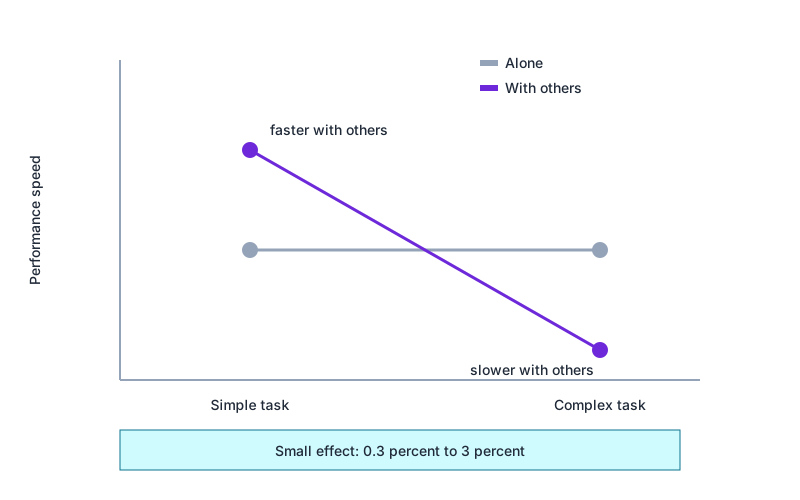
The direction depends on what you do. Simple or well practiced tasks get faster or more accurate with others present. Complex or unfamiliar tasks get slower or less accurate. Psychologists call the first outcome facilitation and the second inhibition. Both belong to the same effect.
Two nearby terms describe different effects. Social loafing is a different effect and the table keeps it apart. The bystander effect describes why people help less when others are present. The mechanism differs.
The first tests
Norman Triplett started the work with bicycle race records from 1897 and a laboratory task. He saw that riders went faster with pacemakers and rivals than against the clock alone. He then asked children to wind fishing reels as fast as possible, alone and side by side with another child. The apparatus used two reels on a Y frame with silk bands and a flag course of 16 meters per trial, timed with a stopwatch after practice and rest intervals. (Triplett 1898)
The results were mixed, and that matters. Of 40 children in the main tables, about half wound faster with a co-actor. A smaller group went slower from over excitement, with labored breathing, flushed faces, and stiff arm muscles. A few showed little change. Triplett concluded that the bodily presence of another contestant releases energy not otherwise available, and that the sight of movement suggests a higher rate. Textbooks often report only the faster half. The original paper reports both. (Triplett 1898)
Floyd Allport gave the effect its name. He called it social facilitation in work he published in 1920 and in his 1924 book Social Psychology. His co-action studies found faster output on simple tasks such as cancellation and word association with others present, with worse quality on tasks that needed careful thought. (EBSCO Research Starter)
Early work also found the cost side. John Pessin found in 1933 that students needed fewer trials to learn lists of nonsense words when alone than when watched by an audience. Travis found in 1925 that trained subjects did better on a pursuit rotor task before spectators. Dashiell found in 1935 that an audience raised the number of simple multiplications completed. The pattern was present before anyone explained it: presence helped easy performance and hurt new learning. (Simply Psychology)
Why others change performance
Robert Zajonc gave the field a single rule in 1965 in Science. Presence raises arousal or drive. Raised drive strengthens the dominant response. The dominant response is the response most likely in that situation. On easy or well learned tasks the dominant response is usually correct, so presence helps. On hard or new tasks the dominant response is usually wrong, so presence hurts. (EBSCO Research Starter)
Three accounts explain where that drive comes from. They answer different parts of the same question.
First, drive from mere presence. Zajonc argued that the presence of any potentially active other raises alertness for the unexpected. The body prepares to respond to what others might do. That account predicts the effect even without judgment.
Second, drive from fear of judgment. Nickolas Cottrell argued in 1968 that what matters is evaluation apprehension, not mere presence. People learn that others judge them, so an audience that can judge raises arousal. In his test, two attentive observers produced the usual boost to dominant responses. Two blindfolded observers who could not judge did not. The result matched the alone condition. (Simply Psychology)
Third, drive from split attention. Robert Baron argued in 1986 that presence creates distraction-conflict. You attend to the task and to the others at the same time. The conflict raises drive and narrows attention. Narrow attention helps when the key cues sit in front of you. It hurts when you must use scattered cues across a complex task. Sanders, Baron, and Moore found support in 1978 by varying how similar a co-actor task was to the participant task. (Simply Psychology)
A later physiological account keeps the same task rule. Blascovich and colleagues found in 1999 that an evaluative audience on easy tasks produced a challenge pattern with more blood pumped and relaxed vessels. The same audience on hard tasks produced a threat pattern with constricted vessels. The bodily signature differs, and the task rule stays. (Simply Psychology)
What the combined evidence shows
The strongest quantitative test is Bond and Titus in 1983. They combined 241 studies with nearly 24000 subjects from 1898 to 1980. They measured speed and accuracy on simple and complex tasks, for audience and co-action studies. (Bond and Titus 1983)
They found the predicted pattern. Presence sped simple task performance and slowed complex task performance. It impaired complex accuracy and slightly helped simple accuracy, with a warning that null results on simple accuracy may stay unpublished. The effect was small. Presence explained 0.3 percent to 3 percent of the variance in a typical experiment. The largest mean effect was social impairment of complex quality. A reader should therefore expect a modest shift, not a transformation. Details of the aggregation appear in the review that cites the study. (Simply Psychology)
Modern work adds a second route. Belletier, Normand, and Huguet argued in 2019 in Current Directions in Psychological Science that arousal and attention are separable paths to the same task result. Motivation accounts engage reward and threat circuits such as ventral striatum and amygdala. Attention accounts engage circuits that narrow focus. Both help simple tasks and hurt complex ones. The review does not pick one winner. (Belletier and colleagues 2019)
Two cautions belong here. Early summaries overstate Triplett. Modern reanalysis finds little firm support for simple-task facilitation in his original data, and his own tables show mixed results. Treat Triplett as the start of the question, not as proof. Also, evaluation apprehension did not explain everything in the meta-analysis. Bond and Titus found social effects surprisingly unrelated to evaluation potential. Mere presence was enough for the core pattern, and evaluation made it stronger. The two add up.
How to tell it apart
Students confuse four terms because all involve other people. The table sorts them by the question each answers. Use one question for social facilitation: is the task simple and well learned, or complex and new.
| Term | What changes | When it appears | Example |
|---|---|---|---|
| Social facilitation | Speed or accuracy shifts with others present | Easy tasks improve, hard tasks suffer | You type a practiced password faster with coworkers near, but you struggle to learn a new formula with watchers |
| Social inhibition | The cost side of the same effect | Complex or new tasks suffer | You need more trials to learn nonsense syllables before an audience |
| Social loafing | Effort drops on a shared task | Individual output is hidden in a group product | You paddle less hard in a team boat when no one tracks your strokes |
| Deindividuation | Self-awareness drops in a crowd, group norms take over | Anonymity and group immersion are high | You chant with a crowd what you would not shout alone, following the group norm |
| Conformity and obedience | Choice follows others | Pressure or orders are present | You give a wrong line length after others do, as in Asch, or you obey orders, as in Milgram |
Social loafing differs in mechanism. People exert less effort when responsibility spreads across a team and individual output stays hidden. Social facilitation changes arousal and attention even when output stays visible. Deindividuation differs in outcome. People follow local group norms more closely, whether prosocial or antisocial, as Postmes and Spears found in their 1998 meta-analysis and as the social identity model of deindividuation effects predicts. (Simply Psychology) Conformity and obedience describe compliance with peers or authority. Groupthink and group polarization describe what groups decide. Social identity theory explains why group membership shapes which norms you follow.
How to use it when you study
Use the task rule to plan where you work. Practice new material alone first. Rehearse known material with others present later.
- 1.Sort your list by familiarity before you choose a room.
- 2.Learn new terms alone in a quiet place with no watchers.
- 3.Drill known terms in a library with co-actors around you.
- 4.Save facilitation, loafing, deindividuation, and conformity terms to one list in Psychology World.
- 5.Turn that list into a game and drill it until the test feels routine.
The third step uses co-action the way Triplett used it: others present, same kind of work, no joint product. The fourth step keeps the four confusing terms together so your Question game, which needs at least four words, can test them against each other. The last step moves the task from complex to well learned, which is the condition where presence stops hurting.
Psychology World holds the dictionary and the study games in one place. Look up a term, save it to a list such as Exam 1, and drill that list with flashcards, multiple choice, or typing. The loop is look up, save, study, and repeat.
Frequently asked questions
What is an example of social facilitation?
You run faster when you run with a partner than when you run alone, if running is well practiced for you. You solve simple multiplications faster with an audience. You learn new nonsense syllables slower with an audience. The task type decides the direction.
What is the difference between social facilitation and social loafing?
Social facilitation is a performance shift from mere presence: easy tasks improve and hard tasks suffer even when your output stays visible. Social loafing is an effort drop on a shared group product when individual output stays hidden. One is about arousal and attention. The other is about responsibility spread across a team.
Why do hard tasks get worse with an audience?
Presence raises arousal and splits attention. Raised drive strengthens the dominant response, which is often wrong on a hard task. Split attention narrows focus, which hurts when you need scattered cues. Both routes point the same way on hard tasks.
Does an audience always help performance?
No. An audience helps simple, well learned performance and hurts complex or new performance. The combined evidence finds a real but small effect. Expect a modest shift in speed and accuracy, not a large change.
Sources
- 1.York University (Triplett 1898). The Dynamogenic Factors in Pacemaking and Competition.
- 2.Bond and Titus (1983). Social facilitation: A meta-analysis of 241 studies.
- 3.Belletier, Normand and Huguet (2019). Social-Facilitation-and-Impairment Effects: From Motivation to Cognition and the Social Brain.
- 4.EBSCO (2023). Social facilitation.
- 5.Simply Psychology (2026). Social Facilitation.
- 6.Simply Psychology (2026). Deindividuation in Psychology.