
The planning fallacy is the tendency to underestimate how long your own future task takes, even when you know similar tasks ran longer before. In a 1994 thesis study, students predicted 33.9 days on average and needed 55.5 days, and only about 30 percent finished on time. Three fixes help: use your past times, split the task, and set when and where each part gets done.
What the planning fallacy is
The planning fallacy describes predictions about your own task that show optimism bias and underestimate the time needed. Kahneman and Tversky first described it in a 1977 report, often cited as 1979. Lovallo and Kahneman later gave a wider form: people underestimate time, costs, and risks, and overestimate benefits.
The bias affects only your own tasks. When outside observers predict your time, they tend to show the reverse and overestimate the time needed. That self-only pattern matters for study plans, because your plan feels realistic to you and long to a friend.
It also repeats. People know their past predictions were too optimistic, yet they insist the current one is realistic. A tax-form survey published in 1997 showed the pattern: filers mailed forms about one week later than they predicted, with no illusion about their past record.
The thesis study and the tax-form study
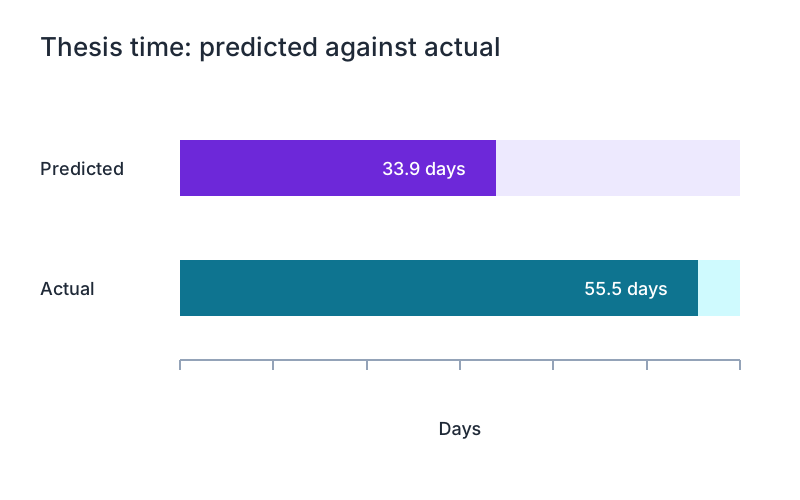
Buehler, Griffin, and Ross ran the classic test in 1994 with 37 psychology students finishing senior theses. The mean estimate was 33.9 days. The mean best-case estimate was 27.4 days. The mean worst-case estimate was 48.6 days. The mean actual completion time was 55.5 days, past even the worst-case mean, and about 30 percent of students finished in the time they predicted.
The mean predicted time was 33.9 days and the mean actual time was 55.5 days.
A second study asked students for times by which it was 50, 75, and 99 percent probable that personal projects would be done. Only 13 percent finished by the 50 percent time, 19 percent by the 75 percent time, and 45 percent by the 99 percent time. Even near-certain dates slipped for most students.
The tax-form survey adds a real-life case. Taxpayers predicted they would mail forms much earlier than their usual date, then mailed them at about the usual late date. They knew their history and still trusted the new plan. Large projects show the same gap. The Sydney Opera House was expected in 1963 and opened in 1973, at about 7 million against about 102 million.
Why study plans run late
Social psychologists explain the fallacy mainly through the inside view. When you plan, you focus on the parts of the next task and build a smooth story in which each step works. You ignore base rates from similar past tasks, even when those tasks hit delays. Kahneman and Tversky called the cure the outside view: start from how similar tasks actually went.
Other causes add to the inside view. Optimism bias pushes you toward good outcomes and away from bad ones. Self-serving memory takes credit for past success and blames delays on outside forces, so past failures feel less relevant. Focalism narrows attention to the target task and drops competing demands such as illness, messages, and chores. Memory bias plays a role too: people recall past task times as shorter than they were, so the next forecast starts low. Social pressure can push estimates down when you want to impress a teacher, a boss, or yourself.
The fallacy is robust. It appears for small chores and large projects, for groups and persons, and across cultures and traits. Conscientious students finish earlier than procrastinators on average, yet both groups underestimate their own times.
Planning fallacy, procrastination, and optimism bias
Students mix three terms. The differences matter because each needs a different fix.
| Term | Meaning | Fix |
|---|---|---|
| Planning fallacy | Wrong time estimate for your own future task | Use past times, split task, set cues |
| Procrastination | Delay of a started task for mood repair | Start small, remove friction, keep routine |
| Optimism bias | Broad expectation of good outcomes | Check base rates, ask a neutral person |
Procrastination is delay, the planning fallacy is a wrong estimate. You can plan badly without delaying, and you can delay without planning badly. For the delay side, see our guide on procrastination is delay, the planning fallacy is a wrong estimate. Optimism bias is wider than time: higher pay, more offers, fewer risks. The planning fallacy is time-first, with costs and risks added in the wider form.
Three fixes that work
Use all three together for exam study. Each fix targets one failure: no base rate, no parts, no cue.
1. Take the outside view
Base your plan on similar past tasks, not on the parts of the next one. This is reference class forecasting in plain form: find a set of similar tasks, note how long each took, and plan from that range.
Do it in four steps for a term list.
- 1.List your last three study times for a 20-term list.
- 2.Take the middle value as your base rate for 20 terms.
- 3.Scale it to the next list size and add a buffer of one half.
- 4.Ask one neutral person if the result looks realistic.
If you have no past times, use one timed trial of 10 terms and scale with care. Past data beats a smooth story. For spacing those sessions across days, use a plan that helps you spread study over days.
2. Split the task into parts
Estimates for parts sum above the estimate for the whole. Forsyth and Burt showed this segmentation effect in 2008: the time for a whole task reads smaller than the sum of its parts. Kruger and Evans found the same with unpacking in 2003. Splitting forces you to see steps that the whole hides.
Split a 40-term list into four dated parts of 10 terms. Estimate each part alone, then sum the parts. Plan each part as its own session with its own date. Expect the split plan to feel long. That long feeling is the correction. Splitting also adds useful effort, which supports memory, as explained in our guide on harder studying that pays off.
3. Set implementation intentions
Koole and Van't Spijker tested this in 2000 with an assignment due within a set period. Half the students set when and where they would work. The intentions group gave more optimistic predictions, yet raised actual completion even more, so the bias fell. Fewer interruptions explained much of the gain. A 2024 meta-analysis by Sheeran, Listrom, and Gollwitzer across 642 tests found small-to-moderate effects of such intentions on thought, feeling, and behavior.
Write your intention in one line per part: date, time, place, and list range. Picture yourself starting there. Keep the cue visible during the day. When the time comes, start with the first term and protect the block from messages.
Cost overruns follow the same logic as time overruns, and they raise a second trap once you have started: throwing good time after bad plans. For that trap, see our guide on the sunk cost fallacy.
A study example you can copy
Say you must learn 40 terms in six days. Your last 20-term lists took 50, 65, and 70 minutes. The middle value is 65 minutes for 20 terms. For 40 terms, plan about 130 minutes plus a 65-minute buffer, or about 195 minutes total. Split that into four parts of 10 terms across four days, about 50 minutes each, with two spare days for review.
- 1.Day 1, 18:00, desk, terms 1 to 10: drill with flashcards.
- 2.Day 2, 18:00, desk, terms 11 to 20: drill with flashcards.
- 3.Day 4, 18:00, desk, terms 21 to 30: use multiple choice with at least four terms per set.
- 4.Day 5, 18:00, desk, terms 31 to 40: type each answer from memory.
- 5.Day 6, 18:00, desk: review missed terms only.
Keep each list saved by topic so the parts stay separate and easy to drill. A dictionary app with saved lists and short games fits this pattern well: Psychology World lets you store terms in named lists and turn one list into a quick session, which keeps the plan concrete. If a day slips, re-plan from actual times, not from hope.
Frequently asked questions
What is the planning fallacy in psychology?
It is the tendency to underestimate the time your own future task needs, even when past tasks ran longer. It covers costs and risks in the wider form, and observers show the reverse pattern for your tasks.
Which of the following is an example of planning fallacy?
A student predicts one week for a paper that took three weeks last term, then needs an extension. Thesis writers predicting 33.9 days and needing 55.5 days show the same pattern with numbers.
Is the planning fallacy the same as procrastination?
No. Procrastination delays a task, often to repair mood. The planning fallacy misjudges how long the task needs. You can plan badly without delaying and delay without planning badly.
How do I avoid the planning fallacy when studying?
Use your past list times as the base rate, split the next list into dated parts, and set a when-and-where cue for each part. Sum the parts, add a buffer, and protect each block from interruptions.
Sources
- 1.Buehler, Griffin, and Ross (1994). Exploring the planning fallacy: Why people underestimate their task completion times.
- 2.Kahneman and Tversky (1977). Intuitive prediction: Biases and corrective procedures.
- 3.Koole and Van't Spijker (2000). Overcoming the planning fallacy through willpower.
- 4.Buehler (2019). The planning fallacy: An inside view.
- 5.Forsyth and Burt (2008). Allocating time to future tasks: The effect of task segmentation.
- 6.Scribbr (2023). What is the planning fallacy? Definition and examples.
- 7.Wikipedia (2026). Planning fallacy.
- 8.DecisionLab (2026). Planning fallacy.