
The overconfidence effect is the gap between how sure you feel and how often you are right. Confidence runs ahead of accuracy, ranges come out too narrow, and most people place themselves above the middle.
- The effect has three faces: overestimation of your own score, overplacement above other people, and overprecision in narrow ranges.
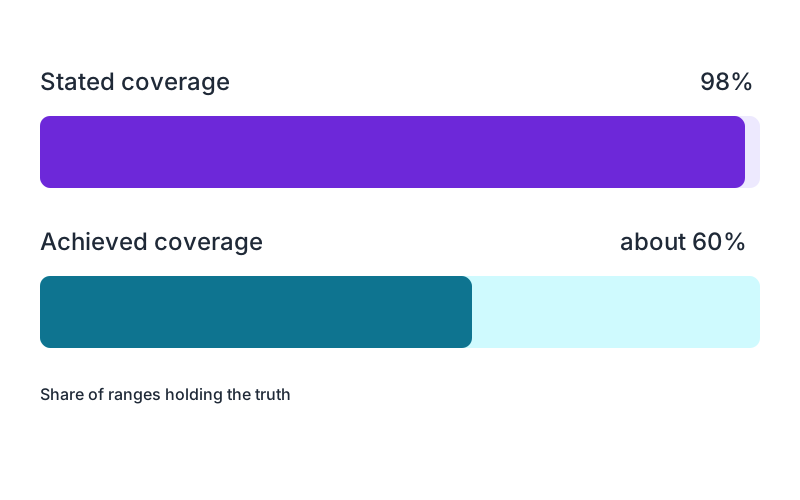
- In a classic calibration task, 98 percent ranges held the true value about 60 percent of the time.
- About 2,000 managers gave 90 percent ranges that missed 4 to 6 answers in 10.
- In a 1981 study, 93 percent of US drivers rated their skill as above the median.
- Hard tasks raise self-estimates but lower self-rankings; easy tasks do the reverse.
- One tested fix helps: write down one reason your answer could be wrong.
What the effect is
Psychologists measure overconfidence with calibration. You state how sure you are, then the result shows whether that level of sureness was right. A person with good calibration is right about 90 times in 100 when they claim 90 percent sureness. A person with overconfidence claims 90 and scores far less.
The pattern shows in three places: test scores, self-rankings, and ranges. Students predict higher scores than they earn. Drivers rank themselves above most other drivers. Forecasters give tight ranges that miss the true value. Each case shows the same gap from a different side.
The blog lists this bias beside nine others in the ten cognitive biases in brief. That overview names it in one line. This article treats it alone, with the tests and the numbers.
The three faces of overconfidence
Don Moore and Paul Healy described the split in 2008. They argued that one label hides three separate effects. The split matters because the three can point in opposite directions in the same task. A group can overestimate its scores while it underplaces itself against others. A report on the overconfidence effect summarizes the three faces with the studies behind each one.
| Face | Question it answers | Sign of the effect |
|---|---|---|
| Overestimation | How well did I do | Predicted score sits above earned score |
| Overplacement | How do I rank against others | More than half place themselves above the middle |
| Overprecision | How wide is my range | Stated 98 percent ranges hold about 60 percent of true values |
Overestimation concerns your own result. You predict a test score, a project date, or a budget, and the outcome lands worse. The error grows on hard tasks with unfamiliar facts. It shrinks or flips on easy tasks you know well.
Overplacement concerns your rank. You judge your skill, safety, or honesty against the average person. On easy and common traits, most people claim a place above the middle. That claim connects to the self-serving bias, which gives wins a personal cause and losses an outside cause. The two push self-rankings up together.
Overprecision concerns your range. You give a low and a high bound that should catch the answer 9 times in 10, and the bounds miss far more often. Of the three, overprecision resists correction most. It stays high on hard and easy tasks alike. Judgment work on the availability vs representativeness heuristic shows a related shortcut in the same family: fast cues replace full search.
The range test that proved it
Marc Alpert and Howard Raiffa ran the task that later work still uses. Their report moved in draft from 1969 and reached print in 1982 in a volume on judgment under uncertainty. They asked students for quantities no one could know by heart, such as the number of eggs produced in the United States in a past year. They did not ask for one number. They asked for fractiles of belief: a value so low the truth would fall below it only 1 time in 100, a value so high it would sit above it only 1 time in 100, and the quartiles between them.
The 98 percent ranges should have held the truth about 98 times in 100. They held it about 60 times in 100. The middle 50 percent ranges should have held about half the answers. They held about one third. A detailed 2026 review of the overconfidence effect walks through these fractile results with the cited hit rates and the study history.
The instruction did not fix the gap. Alpert and Raiffa told later groups to spread their outer values and to admit what they did not know. Scores rose only a little. The range stayed too tight around the first guess.
For study, the 60 percent number carries a plain lesson. A range that feels safe still misses about 2 times in 5 on unfamiliar facts. So a student who feels ready after one fluent reread holds an easy-task feeling about a hard-task test. Timed recall gives the missing score and resets the range.
Edward Russo and Paul Schoemaker carried the same test to managers in 1992. They asked about 2,000 managers for 90 percent ranges on 10 questions in or near their own fields. A calibrated group misses 1 answer in 10. Most groups in their sample missed 4 to 6. Advertising, oil, and investment staff showed the same miss rate on questions from their own trade.
Managers, drivers and hard tasks
Ola Svenson gave the best known overplacement number in 1981. He asked US drivers to rate their skill and safety against other drivers. About 93 percent placed themselves above the median. The median cannot hold 93 percent of a group. The number has lasted because it is simple, dated, and tied to a defined sample: US drivers, self-rated skill, 1981.
The hard-easy effect explains the flip that confuses students. On hard items, people overestimate their own scores but place themselves below others. On easy items, they underestimate their own scores but place themselves above others. Moore and Healy showed the two move apart as task difficulty shifts. So a hard practice test can leave you too sure of your score yet too modest about your rank, while an easy reread can leave you too modest about your score yet too sure of your rank.
Feedback decides whether the gap lasts. Weather forecasters and experienced bridge players receive fast scores on hundreds of stated odds, and they stay close to full calibration. Most study and work judgments receive no score. Without a record of hits and misses, sureness drifts up because it wins approval in the room.
What overconfidence is not
The name covers a family, and nearby terms name single members. Keep them apart in study answers.
It is not the Dunning-Kruger pattern, which claims how the gap shifts with skill. Overconfidence names the gap itself across the full skill range. It is not illusory superiority alone, which is overplacement against others with no range claim. It is not the planning fallacy, which is the narrow case of late and costly delivery with its own fix in outside-view planning. It is not the hard-easy effect, which describes how error direction shifts with task difficulty.
Exam answers score when they name the face the item tests. A question about predicted versus earned score asks for overestimation. A question about above-average claims asks for overplacement. A question about narrow ranges asks for overprecision.
A fast sort helps in timed answers. Read the item and ask what was stated: a score, a rank, or a range. If the item gives a score and an outcome, compare the two and name overestimation. If it gives a share above average, test whether the share can fit the middle and name overplacement. If it gives a stated hit rate and a lower hit count, name overprecision. Most AP items test only one face at a time.
Examples from study and work
Overconfidence shows where an estimate meets a later outcome. The rows below sketch common cases for study and work. They are sketches, not lab results.
| Case | What the bias does | What a check looks like |
|---|---|---|
| A study plan with one exam date | One date carries no range, so each delay reads as failure | Add a 50 and a 90 percent date from the last 10 study blocks |
| A project budget | The math starts from the best case and trims the buffer | Price from past jobs of the same kind, then add their mean overrun |
| A hire after a strong interview | A sure read replaces a work sample | Score blind work first, then compare with the interview read |
| A forecast to a board | Tight ranges sound skilled, so the tightest wins | Ask each owner for an 80 percent range and keep a public hit log |
| Fluent rereading before a test | Known text feels known, so recall feels ready | Sit a timed recall test and grade it before you stop |
Each check replaces an inside view with an outside one. Past cases carry the base rate. The current case must argue against it.
How to calibrate your judgment
Use these steps on your next estimate. Write the numbers down so you can score them later.
- 1.State the promise of your range. Name whether it is a 50, 80, or 90 percent range before you set it.
- 2.Widen past comfort. Stretch both ends of a 90 percent range further than feels right.
- 3.List one reason you are wrong. In a 1980 test by Asher Koriat, Sarah Lichtenstein, and Baruch Fischhoff, writers of one contradicting reason gave better ranges, while writers of supporting reasons did not improve.
- 4.Use outside numbers. For work with a past, take the last 10 same-kind cases and use their spread.
- 5.Keep a dated log. Record each range, then mark hits and misses on a fixed date.
- 6.Save the bias set as one study list. Put this term with its neighbors in one bookmark list and drill that list with timed recall until the labels stay.
Students who study psychology terms can use the last step as a loop. Save each bias term the week you meet it, group the set by exam, and turn the list into short recall rounds. The loop fits the app well: find the term, save it to a list, and drill the list until recall holds.
Frequently asked questions
Is overconfidence the same as narcissism
No. The overconfidence effect describes a gap in judgment that shows in most people on unfamiliar tasks, while narcissism names a lasting pattern of grandiosity and need for regard. This article treats only the judgment gap, never a trait or a diagnosis.
What are the three kinds of overconfidence
Overestimation is a high self-score. Overplacement is a high self-rank against others. Overprecision is a tight range that misses too often. Moore and Healy set out the three in 2008 because one number cannot track all three at once.
Does skill or expertise remove the effect
No. Scored experts with fast feedback, such as weather forecasters, run close to calibration. Most professionals lack such feedback, and manager samples miss 4 to 6 in 10 at 90 percent sureness even in their own fields, as Russo and Schoemaker found in 1992.
How do I give a better estimate
State the hit rate of your range, widen both ends, write one reason the answer could sit outside, and check the spread of the last 10 same-kind cases. Keep a dated log of ranges and hits so the next estimate starts from a base rate.