
The halo effect is the spread of one known quality to unrelated judgments without separate evidence. A good first trait lifts the rest. A bad first trait drags them down, which is called the horn effect.
- The halo effect moves from a person to traits, not from a group to a person. That second case is a stereotype.
- Edward Thorndike named it in 1920 after officers rated soldiers too evenly across separate traits.
- Dion, Berscheid and Walster showed it in 1972 with photos: attractive people were judged kinder and more successful, but not better parents.
- Nisbett and Wilson showed it in 1977 with videos: the same instructor seemed better looking when he acted warm, and raters denied the influence.
- The fix is to judge each trait on its own evidence, blind the cue when possible, and use more than one rater.
What the halo effect is
A halo judgment starts with one clear cue and ends with many claims. You learn that someone is attractive, warm, or well-spoken. You then rate that person as smarter, kinder, and more honest, though you saw no proof for those traits.
The religious image gives the name. A halo is a ring of light above a holy figure. One bright cue lights the whole person. The horn effect is the mirror. One dark cue darkens the whole person.
The halo effect is not a stereotype. A stereotype applies a group belief to a person. The halo effect applies one known trait of a person to other traits of the same person. The unit is one person, not one group.
It is also not the same as the confirmation bias. Confirmation bias filters what you search and notice so it fits a view you already hold. The halo effect spreads one observed trait to new traits. One filters input. The other inflates output.
It is also not the same as the self-serving bias. The self-serving bias picks causes for your own outcomes. The halo effect judges another person. One protects your esteem. The other colors your view of someone else.
The 1920 ratings that named it
Edward Thorndike, a psychologist at Teachers College, Columbia University, gave the effect its name in 1920. His paper was called A Constant Error in Psychological Ratings.
Thorndike studied two sources. One was ratings of employees in two large firms. The other was ratings of officers by their commanders in the army. The army plan asked for separate scores for physical qualities, intelligence, leadership, and personal qualities. The orders stressed that each score must stand alone.
The scores did not stand alone. One officer rated 137 aviation cadets. Intelligence with physique gave .51. Intelligence with leadership gave .58. Intelligence with character gave .64. The numbers were too high and too even. True links between body build and command skill cannot all run at the same strength.
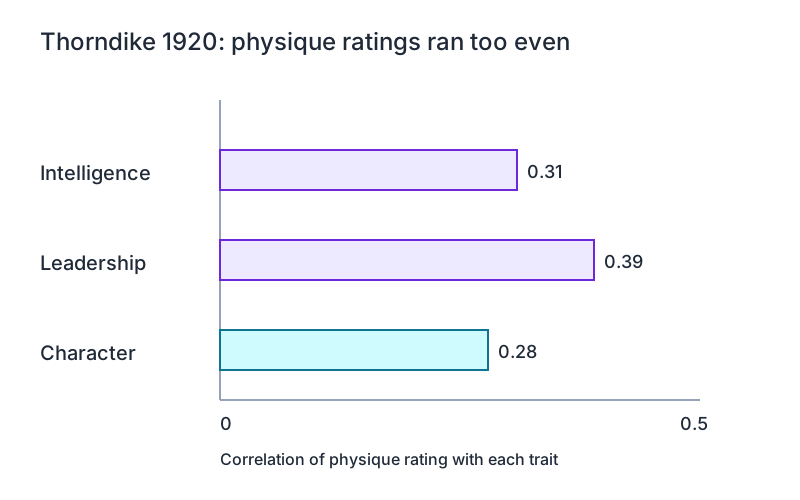
Three more raters showed the same shape on a smaller scale. Physique with intelligence gave 0.31. Physique with leadership gave 0.39. Physique with character gave 0.28. The chart runs from 0 to 0.5. A teacher study showed the same pull. General merit as a teacher gave .68 with intellect and .79 with power in discipline. Voice gave .50 with interest in community affairs and .63 with intelligence. Raters could not treat a person as separate parts.
Thorndike drew a hard line from this. He wrote that even a strong judge cannot rate separate qualities apart from a general feeling. His fix still holds: report the evidence for each trait, then rate each trait from its own evidence, without sight of the rest.
An earlier note came from Frederick Wells in 1907, who saw the same pull in ratings of literary merit. Thorndike gave it proof and a name.
What is beautiful is good
Karen Dion, Ellen Berscheid and Elaine Walster tested the attractiveness form in 1972. Their paper was called What Is Beautiful Is Good.
Sixty students at the University of Minnesota took part, 30 men and 30 women. Each saw photos of people rated as attractive, average, or unattractive. Each judged 27 traits, then predicted life outcomes such as job status, marriage, parenting, and happiness.
Attractive people drew more kind judgments across social traits. They were seen as more warm, more social, and more likely to hold strong jobs and happy marriages. The pattern held for male and female raters alike. Jealousy did not shrink it.
Two limits matter for exams. Attractive people were not judged to be better parents. That line showed no clear gain. And the stereotype ran strongest for social traits. Later work by Eagly and colleagues found in a 1991 review that beauty lifts social views far more than views of honesty.
The lesson is narrow. Beauty signals social ease in raters' minds. It does not prove skill, care, or trust. A test answer that claims a broad gain goes too far.
The halo you do not notice
Richard Nisbett and Timothy Wilson tested awareness in 1977. They used the same college instructor in two videos. One version acted warm and friendly. The other acted cold and distant. Students then rated his looks, manner, and accent.
The same face and voice drew split scores. The warm version seemed appealing in looks, manner, and speech. The cold version seemed harsh in the same points. The gaps were large and clear.
The striking part came after. Most students said liking had not shaped their trait scores. Many said the reverse: that looks and speech had shaped liking. They held cause and effect backward. The global feeling had moved the parts, but they felt the parts had moved the whole.
Solomon Asch had shown the seed of this in 1946. Lists with warm drew kind readings of every other word. Lists with cold drew harsh readings. A swap of polite and blunt, which are less central, moved little. First central traits set the frame.
Where it shows up
Classrooms show it plainly. Clifford and Walster found in 1973 that teachers read the same school record with higher hopes when the photo showed an attractive child. Landy and Sigall found it in grading in 1974. Sixty male students rated essays as good or poor, with a photo of an attractive author, an unattractive author, or no photo. On a 1 to 9 scale, a good essay drew 6.7 for the attractive author and 5.9 for the unattractive author. A poor essay drew 5.2 for the attractive author and 2.7 for the unattractive author. Weak work gained most from a good photo.
Work settings show the same pull in reviews and hiring. One strong trait, such as drive, can lift scores for skill and care. Blind review helps here. When graders cannot see the student, the photo gain fades.
Courts show it with a flip students should learn. Efran found in 1974 that attractive defendants drew lighter penalties for the same act. Sigall and Ostrove found the edge in 1975 and its limit. A burglary case with $2,200 at stake drew lighter terms for the attractive defendant. A swindle case with the same $2,200 at stake drew harsher terms for the attractive defendant once looks seemed tied to the crime. Beauty helps until it looks like the tool.
Culture sets what good means. Wheeler and Kim found in 1997 that North American raters linked beauty to strength, while Korean raters linked it more to care for others. The spread stays. Its content shifts.
Halo, horn, and stereotype in one place
Use this split in exams. The start point tells you the name.
| Pattern | Start | Spread | Example |
|---|---|---|---|
| Halo effect | One good trait of a person | Good view of unrelated traits | A friendly speaker is rated as more honest |
| Horn effect | One bad trait of a person | Bad view of unrelated traits | A rude manner leads to low skill scores |
| Stereotype | Group belief | Applied to a person | Members of one school are assumed to be sharp |
The ten cognitive biases in brief names the halo effect in one line beside nine others. This article treats it alone, with the studies and the sorting test.
The one-question test
Ask this of any story: does one known trait drive judgments of unrelated traits without separate proof.
- 1.Name the known trait the rater truly saw.
- 2.Name the judged traits the story claims next.
- 3.Ask if each judged trait has its own evidence in the story.
If the judgments lack their own proof and follow the tone of the first trait, call it the halo effect for a good start and the horn effect for a bad start. If the story starts from a group label, call it a stereotype. If the story filters search to fit a view, call it confirmation bias.
Two checks stop errors. First, a true link needs its own facts, such as a test score for skill. Second, a parental or honesty claim needs care, since the beauty gain is weak there.
How to judge more fairly
Judge traits apart, in this order. These steps fit grading, hiring, and study notes.
- 1.Write what each trait needs as proof before you rate.
- 2.Score one trait at a time from its own notes only.
- 3.Hide the cue that should not matter, such as a photo, where rules allow.
- 4.Ask a second rater to score alone, then average the two scores.
- 5.Keep the global score last, so it cannot pull each part upward.
This is Thorndike advice in plain form. Separate the evidence, then rate.
Save the three labels as one set in Psychology World: halo effect, horn effect, and what-is-beautiful-is-good. Drill them with flashcards until the sorting question runs on its own.
Frequently asked questions
What is the halo effect in simple terms
The halo effect is the pull of one clear trait on the rest of your judgment. One good cue lifts unrelated scores. One bad cue lowers them. Each new claim needs its own proof.
What is the horn effect
The horn effect is the negative side of the same pull. One flaw darkens the whole view, so real strengths lose weight. Teachers who see defiance may rate hyperactivity too high, even when the counts match.
What is the difference between the halo effect and a stereotype
The halo effect moves within one person, from one trait to others. A stereotype moves from a group to a person. Ask where the judgment starts. A person start points to halo. A group start points to stereotype.
Does being attractive really help grades and sentences
Photo studies show a gain in grades and lighter terms for the same act, but with limits. Blind marking removes the grade gain. Crime tied to looks can flip leniency into penalty. Do not read beauty as skill or trust.
How can the halo effect be reduced
Rate each trait from its own evidence, hide cues that should not count, and average separate raters. Global views form fast and run outside awareness, so willpower alone does not stop them.
Sources
- 1.Edward L. Thorndike (1920). A constant error in psychological ratings.
- 2.Karen Dion, Ellen Berscheid and Elaine Walster (1972). What is beautiful is good.
- 3.Richard E. Nisbett and Timothy D. Wilson (1977). The halo effect: evidence for unconscious alteration of judgments.
- 4.Ayesh Perera (2026). Halo Effect In Psychology: Definition and Examples. Simply Psychology.