
The gambler's fallacy is the belief that a random past changes a future chance. After four heads in a row, tails feels due. A fair coin stays one in two on every toss.
- Five heads in a row is 1 in 32 before the first toss, yet heads after four heads is still 1 in 2.
- Short runs feel wrong, so people expect a correction that never comes.
- As the story goes, black came up 26 times at Monte Carlo in 1913, and players lost betting on red.
- The test is one question: does the past change the physical mechanism behind the next event?
- The error reaches far beyond casinos: judges, umpires, and loan officers show the same pattern.
What the fallacy is
A random sequence has no memory. Each fair coin toss is independent of the last, so knowledge of past tosses gives no power to predict the next one. The coin has no memory, and every toss carries the same chance whatever came before.
The numbers show the trap. The chance of five heads is 1 in 32 before the first toss. After four heads, the chance of heads on the fifth toss is still 1 in 2. Twenty heads then tails and twenty heads then heads are both 1 in 2,097,152. Ten heads in a row is 1 in 1,024, which is also the chance of any other single ten-toss pattern. Each combination is equally likely because each toss is independent.
Roulette works the same way. On a single-zero wheel, red and black each cover 18 in 37 pockets. The wheel keeps no record of past spins. No run of black changes the 18 in 37 on the next spin.
As the story goes, the ball fell on black 26 times in succession at the Monte Carlo Casino in 1913. Players rushed to bet on red, doubled and tripled their stakes as black continued, and lost heavily. The example comes from a 1959 account of betting doctrine, retold ever since. The run and the reported losses match the standard retelling.
| Sequence | How it feels | Actual chance |
|---|---|---|
| H-T-H-T-T | random | 1 in 32 |
| H-H-H-T-T | less random | 1 in 32 |
| H-H-H-H-T | a streak, so tails feels due | 1 in 32, and the next toss is still 1 in 2 |
Why it happens
People expect short sequences to look like long ones. A short run with many alternations feels representative of chance. A short run of identical outcomes feels wrong. This expectation has a name: local representativeness. People judge a short sequence by how much it resembles a long random process, even when the resemblance means nothing.
A related habit is the law of small numbers. Small samples are treated as if they carry the full character of the larger population. Five tosses are expected to show the balance of five thousand. Five tosses feel like enough to judge chance, yet five tosses prove almost nothing.
Chance then looks self-correcting. A deviation in one direction seems to call for a deviation in the opposite direction to restore balance. In fact deviations are not corrected as a chance process unfolds. They are merely diluted by later outcomes. The mechanism behind this judgment is the representativeness heuristic, which this article explains in full.
The one-question test
Ask whether the past changes the physical mechanism behind the next event. If nothing about the device changed, the past carries no information. If the setup changed, the past can matter. Thinking through the actual process behind an event shows whether past outcomes play any role.
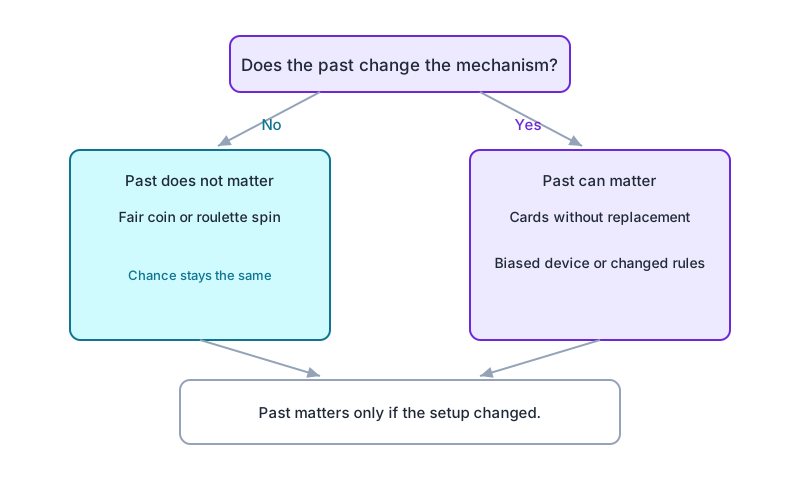
| Situation | Does the past change the mechanism? | Result |
|---|---|---|
| Fair coin or roulette spin | No | Past does not matter; the chance stays the same |
| Cards dealt without replacement | Yes | Past matters; an ace goes from 4 in 52 to 3 in 51 |
| Device that may be biased | Possibly | Update toward the frequent outcome; this is Bayesian reasoning, not the fallacy |
| Rules or players changed | Yes | Past matters only under the old setup; recheck the new one |
A fair coin belongs in the first row. Cards dealt without replacement belong in the second, because each dealt card changes the deck. When rules, dealers, or decks change, start the analysis over. A device that may be unfair belongs in the third. After many heads, suspect bias and bet with the frequent outcome. Judging a possibly unfair device by its history is reasonable inference, and the fallacy label does not apply.
The field proof
The error is not limited to casinos. Three high-stakes field studies found negative autocorrelation unrelated to the merits of each case. The pattern fits the law of small numbers and the gambler's fallacy. The pattern held across asylum courts, loan reviews, and baseball pitches.
The numbers are concrete. Asylum judges were 5.5 percent less likely to approve a third case after granting the previous two. Baseball umpires were 1.3 percent less likely to call a strike after two called strikes, across more than 12,000 games. Loan officers without monetary incentives were 8 percent less likely to approve a loan after approving the previous one. The effect grew with longer streaks and faded with experience and stronger incentives for accuracy. A contrast explanation, where each case is judged against the last rather than misjudged by chance beliefs, could not be fully ruled out.
A laboratory nuance sharpens the picture. In a fictitious roulette study with 320 men, problem gamblers staked more. They were not more prone to the fallacy than non-problem gamblers. Impulsivity and sensation seeking barely affected it. The bias looks general, not confined to gamblers. No betting system beats independence. If gambling ever feels out of control, speak to a professional or a gambling support service.
Three biases to keep apart
The gambler's fallacy is often mixed with two neighbors. The sunk-cost fallacy concerns money already spent, not a future chance. The hot-hand fallacy is the direct counterpart: success feels likely to continue.
| Bias | Wrong question it answers | Direction |
|---|---|---|
| Gambler's fallacy | Will the streak reverse? | Negative recency: change feels due |
| Hot-hand fallacy | Will success continue? | Positive recency: success feels likely to continue |
| Sunk-cost fallacy | Should past spending decide? | Staying: money spent feels like reason to continue |
The hot hand belongs to human performance, where form can persist, not to random devices. People trust streaks in skilled performance yet distrust identical streaks in random draws. The two fallacies can even co-occur: roulette players bet against a streak while staking more after a win. Exam questions often test both directions, so learn the pair. One bias concerns the outcome, the other the bettor.
What helps on exams
- 1.Name the device and the exact chance claimed.
- 2.Ask the independence question before any math.
- 3.State the chance with the past removed.
- 4.Check the three exceptions: removal, bias, and rule change.
- 5.Pick the answer that matches the mechanism, not the streak.
Classroom research found that telling students about randomness alone left their choices unchanged, while treating each trial as a fresh start removed the error. Grouping changes how each event is framed, which changes the judgment. Statistical literacy helps on top: grasping independence lets each event stand alone. A short guide to the two mistaken forms and their fixes collects the same advice. Save these terms into a Psychology World list: gambler's fallacy, hot-hand fallacy, independence, and representativeness. Drill the list with flashcards, multiple choice, and typing until each distinction sticks.
Frequently asked questions
Is it ever rational to expect a change after a streak?
Yes, when events are dependent or the setup may have changed. Cards dealt without replacement, a device that may be biased, and altered rules all let the past carry real information. The fallacy applies only when each event is independent and the mechanism is unchanged.
What is the hot-hand fallacy?
It is the counterpart that predicts continuation instead of reversal. After successes, further success feels likely. It fits judgments of human performance better than judgments of random devices, and both fallacies can appear in the same person at the same table.
Does the fallacy appear outside gambling?
Yes. Asylum judges, baseball umpires, and loan officers showed negatively autocorrelated decisions unrelated to case merits. Lottery players avoid past winning numbers, investors sell winners early and hold losers, and students dodge an answer repeated too often. Independence is the issue in each case.
Sources
- 1.Tversky, A., & Kahneman, D. (1974). Judgment under uncertainty: Heuristics and biases. Science, 185, 1124-1131.
- 2.Chen, D. L., Moskowitz, T. J., & Shue, K. (2016). Decision-making under the gambler's fallacy. NBER Working Paper 22026.
- 3.Matarazzo, O., Carpentieri, M., Greco, C., & Pizzini, B. (2019). The gambler's fallacy in problem and non-problem gamblers. Journal of Behavioral Addictions, 8, 754-769.
- 4.Owen, A. M. (2011). The Monte Carlo fallacy. Medical Journal of Australia, 195, 421.
- 5.Wikipedia. Gambler's fallacy.
- 6.The Decision Lab (2019). Gambler's fallacy.
- 7.Curtis, G. N. Gambler's fallacy. The Fallacy Files.
- 8.Effectivology. The gambler's fallacy.