
You learn a new word in the morning. By evening you see it in a book, in a feed, and in a talk. The word did not spread in one day. Your notice of it spread. That gap is the frequency illusion.
- The frequency illusion is the feeling that something you just noticed now appears often.
- Its other name is the Baader-Meinhof phenomenon.
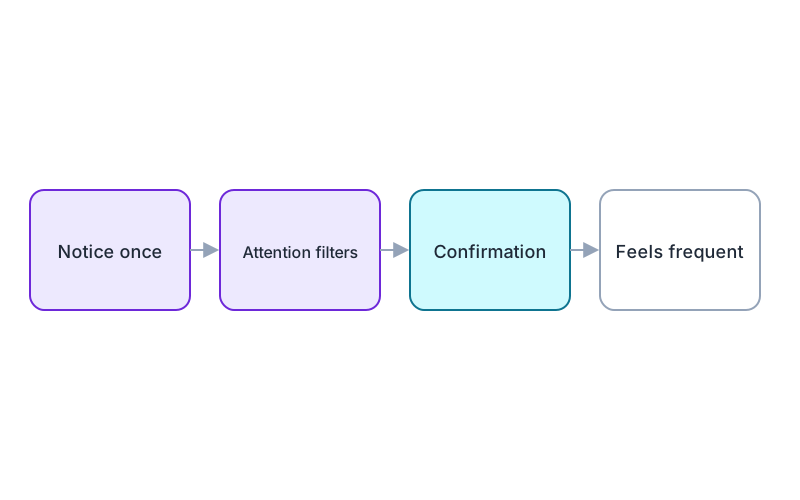
- Two processes drive it. Selective attention picks out what matters to you. Confirmation bias keeps the hits and drops the misses.
- Real frequency does not change. Perceived frequency changes.
- You can test it in 30 seconds. Write down hits and misses and check the base rate.
What the frequency illusion is
The frequency illusion is a cognitive bias. After you become aware of a word, a car model, or a diagnosis, you notice it more often. You then judge it as more common. The judgement feels strong because each new sighting seems to confirm it. For the field as a whole, start with our overview of cognitive bias.
Medical writers describe it the same way. A review of a rare gut lesion defines Baader-Meinhof the same way. A new experience makes you meet the same thing more often, even when it was there all along. The review links the bias to teaching, not to a rise in cases. Kolli and colleagues (2019). The Baader-Meinhof Phenomenon of Dieulafoy Lesion.
The second name comes from a newspaper letter. In 1994 Terry Mullen wrote to the St. Paul Pioneer Press that he had mentioned the German militant group Baader-Meinhof once, then kept noticing the name. Other readers wrote in with the same experience. The name stuck for the general pattern, not only for that group. Linguist Arnold Zwicky later gave the pattern its technical name. His 2006 summary defines the frequency illusion in one line. Once you notice a phenomenon, you believe it happens a whole lot. Zwicky (2006). Why are we so illuded?
Three points keep the definition clean. First, the trigger is recent notice, not recent origin. Second, the result is perceived frequency, not true frequency. Third, the same mechanism works for words, objects, diagnoses, and news topics. An encyclopedia entry on the topic lists linguistics, medicine, marketing, economics, and research methods as fields where writers report the same pattern. Frequency illusion.
Why it happens
Two well known processes work in order. Zwicky names both in the same summary. Selective attention comes first. Confirmation bias comes second.
Selective attention filters the flood. You meet far more input than you can process. Attention selects what matters now and drops the rest. A new word, a planned purchase, or a new diagnosis becomes salient. Salience means the item passes the filter more often. You then meet it consciously more often. Attention researcher Carly Leonard puts it plainly in a university interview. Things that are recently important to you receive more attentional processing and are therefore more likely to be consciously perceived. CU Denver (2019). What is the Frequency Illusion?
Confirmation bias locks the feeling in. After you start noticing, you track hits and ignore misses. Each hit feels like proof that the item is everywhere. Each miss passes without note. The bias does not create the first notice. It prevents the correction. For the full mechanism, see confirmation bias. For a nearby judgement that also uses ease of recall, see the availability heuristic.
| Step | What happens | What you experience |
|---|---|---|
| Notice once | A word, car, or diagnosis becomes salient | This is new to me |
| Filter | Selective attention admits matching input | I see it again |
| Count wrong | Confirmation bias keeps hits, drops misses | It must be everywhere |
The order matters for study. If a question asks what starts the illusion, answer selective attention. If it asks what keeps it alive, answer confirmation bias. If it asks for the result, answer inflated perceived frequency with unchanged true frequency.
Frequency illusion vs recency illusion
Students mix these two. Zwicky defines both in one place, which makes the split easy.
- Recency illusion claims a recent start. You notice a form now, so you believe it started now.
- Frequency illusion claims high rate. You notice a form now, so you believe it occurs a lot.
Use one question to sort any example. Are you claiming it is new, or claiming it is common. New points to recency illusion. Common points to frequency illusion. Both can occur together. A new slang form can feel both new and everywhere. Name each claim separately.
Zwicky gives a language example for frequency illusion. Many linguists believed the quotative all, as in I was all surprised, occurred all the time in young speech. When they transcribed talk, counts ran lower than the feeling. The feeling came from notice, not from counts. Zwicky (2006). Why are we so illuded?
Examples you can check
Everyday cases share the same shape. Notice once, then meet again soon.
A new word. You learn serendipity at noon. You then meet it in a novel, in captions, and in a podcast. The word did not surge that day. Your filter now admits it. A psychology education site uses this exact case to teach the pattern, with books, talk, and radio as the later sights. All-About-Psychology. Understanding the Frequency Illusion.
A planned car. You decide to buy a red Toyota. On the road home you see red Toyotas in every lane. Production did not change on your decision day. Your purchase plan made that shape and color salient. The same site uses this case for the same reason. It is easy to verify with sales data, which do not jump with one buyer.
A jacket and a capital. Leonard reports buying a purple jacket, then seeing purple jackets everywhere. She could not confirm a trend in jacket color. She could confirm a change in her own filter. In the same interview she gives a travel case. You learn that Asmara is the capital of Eritrea. A week later every driver seems to come from Eritrea. Knowledge made the name salient. CU Denver (2019). What is the Frequency Illusion?
A clinical case. A medical student learns the bovine aortic arch pattern, then spots it three times in the next 24 hours. The report in Academic Radiology treats the run as a teaching effect, not as a local outbreak. The same logic appears in the Dieulafoy review. Once trainees learn a rare lesion, they search for it on every scope withdrawal and find more of what was already there. CU Denver (2019). What is the Frequency Illusion? Kolli and colleagues (2019). The Baader-Meinhof Phenomenon of Dieulafoy Lesion.
What these cases do not show. They do not show that notice creates frequency. They show that salience changes sampling. Your sample of the world now overholds the noticed item.
Where it helps and where it misleads
The same filter can aid learning or distort judgement. Context decides.
It helps when the goal is detection of rare but real targets. Radiology and endoscopy training use this on purpose. Priming trainees to look for a rare pattern raises hits without new equipment. The Dieulafoy review ends with this hope. Wider teaching of the lesion plus the Baader-Meinhof effect should raise perception of a rarely seen cause of bleeding. Kolli and colleagues (2019). The Baader-Meinhof Phenomenon of Dieulafoy Lesion.
It misleads when the goal is base rates, causes, or choices. Three settings recur in sources.
First, investigation. A detective who learns one suspect may attend to that suspect in each new fact. Attention can solve the case or hide other leads. Leonard raises this exact trade-off. CU Denver (2019). What is the Frequency Illusion?
Second, diagnosis. A doctor who just learned a pattern may assign it more often. The 24-hour run of arch findings teaches the pattern and warns against overuse. Check prevalence before you upgrade a hunch.
Third, feeds. Targeted ads and recommends repeat what you paused on. Repetition then feels like popularity. A psychology guide notes that platforms show you more of what you engaged with, which strengthens the feeling that the topic is everywhere. Treat feed frequency as selection, not as census. All-About-Psychology. Understanding the Frequency Illusion.
For study, link this limit to source checks. If an item feels common, ask for counts outside your feed. If no counts exist, say so and hold the claim as feeling, not fact.
How to test it in 30 seconds
Use this check the next time a new term seems everywhere. It counters both processes in order.
- 1.Write the claim in one line. Say what you think rose and where.
- 2.Write the base rate you assume. If you do not know it, write unknown.
- 3.Count hits for one day. Note each sighting with time and place.
- 4.Count misses for the same day. Note each similar slot where the item did not appear.
- 5.Compare hits to all slots, not to zero. A few hits in many slots is not a surge.
- 6.Search outside your feed. Check sales, counts, transcripts, or prevalence data.
- 7.Keep the feeling separate from the finding. Say I notice it more. Add it is more common only with counts.
If you study with Psychology World, save the term to a list such as Cognitive Biases and drill it with flashcards. Retrieval practice fixes the label and the test together.
Frequently asked questions
Is the frequency illusion real?
Yes, as a feeling with a mechanism, not as a rise in the world. Selective attention raises notice. Confirmation bias keeps hits. Counts usually show no rise. Zwicky defines it as belief about rate after notice, not as proof of rate. Zwicky (2006). Why are we so illuded?
What is another word for the frequency illusion?
Baader-Meinhof phenomenon. Sources use both for the same pattern. Use frequency illusion in study answers, with Baader-Meinhof in brackets, since exam keys favor the technical term.
Does it mean the thing got more common?
No. It means you sample it more. True frequency needs outside counts, such as transcripts, sales, or prevalence. Without counts, report higher notice only.
How is it different from confirmation bias?
Confirmation bias is the second step. It keeps supporting hits and drops misses after you start noticing. Frequency illusion is the whole result, the inflated feeling of how often the item occurs. One starts the error, the other sustains it.
Why do students mix it with recency illusion?
Both start with recent notice. Recency claims a recent start. Frequency claims a high rate. Ask which claim the example makes. If both appear, name both and keep them separate.