
Envy vs jealousy comes down to what you lack and what you fear to lose. Envy is pain from lacking what another person enjoys. Jealousy is fear that a rival threatens a relationship you value. If a rival threatens what you have, think jealousy. If you want what another has, think envy.
Envy needs two people. You notice a desired attribute in another person and feel inferior, hostile and resentful. Jealousy needs three. You, a relationship you value, and a real or imagined rival who could take it. The one-question test asks if something you hold is under threat. A yes points to jealousy. A no points to envy.
What envy is
Envy is an unpleasant and painful emotion. It starts with an upward social comparison. You compare yourself with someone similar in a domain you care about. The other person seems superior. You feel that you lack their quality, achievement or possession. You cannot close the gap at once.
Researchers describe envy with three feelings. Inferiority comes first. You feel smaller next to the other person. Hostility and resentment follow. You feel angry that they have it and you do not. The definition comes from a systematic review of envy and social comparison (Carraturo and colleagues (2023). Envy, Social Comparison, and Depression on Social Networking Sites.).
Envy grows under clear conditions. The comparison must matter to you. The target must seem similar, yet superior. A distant star does not trigger it. A peer with the same start does. Social feeds strengthen it. They show selected wins and hide losses. You meet high standards with little context.
For where envy sits among emotions, read our overview of basic emotions. Basic emotions are short core responses. Envy is complex. It mixes pain, comparison and social judgment. It lasts longer than a startle. It shapes how you see yourself and others.
Envy correlates with low mood. People who feel envy often report depression, unhappiness and low self-esteem. The link runs both ways. Most studies are cross-sectional. They show correlation at one time. Only two studies test direction. They suggest depression may predict later envy and comparison, not only the reverse. Treat the link as association, not proof that envy causes depression. The pattern is reviewed in the same systematic review (Carraturo and colleagues (2023). Envy, Social Comparison, and Depression on Social Networking Sites.).
Envy also says two things at once. It says you wish you had what the other has. It implies you wish they did not have it. The double wish explains why envy divides people. It can pull you toward effort. It can pull you toward harm. Which path wins depends on the subtype. The next sections separate them.
What jealousy is
Jealousy is a negative response to a perceived threat. You hold a valued relationship. A rival appears. The rival may be real or imagined. You fear loss. The response includes feelings, thoughts and actions. Researchers define it as perception of threat of loss of a valued relationship to a real or imagined rival (Marazziti and colleagues (2010). Romantic Attachment and Subtypes and Dimensions of Jealousy.).
Romantic jealousy is the most studied form. A partner shows interest in another person. You read it as a threat to exclusivity. Fear rises. You watch the partner more. You question reassurance. You guard time together. The same structure fits other bonds. A sibling fears losing parent attention. A friend fears losing closeness. A coworker fears losing a role. Romance is common, not exclusive.
Three features mark every case. A real or imagined rival takes part in a dyad. A perceived threat follows from the rival. Fear of loss results from the threat. Reviews converge on this trio across many definitions. The three emotions that best mark jealousy are hurt, anger and fear. The essential part is a relationship you could lose plus a rival who could take it. The convergence is summarized in a comprehensive review (Karakocoglu and Hasdag (2025). Romantic Jealousy: A Comprehensive Review.).
Fear of loss organizes the phenomenon. People with anxious attachment score higher on fear of loss, obsessionality and sensitivity. Preoccupied and fearful-avoidant styles show the strongest fear. Secure styles show less. Fear of loss appears across styles, even when other features vary. The link between attachment anxiety and jealousy dimensions is reported in the Pisa study (Marazziti and colleagues (2010). Romantic Attachment and Subtypes and Dimensions of Jealousy.).
Jealousy differs from envy in number. Jealousy is triadic. It links you, your partner or bond, and a rival. Envy is dyadic in romantic context. It links you and a rival who has what you want. Jealousy fears losing to another. Envy desires obtaining what another holds. The triadic versus dyadic contrast is stated in the same comprehensive review (Karakocoglu and Hasdag (2025). Romantic Jealousy: A Comprehensive Review.).
Everyday speech blurs the line. People say jealous when they mean envious. They rarely say envious for romantic suspicion. The broad use of jealousy creates confusion. Psychology keeps the terms apart for this reason. Use jealousy only when a bond faces a rival.
The difference in one view
One question sorts most cases. Ask what threatens you. A threatened bond points to jealousy. A lacked advantage points to envy. Apply it before you label the feeling.
| Envy | Jealousy | |
|---|---|---|
| People involved | Two: you and the envied person | Three: you, your relationship, and a rival |
| Trigger | You lack what another enjoys | A rival threatens what you hold |
| Core feeling | Inferiority, hostility and resentment | Fear of loss, distrust, anxiety, anger and hurt |
| Time focus | The gap you feel now | The loss you fear next |
| Test that reveals it | No threat to your bond, but want for their advantage | Threat to your bond from a rival |
| Classic example | Peer promotion you wanted | Partner attention to another person |
The table restates the definitions above. Envy starts from comparison. Jealousy starts from threat. Both hurt. Only jealousy centers on keeping.
Students mix envy with admiration. Admiration is positive. It lacks pain and inferiority. You praise the other and feel inspired. Envy includes pain. You feel inferior and resentful. Benign envy sits between them. It still hurts. It still involves inferiority. It adds a wish to improve. Do not call it admiration.
Students also mix jealousy with possessiveness alone. Possessiveness can guard without a rival. Jealousy needs a rival. No rival, no jealousy. A general wish for control is not enough.
Everyday examples that sort any case
Use the test on each story. Name the bond, name the rival, name the lack. Then label it.
- Work promotion. Two peers seek one role. Your peer wins. You feel inferior and resentful. No one threatens your current role. The pain comes from lack. This is envy. If you wished to improve to match them, it leans benign. If you wished them to lose the role, it leans malicious.
- Friend vacation. A close friend posts a long trip. You feel a sting. You want the same freedom. Your friendship faces no rival. The sting comes from comparison with a similar other in a domain you value. This is envy. It grows on feeds that show wins without context.
- Partner attention. Your partner messages often with a new colleague. You fear losing closeness. A rival now stands between you and your bond. The fear centers on loss, not on lacking a skill. This is jealousy. Hurt, anger and fear mix. Checking and reassurance seeking may follow.
- Sibling attention. A child sees a parent praise a sibling. The child fears losing love and time. The rival is the sibling. The bond is parent care. This is jealousy, not only rivalry. It can appear outside romance. Friend and coworker versions follow the same triad.
If envy or jealousy feels overwhelming or affects your relationships, talk to a doctor or a qualified psychotherapist. This article explains terms. It does not assess you. A professional can assess your case.
Notice how often both appear together. An attractive rival triggers jealousy about your partner and envy about the rival traits. You fear loss and feel inferior at once. The blend explains why people use the words as synonyms. Psychology separates them to keep the causes clear. Name the threat and the lack apart, even when they arrive together.
Benign versus malicious envy
Envy splits into two subtypes. Both share painful inferiority. They differ in goal and action. Benign envy aims to move up. You wish to improve yourself to match the other. Malicious envy aims to pull down. You wish the other to lose the advantage. The split is supported across cultures with distinct words and latent classes. It is summarized in the systematic review (Carraturo and colleagues (2023). Envy, Social Comparison, and Depression on Social Networking Sites.).
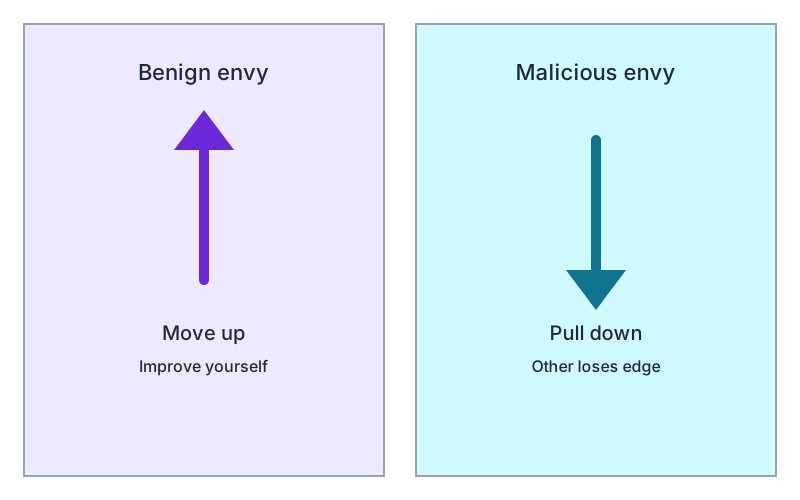
Benign envy still hurts. It is not praise. It includes frustration that another is better off. It holds the other in fair regard. It turns pain into effort. You study their method. You practice more. You seek attainable steps. Research notes it can inspire effort when the outcome feels attainable. The effort link is discussed with status and comparison (Fiske, S. T. (2010). Envy Up, Scorn Down: How Comparison Divides Us.).
Malicious envy also hurts. It adds hostility toward the superior other. It seeks to disparage or remove their edge. It predicts unhelpful acts. It links to resentment and low mood. Do not excuse it as drive. Name it and redirect it.
How inferiority links to self-esteem matters here. Envy rises when self-esteem drops and comparison stings. Our guide to self-esteem and self-efficacy explains that distinction. Self-esteem is worth you assign to yourself. Self-efficacy is belief you can act. Envy wounds the first. Improvement builds the second.
For study, keep the pair together. Benign and malicious share pain. They differ in direction. Up means improve yourself. Down means harm them. Exams test the direction, not your approval of it.
How to remember it for exams
Link the numbers first. Two means envy. Three means jealousy. Draw two dots for you and the envied peer. Draw a triangle for you, your bond and a rival. The shape gives the answer before the words do.
Link the feelings next. Envy brings inferiority, hostility and resentment. Jealousy brings fear of loss, anxiety, anger and hurt. If the question names a rival threat to a relationship, answer jealousy. If it names a lacked advantage with a similar other, answer envy. If it names a wish to improve, add benign. If it names a wish to harm, add malicious.
Save envy and jealousy with two more confusing pairs in one bookmark list such as Confusing pairs and drill that list with Flashcard and Question. Question needs at least four words in the list. Short repeated sessions beat one long reread. Use Typing for the pair you miss most, because writing the answer tests recall harder than flipping a card.
Frequently asked questions
What is envy in simple words
Envy is pain from lacking what another person enjoys, with inferiority, hostility and resentment. It needs two people, you and the envied person, and it can push you to improve or to pull the other down.
What is jealousy in simple words
Jealousy is fear of losing a valued relationship to a real or imagined rival, with hurt, anger and fear. It needs three, you, your bond and a rival, and fear of loss organizes it.
What is the difference between envy and jealousy
Envy starts from lack of what another has. Jealousy starts from threat to what you hold from a rival. Ask if a rival threatens your bond. A yes means jealousy. A no with want for their advantage means envy.
What is benign versus malicious envy
Both share painful inferiority. Benign envy motivates you to improve to match the other. Malicious envy motivates you to damage their advantage. The direction, up for you or down for them, tells them apart.
Sources
- 1.Carraturo, F., and colleagues (2023). Envy, Social Comparison, and Depression on Social Networking Sites.
- 2.Marazziti, D., and colleagues (2010). Romantic Attachment and Subtypes and Dimensions of Jealousy.
- 3.Fiske, S. T. (2010). Envy Up, Scorn Down: How Comparison Divides Us.
- 4.Karakocoglu, N., and Hasdag, D. (2025). Romantic Jealousy: A Comprehensive Review.