
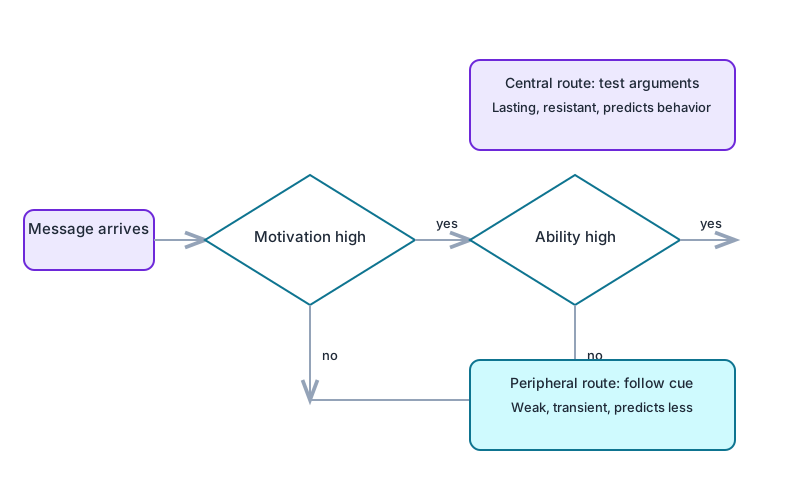
The elaboration likelihood model says persuasion follows how much a person thinks about the arguments. When motivation and ability are both high, people use the central route and judge the arguments. When either is low, people use the peripheral route and follow cues such as source prestige, attractiveness, number of arguments, mood, or music. Central-route attitudes last longer, resist counter-pressure, and predict behavior. Peripheral-route attitudes shift fast and predict less.
Richard E. Petty and John T. Cacioppo proposed the model in 1986 to organize conflicting persuasion results under one framework. Elaboration means the extent of thinking about issue-relevant arguments in a message. The routes are the two ends of one continuum, not two separate brain systems. Most real messages fall somewhere between the ends.
How the two routes differ
The central route needs effort. The person reads the claims, recalls relevant knowledge, tests each argument, and forms an attitude from that test. Strong arguments win. Weak arguments lose because they invite counter-arguments.
The peripheral route needs little effort. The person lacks motivation or ability at that moment, so simple cues decide. A famous endorser, a confident speaker, many listed reasons, pleasant music, or a good mood can carry the message. The person does not test the claims.
| Feature | Central route | Peripheral route |
|---|---|---|
| Elaboration | High; the person scrutinizes the arguments | Low; the person relies on simple cues |
| Needs | Both motivation and ability | Either one is missing |
| What persuades | Logic and quality of the arguments | Source prestige or looks, number of arguments, mood, music |
| Attitude | Stronger and more lasting | Weaker and more transient |
| Counter-pressure | More resistant | Shifts with the next cue |
| Behavior link | Predicts behavior more reliably | Predicts behavior less reliably |
| Everyday sign | Compares safety data before a car purchase | Picks a snack because a celebrity holds it |
What decides the route
Both motivation and ability must be present for the central route. If either drops, processing slides toward the peripheral route.
Motivation: does the person care
Personal relevance matters most. In the early exam-policy study, students who expected new exams soon thought harder about the proposal than students who expected exams in ten years. Strong arguments moved the involved group more. Weak arguments moved them less, because scrutiny exposed the flaws.
Personal responsibility also raises motivation. People think harder when their judgment alone decides the outcome. Need for cognition matters too. Cacioppo and Petty described it in 1982 as a stable trait: some people enjoy effortful thought, others avoid it. In the 1986 follow-up, high need-for-cognition students generated more issue-relevant thoughts and tracked argument quality. Low need-for-cognition students tracked cues instead.
Prior attitude can bias motivation. When a message clashes with held beliefs, people may defend the old view instead of testing the new one. That link connects to the pattern described in the article on when new arguments clash with held beliefs. Biased elaboration still counts as elaboration, but the direction is set before the arguments arrive.
Ability: can the person process
Prior knowledge sets the ceiling. A juror who understands the evidence can test it. A juror who lacks the terms must judge the expert instead of the data.
Distraction lowers ability. Noise, time pressure, fatigue, and multitasking cut the resources for scrutiny. Message repetition can raise ability by giving more chances to process, as long as tedium does not set in. Simple and clear wording also helps. Dense jargon pushes even motivated readers toward cues.
Distraction has one twist students should keep. It hurts strong messages because it blocks favorable thoughts. It can help weak messages because it blocks counter-arguments. That pattern supports the claim that the central route runs on self-generated thoughts, not passive listening.
Classic studies that prove each point
Each study below isolates one mechanism. Together they form an exam-ready set.
Petty and Cacioppo ran the founding test in 1979. Undergraduates heard a proposal for compulsory final exams. The researchers crossed personal relevance with argument quality and measured attitudes plus listed thoughts. High relevance magnified the quality effect: strong arguments persuaded more, weak arguments persuaded less.
Petty, Cacioppo, and Goldman ran the source test in 1981 with 145 undergraduates. The speech urged compulsory exams starting next year or in ten years. Arguments were strong or weak. The source was a Princeton professor or a local high-school student. High-involvement students followed argument quality and ignored the source. Low-involvement students followed the source and ignored quality. The result shows the trade-off in one design.
Petty, Cacioppo, and Schumann ran the advertising test in 1983 with a fictitious disposable razor. Some participants expected the product soon in their area and a chance to receive one. Others expected it in a distant city. Ads varied the endorser (famous athlete or ordinary citizen) and argument strength. High involvement tracked arguments. Low involvement tracked the celebrity. The study is the standard example of matching strategy to involvement.
Petty and Cacioppo ran the number test in 1984. More arguments helped under low involvement almost regardless of quality. Under high involvement, only strong arguments helped, and weak extras added nothing. Number works as a cue, not as evidence, when elaboration stays low.
Cacioppo and Petty built the Need for Cognition Scale in 1982, then tested it with Kao and Rodriguez in 1986. High scorers elaborated more and showed stronger attitude-behavior correspondence. The trait explains why the same message persuades two people through different routes.
Snyder and DeBono added a personality moderator in 1985. High self-monitors preferred image-based ads. Low self-monitors preferred quality-based ads. The same product category splits by who receives it.
Brinol and Petty added metacognition in 2003. Participants nodded or shook their heads while hearing strong or weak arguments about campus ID cards, ostensibly to test headphones. Nodding raised confidence in the thoughts generated. With strong arguments, persuasion rose. With weak arguments, persuasion fell because confidence rose in negative thoughts. The effect needs high elaboration, because there must be thoughts to validate.
Carpenter tested the core prediction across the literature in 2015. The meta-analysis pooled 134 effects that crossed argument quality with processing type. The strong-over-weak advantage was larger under central than peripheral processing. The result confirms the founding pattern beyond single labs, while the same limits remain: mostly student samples and brief messages.
Everyday examples
A car advertisement aimed at active buyers lists crash-test results, fuel use, and warranty terms. The buyer compares numbers and asks for evidence. That is central processing. A snack advertisement shows a popular athlete, catchy music, and bright packaging. The buyer smiles and reaches out. That is peripheral processing.
A classroom shows the same split. Personally relevant material, student-generated questions, and low distraction raise elaboration and retention. Rapid feed scrolling does the reverse. Follower counts, likes, and social proof then carry weight. That is why agreement itself can persuade, as explained in the article on why agreement itself persuades.
Groups add a second layer. Orders, majorities, and compliance techniques each enforce a request in a different way. The article on how groups enforce the request sorts those differences. ELM asks the prior question: arguments or cues.
Why one variable has three jobs
The model holds that any variable can serve as argument, cue, or bias, based on elaboration. Mood shows the switch clearly. Under low elaboration, a good mood works as a cue: people like a pen because they feel good. Under high elaboration, the same mood biases thought: people generate more positive points about the pen features. Expertise works the same way. A title can shortcut thought when energy is low. The same title can anchor scrutiny when the decision matters, such as choosing a surgeon.
The trade-off follows: as scrutiny rises, cue impact falls. As scrutiny falls, cues take over. That is why the same endorser wins one audience and loses another. The audience state decides the role, not the variable alone.
What critics say
Chaiken proposed the closest rival in 1980, the heuristic-systematic model. Systematic processing matches the central route. Heuristic processing matches the peripheral route and names simple rules such as experts merit trust. The models differ on co-occurrence: the heuristic-systematic model lets both modes run together toward a confidence threshold, while ELM stresses the trade-off. Exam answers can state that overlap directly.
Kruglanski and Thompson proposed the sharper rival in 1999, the unimodel. It holds that one if-then process handles all persuasion, and only difficulty differs. Early ELM studies tied central arguments to long complex text and peripheral cues to short simple signals, so route effects may reflect difficulty, not kind. A long expert resume that needs effort to read should then persuade deep thinkers, which ELM would class as a cue. The charge stands as a design critique.
Three further limits matter. The theory describes a continuum, but experiments assign high versus low groups, which fits two boxes better than a gradient. The multiple-roles claim can fit almost any result after the fact, which weakens falsifiability. Most support comes from brief lab messages with student samples, such as exam policies and pen ads. Transfer to sustained campaigns and feeds stays less certain.
The balanced verdict from the literature is narrow: involvement and ability govern which features move attitudes, and the 2015 synthesis supports that claim. Whether central and peripheral name two distinct routes or two regions of one process remains open.
How to spot the route in one minute
Use these steps during study or while reading an ad.
- 1.Ask if the person cares about the outcome.
- 2.Ask if the person can process the claims now.
- 3.If both answers are yes, expect the central route and test argument quality.
- 4.If either answer is no, expect the peripheral route and name the cue.
- 5.Predict persistence: central change lasts and resists; peripheral change fades.
- 6.Check the prediction against the next message on the same topic.
Readers who must keep these terms apart for exams can save the route names and cue types in Apa. Then drill them with flashcards and multiple choice until recall stays stable.
Frequently asked questions
What is the elaboration likelihood model in simple terms?
It is a persuasion model that says thinking effort decides how a message works. High effort leads to the central route and judgment of arguments. Low effort leads to the peripheral route and judgment of cues.
What is an example of the elaboration likelihood model?
A buyer who compares safety data and fuel use follows the central route. A buyer who picks a drink because a celebrity holds it follows the peripheral route. The 1983 razor study shows the same split under controlled involvement.
Which route lasts longer, and why?
The central route lasts longer. It rests on tested arguments, so it resists counter-messages and guides behavior. The peripheral route fades fast because the next salient cue replaces it.
Why do MCAT and AP learners meet this model?
Test-prep pages cover it as a standard persuasion topic. They ask for the two routes, the motivation-plus-ability gate, and one classic example. The 1981 exam study and the 1983 razor study cover that pattern.
What is the difference between ELM and the heuristic-systematic model?
Both separate effortful from low-effort processing. The heuristic-systematic model names specific heuristics and lets both modes run together. ELM stresses the trade-off where cue impact falls as elaboration rises.
Can the peripheral route produce lasting change?
It can, but the odds are worse. Central-route attitudes persist longer, resist counter-messages, and predict behavior better on average. Peripheral change fades with the next salient cue unless later elaboration strengthens it.
Sources
- 1.Richard E. Petty and John T. Cacioppo (1986). The Elaboration Likelihood Model of Persuasion.
- 2.Richard E. Petty and John T. Cacioppo (1986). Communication and Persuasion: Central and Peripheral Routes to Attitude Change.
- 3.Charlotte Nickerson (2026). Elaboration Likelihood Model. Simply Psychology.
- 4.Elaboration likelihood model. Wikipedia.
- 5.Elaboration Likelihood Model. TheoryHub.